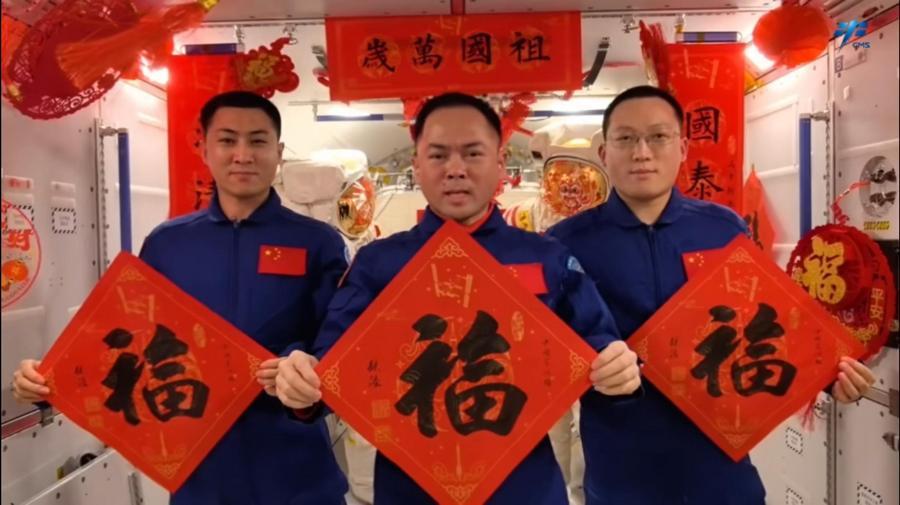
BEIJING, Feb. 18 (Xinhua) -- As China celebrates the 2026 Spring Festival, the crew of the Shenzhou-21 mission aboard the Tiangong space station has received a remarkable gift, a thriving harvest of tomatoes grown in orbit.
The "space vegetable garden" has once again demonstrated the potential for sustained plant life beyond Earth's atmosphere.
In a video reported by China Media Group (CMG) on Wednesday, astronaut Zhang Hongzhang gave his fellow people on Earth a tour of what he calls a "healing corner" of the Tiangong to show the tomato plants exhibiting vigorous growth.
The device nurturing these plants is called an aeroponic cultivation system, developed by a research team from the China Astronaut Research and Training Center.
It works by vaporizing water into a fine mist. This method can significantly improve the efficiency of water usage, Zhang explained.
"Additionally, the system uses a specially designed LED light spectrum, which greatly enhances energy efficiency. The result is this thriving scene of space-grown tomatoes we have before us," he said.
The aeroponic device was delivered to the space station by the Tianzhou-9 cargo spacecraft in July 2025. Its primary mission is to validate key technologies for the efficient cultivation of plants in a microgravity environment, according to the CMG report.
The data gathered will inform future long-duration space missions where bioregenerative life support systems may prove essential.
The sight and scent of the ripening tomatoes are a treat for all the astronauts onboard.
"Look at these tomatoes. They are so enticing, with a faint, fresh scent. Every time I pass by this area, I want to take a deep breath and enjoy the fragrance," said astronaut Wu Fei.
"Currently, we tend to them every day and record their growth data. This precious data on plant growth in orbit will serve as an excellent reference for cultivating crops in space in the future," Wu said.
The research goes beyond mere observation. Scientists on Earth are systematically using the facility to investigate multiple aspects of space agriculture, including efficient cultivation methods, the productivity of fruits and vegetables, the atmospheric regeneration capacity of plants, and optimized protocols for plant care by the crew.
Future plans for the Tiangong "space garden" include aeroponic cultivation trials of wheat, carrots and medicinal plant species, progressively expanding the diversity of crops that can be sustained in orbital environments, according to the report.
For the astronauts, tending to this little garden provides a profound psychological boost amidst their demanding schedule.
"To see such a vibrant splash of green in the vastness of space is incredibly healing," said astronaut Zhang Lu. "It also gives us greater confidence to complete our subsequent experimental tasks."
"We will continue to document the growth of these space tomatoes and share more wonders of the space ecosystem with everyone," he added.
Launched on Oct. 31, 2025, the space journey of the Shenzhou-21 crew has already exceeded 100 days. All tasks, including scientific experiments, equipment maintenance and health management, are progressing smoothly, according to the China Manned Space Agency. ■