
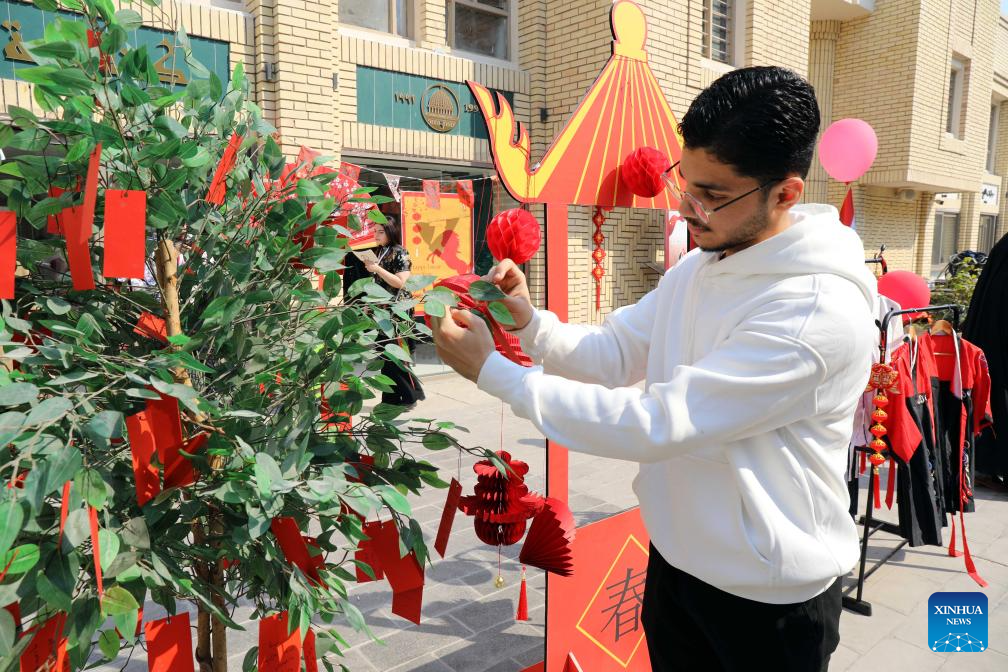
An Iraqi man hangs his New Year's wish on a tree on al-Mutanabbi Street in central Baghdad, Iraq, on Feb. 13, 2026.(Xinhua/Khalil Dawood)
The historic street, named after the 10th-century classical Iraqi poet al-Mutanabbi, is considered the heart and soul of Baghdad's literary and intellectual community. On this winter afternoon, the historic thoroughfare becomes something new: a bridge between Mesopotamia and the East.
Bright red lanterns, their color symbolizing prosperity and good fortune in Chinese tradition, hang before century-old buildings. Beneath them, a calligraphy booth quickly draws crowds that spill into the street.
Iraqi visitors queue patiently, watching in quiet fascination as Chinese brushes dance across rice paper. Some stand transfixed, watching the ink bloom into the paper's fibers; others smile towards the camera, holding up the finished scrolls with quiet pride.
A young woman gasped softly when the artist completed her name in elegant characters. She held up the scroll carefully, as if it might dissolve in the winter light.
"It feels special to see my name written like this," she said, rolling the paper with reverent hands. "It connects me to a culture I want to learn more about."
Nearby, the aroma of sizzling dumplings cuts through the crisp winter air. Volunteers from the Iraqi-Chinese Friendship Association, the organizer of the celebration, are busy explaining the symbolism behind each dish as curious onlookers sample. The dumplings, pleated like ancient silver ingots and symbolizing reunion and wealth, are quickly snatched up.
"I didn't expect them to taste so good," a Baghdad resident said after sampling one. "They look exquisite, and are full of flavor."
At the tea station, steam rises from small ceramic pots as visitors learn the subtle art of brewing. They sip from tiny cups, listening to explanations about etiquette and tradition that span millennia.
At the heart of the celebration stands a "wish tree," its branches gradually filling with handwritten cards fluttering like colorful leaves. Many Iraqis write their hopes in Arabic for the new year: peace, prosperity, educational opportunities, and stronger ties between Iraq and China. Each note tied to the tree carries a prayer across cultures.
Among the crowd, students from the University of Baghdad's newly established Chinese Department are dressed in traditional Chinese attire. They translate customs for older Iraqis, chat confidently with Chinese guests, and assist with questions about the Year of the Snake.
Vian, an Iraqi student bound for Xi'an Jiaotong University in China, said the celebration strengthened her anticipation.
"I'm really looking forward to experiencing the Chinese culture in China," she said in Mandarin, her eyes lighting up. "Today's event has made me yearn for China even more."
Murta, a medical graduate of China's Zhejiang University, guided visitors between exhibits, explaining Chinese traditions with an Iraqi warmth.
"China has given me unforgettable memories," he said. "I hope more Iraqis can study there and build bridges between our two peoples."
As the afternoon softens into early evening, the lanterns glow brighter against the fading sky. Bookstores remain open, cafe tables stay full, and conversations flow in two ancient languages across tables stacked with Arabic poetry and Chinese history.
For this afternoon, al-Mutanabbi Street becomes not only a symbol of Iraq's literary heritage but also a lively crossroads of cultures, where ink, tea, dumplings, and shared dreams weave together a celebration of the Chinese New Year. ■
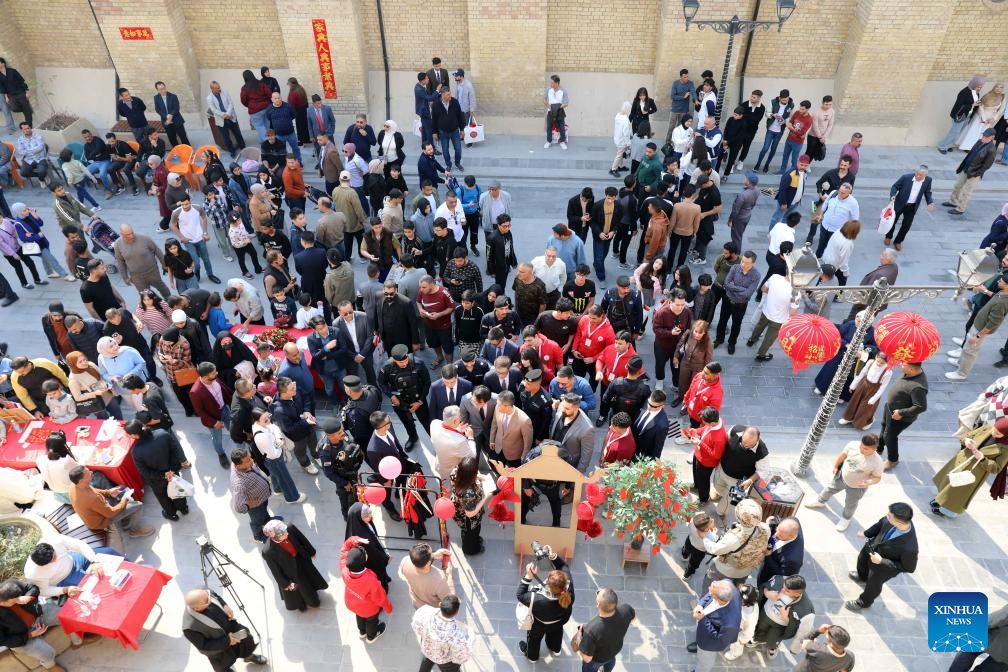
People participate in the Chinese New Year celebration on al-Mutanabbi Street in central Baghdad, Iraq, on Feb. 13, 2026. (Xinhua/Khalil Dawood)


