
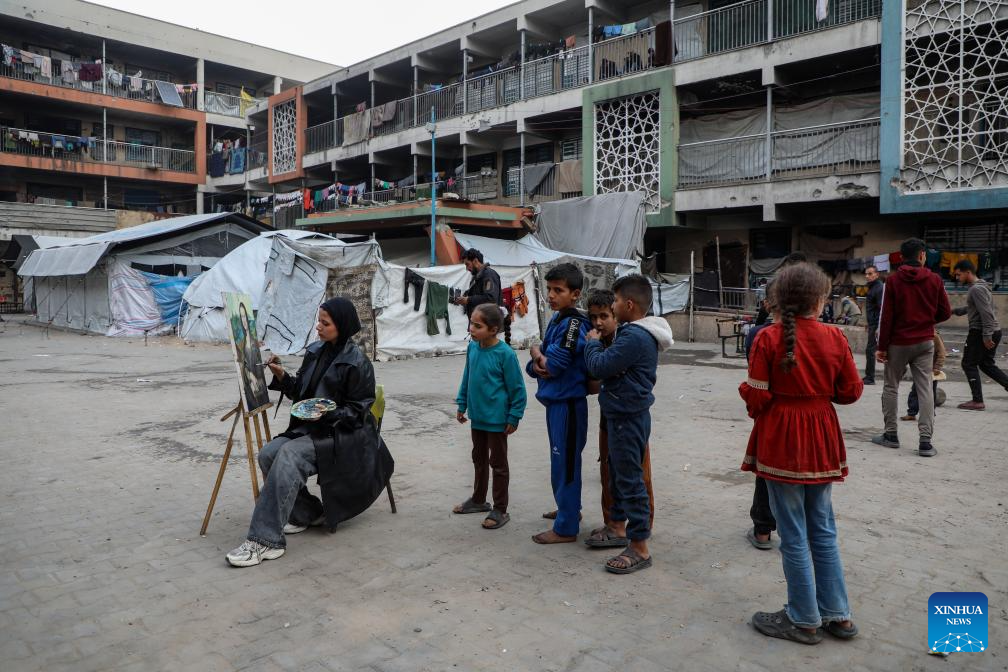
Palestinian artist Marah Al-Zaanin (1st L) draws a painting at a school-turned shelter in Gaza City, on Feb. 12, 2026. (Photo by Rizek Abdeljawad/Xinhua)
GAZA, Feb. 12 (Xinhua) -- A gallery has taken form within a tent, once a temporary refuge for a displaced family in Gaza. Its walls now bear dozens of stark black-and-white paintings, created with charcoal salvaged from cooking pots and the ink of discarded ballpoint pens.
Though it seems to upend the conventions of both exhibition space and artistic medium, the gallery has become, for locals, a repository of memory, preserving the raw emotions of the latest chapter in the Israeli-Palestinian conflict, which erupted on Oct. 7, 2023.
The paintings were created by Marah Al-Zaanin, an 18-year-old Palestinian girl who established and now operates the tent-turned-gallery in Gaza City, in the northern Gaza Strip.
"I did not know how to paint seriously before the war," she said. "But painting has become my own world, a refuge from fear and from the scenes of death that we have been living with."
Originally from Beit Hanoun in northern Gaza, Al-Zaanin and her family members were forced to flee to a shelter in the Rimal neighborhood in western Gaza City after Israeli forces prevented locals from returning to their homes, despite the latest Israel-Hamas ceasefire that took effect in October 2025.
"Losing the house and feeling unstable was a huge shock. I tried to turn this harsh reality into a space for artistic expression," she said.
During the conflict, she began sketching in moments of fear. "Whenever the bombing intensified or I felt overwhelmed, I would draw," she recalled, adding that painting gave her a sense of control over something she could not change.
Day by day, Al-Zaanin found herself drawing dozens of paintings, channeling her emotions into artistic expression.
"Drawing gave me the strength to hold on to life and to see, even if it was far away, the light at the end of the conflict tunnel," she said, adding that the strength she gained from drawing enabled her to continue studying and complete her high school examinations with high scores.
One of the paintings displayed is titled "The Cry of Souls." At its center are overlapping human faces, with their features blurred. In one corner, the faint silhouette of a bent figure carrying a small sack appears -- a reference to Al-Zaanin's father, who was searching for food.
She said she created it during a period of severe food shortages, when her father struggled to secure aid for the family. "I painted it at night," she recalled. "I was afraid he would not return or might be killed while trying to get food."
The Palestinian death toll in the Gaza Strip has surpassed 72,000, with over 171,000 others injured since the conflict began, according to health authorities in Gaza.
Most of Al-Zaanin's works were drawn in black and white, a choice she describes as both symbolic and practical. "Black and white reflect the bitterness of what we've lived through, and the scarcity of art supplies left me no choice but to use whatever I had at hand," she explained.
Al-Zaanin said she had long dreamed of holding an art exhibition, and decided not to wait. "I wanted to create my exhibition inside my tent, a space that encapsulates everything I've felt during the war," she said.
She divided the tent into sections, each reflecting different themes of the conflict: mass displacement, amputee children, hunger, and mothers mourning the dead.
The exhibition has attracted many visitors, some of whom share the experiences Al-Zaanin has depicted. Mohammed Abu Khalil, 42, displaced from the Shuja'iyya neighborhood east of Gaza City, said he stopped by the tent out of curiosity.
"These are not just drawings," he said. "Each tells a story we lived. I see myself and my family in these black lines."
His reaction echoed Al-Zaanin's own intention for the exhibition.
"Painting is not just a hobby. It is my way of documenting what we lived," said Al-Zaanin. "My tent is small, but I wanted to leave a mark, to say that we were here, and that we felt all this pain." ■


