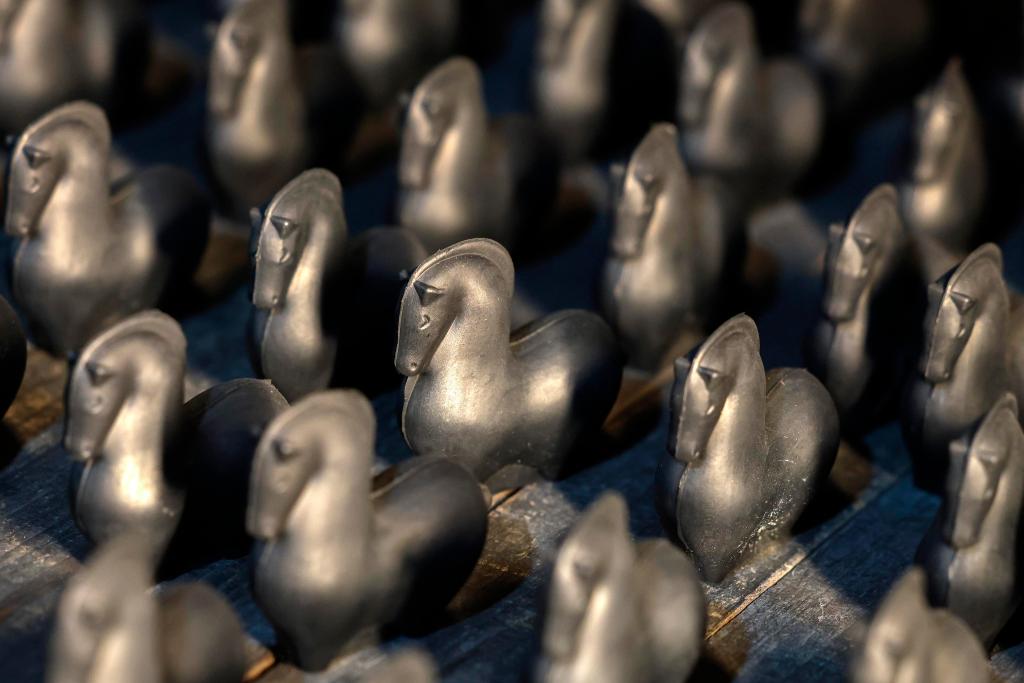

BEIJING, Feb. 12 (Xinhua) -- A team of Chinese researchers has developed a new high-speed 3D printing technology capable of achieving high-resolution printing of millimeter-scale complex objects in just 0.6 seconds, setting a new record for 3D printing speed, according to a study published on Thursday in the journal Nature.
As an essential tool for scientific research and industrial manufacturing, 3D printing has long faced challenges in balancing speed and precision. High-resolution printing of millimeter-scale objects often takes tens of minutes or even hours, making it difficult to meet the demands of scientific research and production.
Dai Qionghai, an academician of the Chinese Academy of Engineering, led a team from Tsinghua University focusing on computational optics. They discovered that computational optics can not only capture light field information but also manipulate high-dimensional holographic light fields to construct three-dimensional entities, offering a novel approach to improving 3D printing.
After five years of research, the team overcame a series of challenges, including the high-speed modulation of multi-perspective light fields, ultimately developing the digital incoherent synthesis of holographic light fields (DISH) 3D printing technology.
Experiments show that this technology can complete the fabrication of millimeter-scale complex structures in just 0.6 seconds, achieving a minimum printable structure size of 12 micrometers and a printing rate of up to 333 cubic millimeters per second.
According to Wu Jiamin, one of the paper's corresponding authors, the DISH technology overcomes the speed limitations of point-by-point or layer-by-layer scanning methods, enabling the precise projection of complex 3D light intensity distributions in an extremely short time and achieving rapid object printing.
Another advantage of this technology is its minimal requirement for the printing container, needing only a single optical flat surface without any special structural design. Moreover, the container remains stationary throughout the printing process without the need for high-precision relative motion between the container and the probe, as required by traditional methods.
According to Dai, the DISH technology could be applied in the mass production of micro-components such as photonic computing devices and mobile phone camera modules, and parts with sharp angles and complex curved surfaces. In the future, it may expand its applications to complex scenarios such as flexible electronics, micro-robots, and high-resolution tissue models. ■