
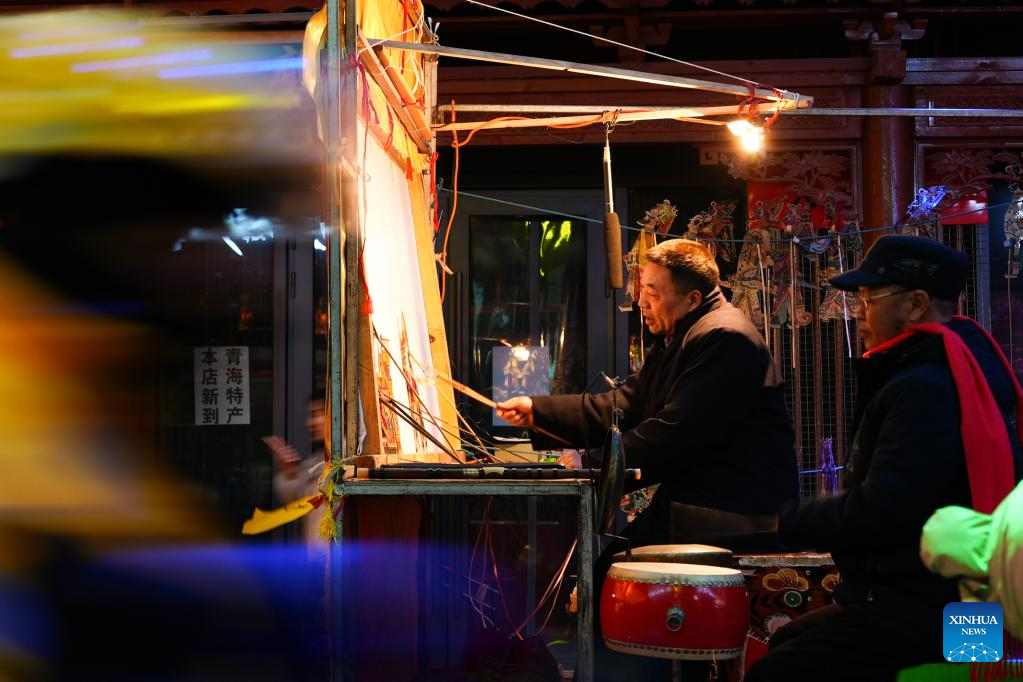
Zhou Banghui (2nd R), a nationally recognized inheritor of Hehuang shadow puppetry, performs in Xining, capital city of northwest China's Qinghai Province, Jan. 25, 2026. (Xinhua/Qi Zhiyue)
XINING, Feb. 12 (Xinhua) -- On a winter night in Xining, capital city of northwest China's Qinghai Province, a beam of light cuts through the cold, casting figures in red and green leather and flowing sleeves into sharp relief as gongs strike and a deliberate chant hangs over the street, holding time itself in suspended motion.
Behind the cloth, Zhou Banghui grips two bamboo rods, guiding the shadows with hands that do not shake. The wind pushes against the makeshift stage, the temperature falling toward minus 10 degrees Celsius, but the small crowd has stopped moving. Children make for the backstage, craning forward to watch the secrets. A street cleaner lingers with her broom. Someone lifts a phone to record.
"These shadows," Zhou once said, "are afraid of being forgotten."
Now in his early 50s, Zhou is a nationally recognized inheritor of Hehuang shadow puppetry, an art locals in Qinghai simply call yingzi, meaning "the shadows." Practiced in the Hehuang Valley for more than two centuries, it once belonged to winter nights in village courtyards and to performances staged on heated brick beds. Today, it survives in moments like this: a patch of light, a strip of cloth, and one man refusing to let the figures fall still.
The insistence begins far from the city street. Zhou's home is in Dongliu Village of Datong Hui and Tu Autonomous County, about 40 minutes by car from downtown Xining. In winter, the valley looks spare, almost austere, but village life hums on. Children pound basketballs on the square. Elderly men cluster over a chessboard. Pickup trucks idle with their beds stacked with fruits and vegetables.
Outside Zhou's two-story house hangs a weathered wooden plaque. Once painted red, the characters reading Xinyi Society have mostly peeled away, revealing pale wood beneath. This is where Zhou has spent most of his life storing puppets, teaching apprentices and worrying, without exaggeration, about what happens when the shadows stop moving.
Born in 1974, Zhou encountered shadow puppetry early. When he was a kid, villagers would raise a wooden stage, gongs and drums would sound, and people came running. "I never missed a show," he recalled. "I was always squeezed into the front."
After finishing middle school in 1990, he once spent three days and nights following performances at a county shadow-puppet troupe, until he caught the attention of Jin Shengchang, a master puppeteer who would later be named a national-level inheritor himself.
Jin, now deceased, had devoted more than five decades to the craft, performing across Datong and neighboring areas. Zhou still recalls his master in vivid detail. Jin had begun as a storyteller, no repeated lines, no stumbles. Once behind the screen, he seemed to dissolve into the play itself. "Sometimes the people on stage cried, and the people watching cried too," Zhou said.
One day, Jin asked the teenage Zhou if he could sing. Zhou stood up and performed an entire play from beginning to end. Jin handed him the key to the troupe's shadow chest on the spot.
Zhou was 16 when he made his first onstage appearance and has never stopped performing since.
Hehuang shadow puppets are distinctive. Their noses are rounded, their eyes long and narrow, and their arms unusually large, nearly three-quarters the length of the body, allowing for sweeping movements. Painted in heavy reds and greens, they glow when lit from behind. Costumes, crowns and flowing ribbons are all cut by hand from yellow cattle hide, carved, pierced and hollowed with techniques that take years to master.
There were no fixed scripts. As much as a third to two-fifths of each performance was improvised. What performers relied on were xizazi, handwritten plot outlines and librettos kept by older masters and brought to life in performance, the practical foundation of a puppeteer's livelihood.
In 2003, Zhou borrowed 1,000 yuan to buy a shadow chest from the family of a deceased elder, about what he would earn in two months of construction work at the time. On a building site he made 40 yuan a day, and a tiny piece of farmland brought in roughly 1,000 yuan a year. Later, searching deep inside a cloth cabinet, he discovered two yellowed xizazi. Inside were outlines for 82 plays. He has kept them ever since, treating them as family heirlooms.
But the question now is not what has been preserved, but who will carry it forward. Zhou speaks of the pressures facing the art in numbers. His son helps backstage with instruments and backing vocals, as his voice cannot carry the lead. In the entire county, Zhou said, only three shadow-puppet singers are under 40.
Once, shadow plays lit up village courtyards on winter nights. Now, as young people drift to the cities, the simple habit of gathering to watch has faded.
Yet Zhou has not let go. The Xinyi Society did not begin with him. It was first founded in 1953. In 1985, veteran performers, including Zhou's own master Jin Shengchang, revived it. Continuity proved fragile as older artists passed away, performances became sporadic, and the troupe gradually fell silent.
In 2011, Zhou reorganized the Xinyi Society once more. Its 13 members are all part-time performers, farmers and laborers who gather when time allows. With five people, they can stage a full show. In 2025 alone, they performed more than 120 times. From December 2024 through March 2025, they were invited regularly to Xining as part of the city's winter cultural events.
As evening settled, the red-draped stage glowed against the street. The gongs struck again. Zhou's hands lifted the shadows into motion. Children watched. Passersby lingered. In the cold wind, the small stage became the warmest place on the street.
When the performance ended, Zhou squatted to pack away the puppets, rubbing his stiff hands. The cold, he said, does not matter. From the first day of the Chinese New Year through the Lantern Festival, performances are already booked.
"Having plays to perform," he said, "that's the happiest thing." ■
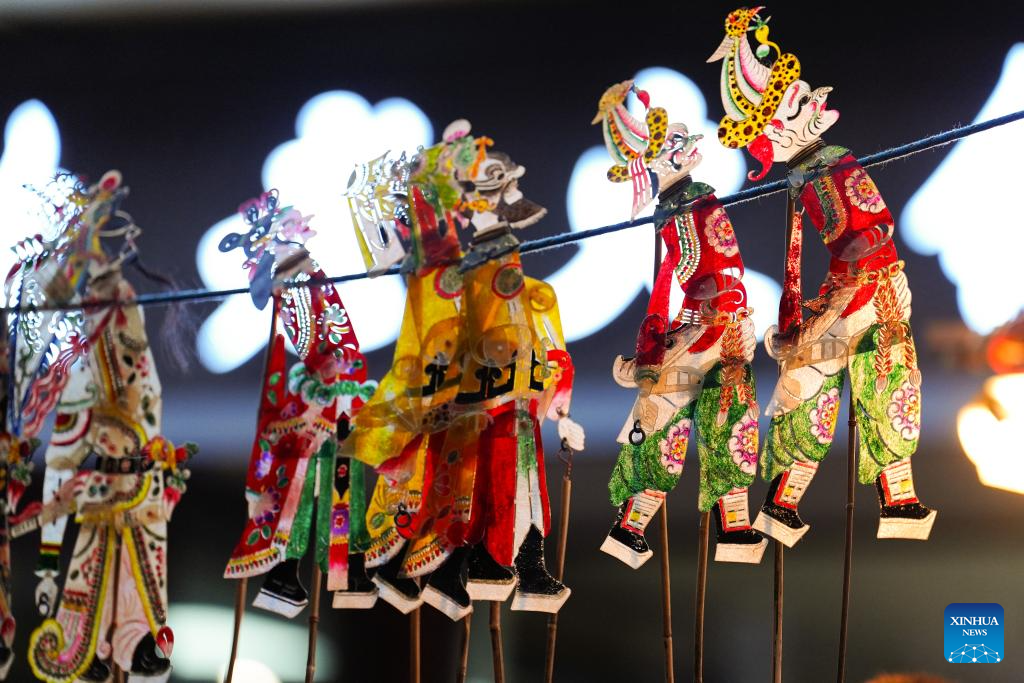
Shadow puppets are pictured at the Xinyi Society in Xining, capital city of northwest China's Qinghai Province, Jan. 25, 2026. (Xinhua/Qi Zhiyue)


