
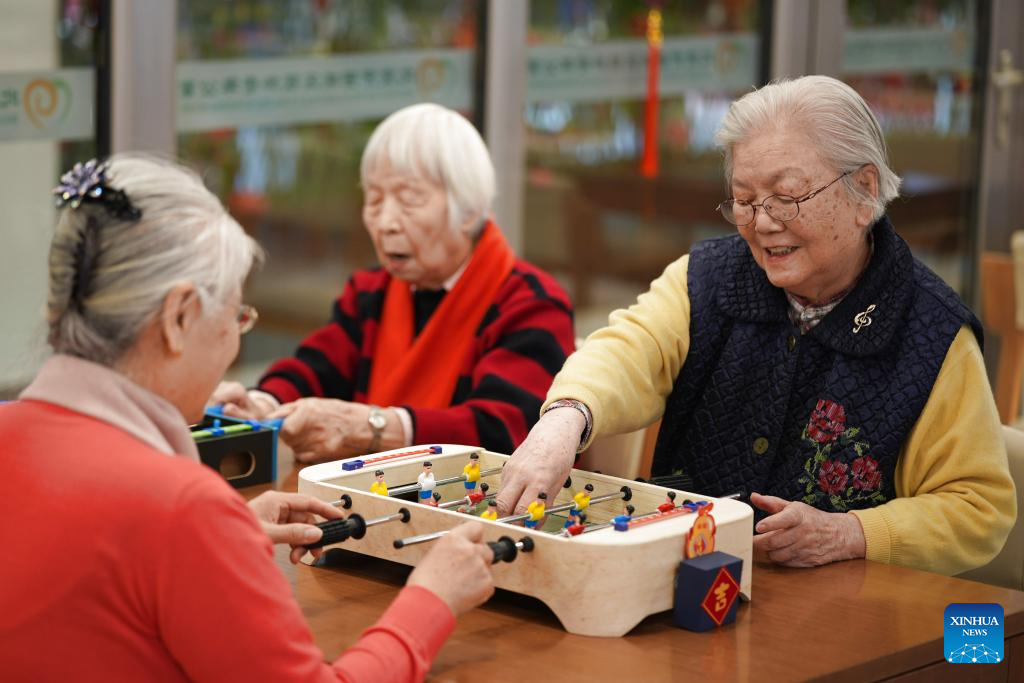
Elderly residents play games at a senior care center in Beijing, capital of China, Feb. 10, 2026. (Xinhua/Xie Han)
BEIJING, Feb. 11 (Xinhua) -- As the Chinese New Year draws near, a senior care center in downtown Beijing glows with festive decorations while residents carefully inscribe auspicious characters on red paper, a cherished tradition during this time of celebration.
Located in the city's Xicheng District, the facility accommodates 119 seniors, averaging 87.5 years old. Rooms are equipped with safety handrails, anti-slip grips and a millimeter-wave radar system that monitors respiration, heart rates and sleep in real time, automatically alerting staff to any irregularities.
"The smart system serves as an auxiliary tool for our night patrols," said Cheng Yulan, head of the elderly center. "More importantly, it enables us to identify emergencies promptly."
During the daytime, the center offers recreational activities ranging from poetry recitals, movie screenings, to calligraphy, allowing residents to choose according to their interests.
"Every corner is considerately designed, which reassures my children that I'm in good hands here," said Zhao Guiyan, 81, who has lived in the center with her husband for a decade.
The thoughtful design and intelligent monitoring at the facility reflect a broader commitment in Beijing -- and across China -- to enable seniors to live safely, comfortably and with dignity.
Figures show that by the end of 2025, Beijing had established 152 senior care service centers benefiting over 2 million elderly people, with 622 nursing institutions offering 110,000 beds in place.
In Xicheng District, where about one-third of the population is elderly, devices such as millimeter-wave radar systems and smart pill boxes have been installed in seniors' homes, feeding real-time data into a central platform that alerts staff to abnormalities, said Yang Jing, chief of the district's civil affairs bureau.
Emergency call devices for those aged 70 or above also provide one-touch access to community, family, or emergency services, Yang added.
The age-friendly facilities in Beijing are part of a nationwide effort to address China's rapidly growing elderly population, with over 320 million people aged 60 or above by the end of 2025.
Local authorities across the country have expanded elderly care initiatives, including trade-in programs for senior-friendly products, age-friendly housing and community senior canteens with meal delivery.
The Communist Party of China Central Committee's recommendations for formulating the 15th Five-Year Plan (2026-2030) for the country's economic and social development call to enhance the provision of basic elderly care services, improve elderly care services networks in both urban and rural areas, and renovate more public facilities to make them age-friendly and barrier-free.
Guo Shuli, an expert with the China Association of Gerontology and Geriatrics, said that age-friendly renovations are both a core expression of China's culture of respecting the elderly and a necessity for social development.
"They are crucial for safeguarding the well-being, dignity and social participation of hundreds of millions of seniors, forming the foundation for an age-friendly society," Guo added. ■
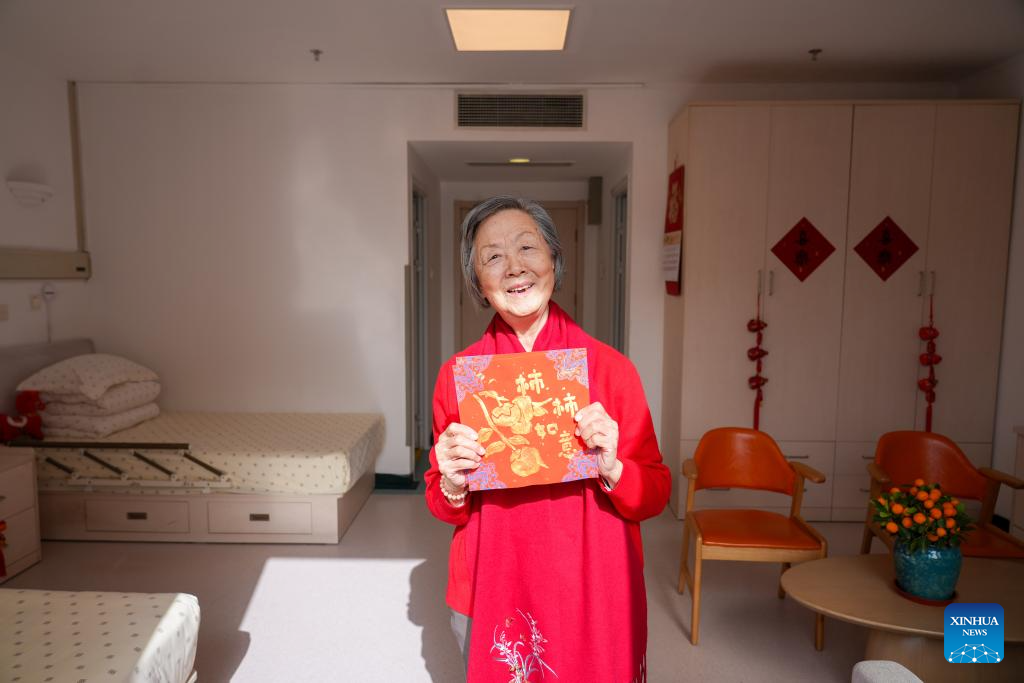
Zhao Guiyan, 81, presents a rubbing work she made at a senior care center in Beijing, capital of China, Feb. 10, 2026. (Xinhua/Xie Han)
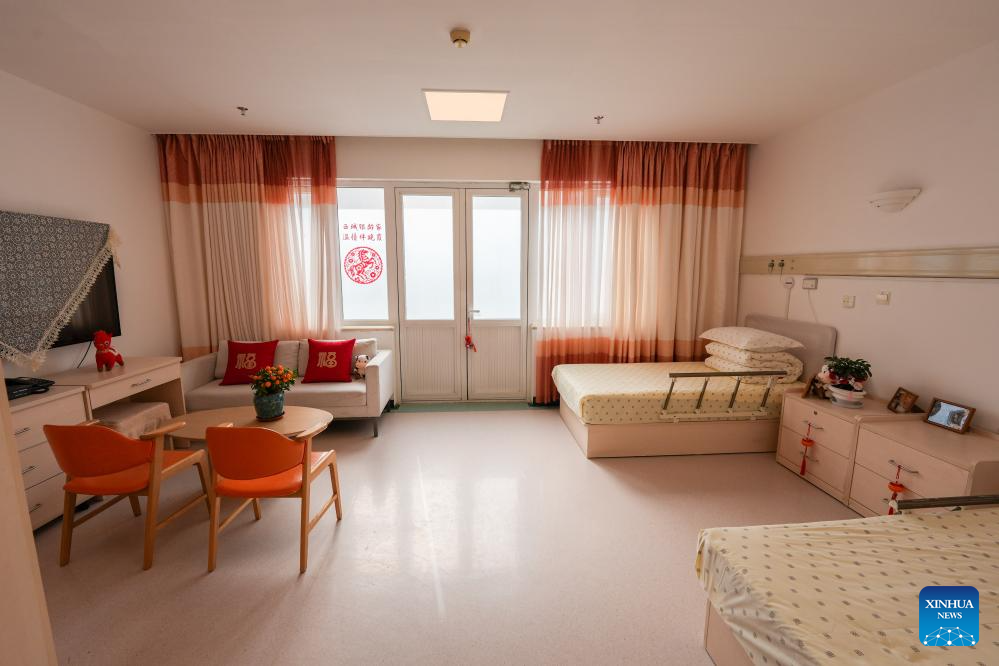
This photo taken on Feb. 10, 2026 shows a room at a senior care center in Beijing, capital of China. (Xinhua/Xie Han)
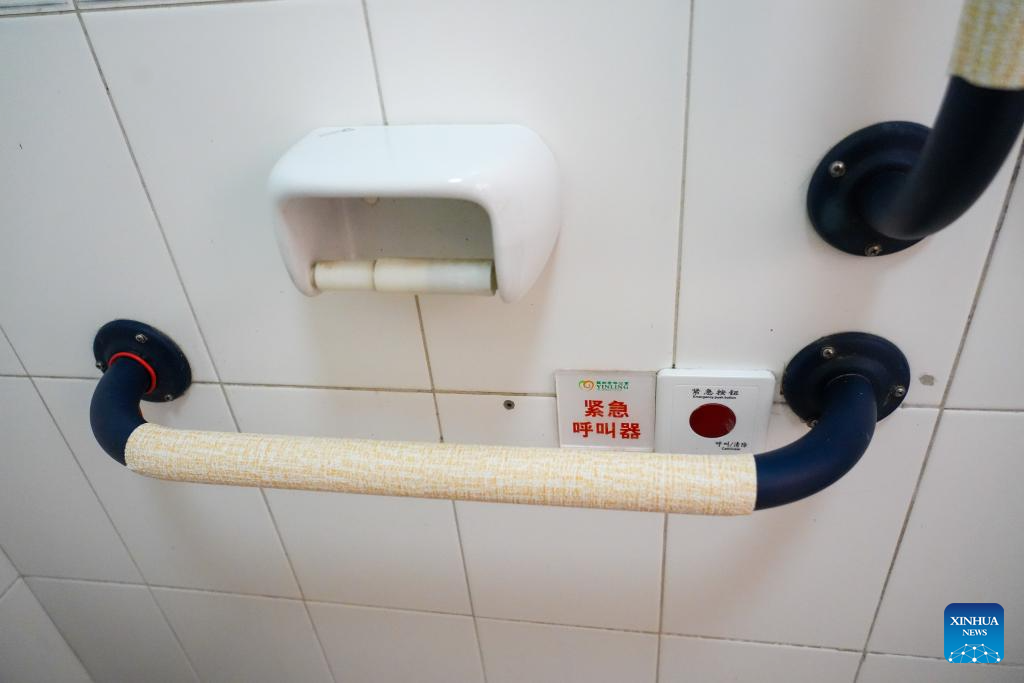
This photo taken on Feb. 10, 2026 shows safety handrails and an emergency call button at a bathroom at a senior care center in Beijing, capital of China. (Xinhua/Xie Han)


