
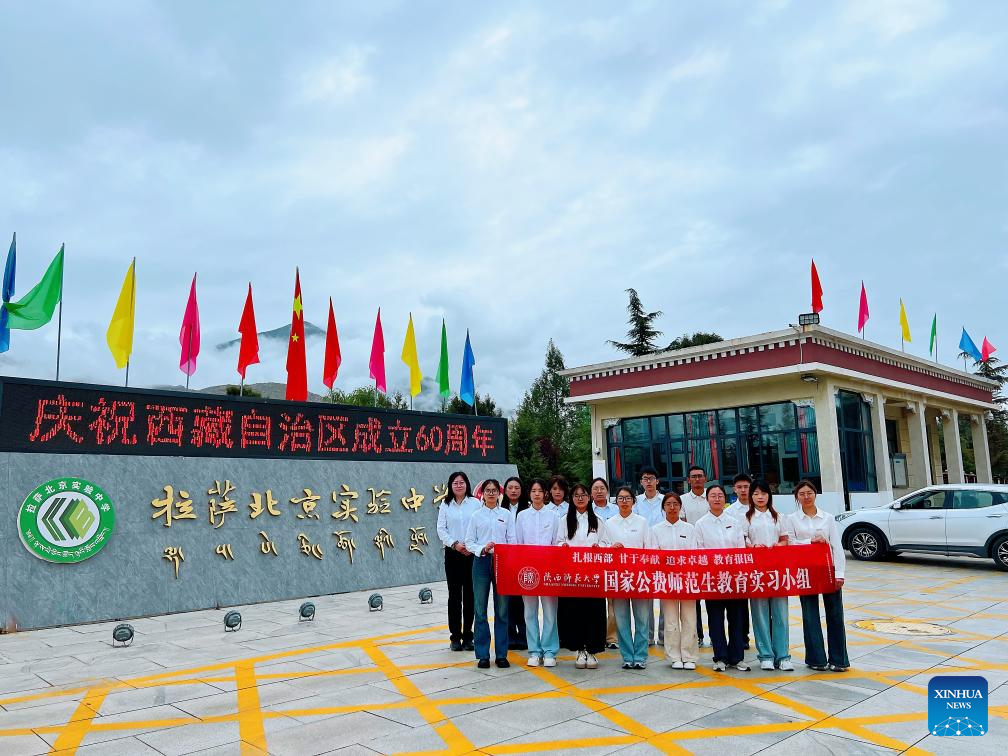
Members of a teaching-practice group of students from Shaanxi Normal University pose for a group photo at an experimental middle school in Lhasa, southwest China's Xizang Autonomous Region, Aug. 26, 2025. (Xinhua)
by Xinhua writers Lyu Qiuping, Xu Zuhua and Yao Youming
LHASA, Feb. 11 (Xinhua) -- Fifteen years ago, Shi Lei, a university student from Shaanxi Province in northwest China, landed on the snowy plateau of Xizang, thinking he was just going to teach for three months. Little did he know that he would end up staying for 15 years.
Majoring in English at Shaanxi Normal University in Xi'an, the provincial capital, Shi is one of over 800 volunteers from the institution who have taught in southwest China's Xizang Autonomous Region.
Their service is part of a broader national effort to support the plateau's development through education, which has drawn specialized talent and sustained investment to the area -- helping open young minds, kindle aspirations, and equip students with the tools needed to pursue their goals.
Shi was born in the rural area of Shaanxi's Tongchuan City. Inspired by his own high school teacher, who had previously taught in Xizang, Shi applied for a teaching internship there in his final year of university.
He still recalls the harsh conditions at the high school in Shannan City, where he started in late 2011.
"We burned yak dung to keep warm indoors when temperatures fell to around minus 15 degrees Celsius," he said, noting that at night they had to walk hundreds of meters outside to use the nearest restroom.
Amid all the challenges he faced, Shi was warmly welcomed by students and staff, most of whom are Tibetan. When his three-month placement ended, a group of students surrounded him, offering gifts like yak jerky and hoping he would stay.
"It was their affection that touched me and prompted me to stay," he said.
Now working at a high school in the regional capital Lhasa, Shi has adopted mathematical methods to help local students learn English, using a coordinate axis to illustrate various tenses.
"The part greater than zero represents the future tense, while the part less than zero represents the past tense. What stays precisely at a particular point is the continuous tense," he said.
He also runs a WeChat public account where he shares English learning resources, which reaches about 2,000 students across Xizang.
With his guidance, students have not only improved their grades but also discovered dreams that extend beyond the classroom. Many have continued their studies at top universities in China and even abroad.
Influenced by Shi, Samten Gyatso, one of his former students who studies at Tsinghua University now, decided to return to Xizang to be a volunteer himself in 2025, teaching maths, English and history.
"Volunteer teachers don't just help with grades; they shape students' attitudes and habits," said the 26-year-old Tibetan. "My own path shows these kids that leaving the plateau to see the wider world is an achievable dream."
A white paper issued last year showed that, by 2024, Xizang had 3,618 schools at various levels and of different types, 96,600 faculty and staff members, and 970,000 students on campus, accounting for more than 25 percent of the region's total population.
The number of college or university graduates per 100,000 inhabitants in the region rose from 5,507 in 2010 to 11,019 in 2020, the white paper said.
As the only child in his family, Shi acknowledges the sacrifices made by his wife, who cares for their five-year-old son and his aging parents back in Xi'an. He makes it a point to go home for every holiday to spend time with them.
"I hope the time we spend together during breaks can make up a little for my long absences," he said. ■
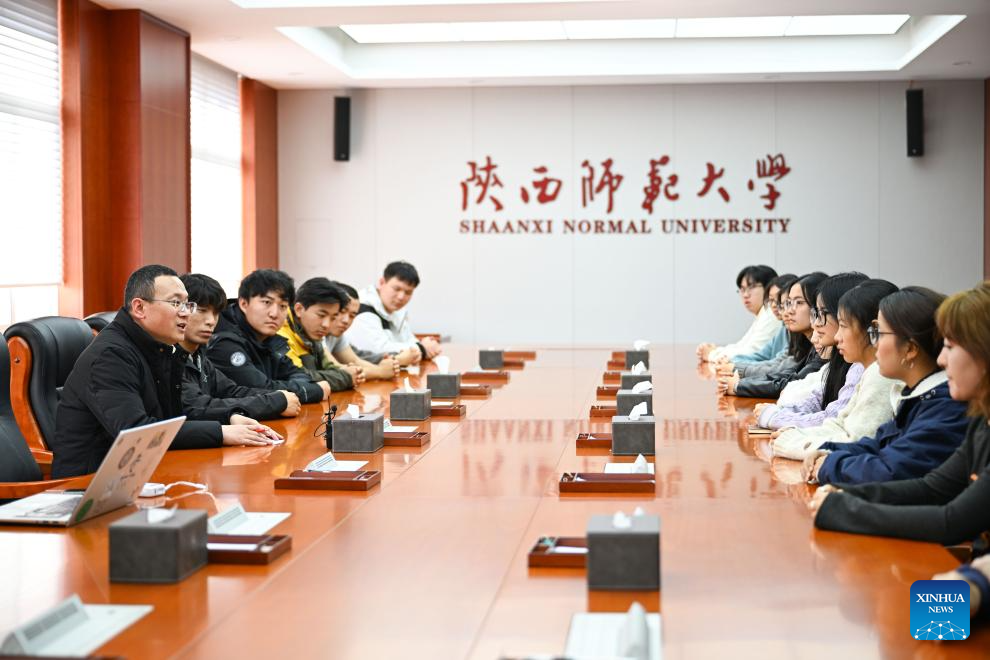
Shi Lei (1st L) communicates with representatives of students who are about to set off to southwest China's Xizang Autonomous Region for teaching practice, at Shaanxi Normal University in Xi'an, northwest China's Shaanxi Province, Jan. 7, 2026. (Xinhua/Zhang Bowen)


