
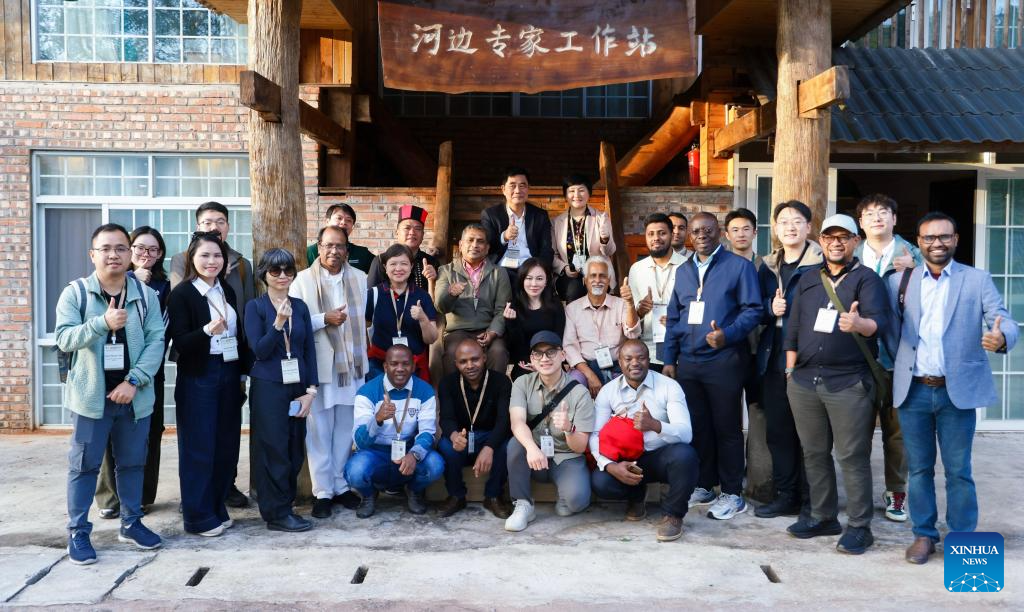
People from Global South countries pose for group photos at Hebian Village in Mengla County, southwest China's Yunnan Province, Dec. 5, 2025. (Xinhua)
KUNMING, Feb. 8 (Xinhua) -- Under a winter sun in Xishuangbanna, a group of young leaders from Indonesia, Kenya, Laos, Tanzania and Uganda recently trekked into the lush mountains of southwest China's Yunnan Province. They came not as tourists, but as students of a "living classroom" focused on rural development.
Their campus was Hebian Village, home to a Yao ethnic group nestled near the China-Laos border in Mengla County. Once a pocket of deep poverty, Hebian has been transformed into a "star village" that has received thousands of officials, scholars, experts and young people from Global South countries.
Here, the traditional wooden houses of the Yao people have been turned into guestrooms, conference halls and rural bars, a model which enables modern tourism to fit seamlessly into this village.
Watching Yao villagers manage high-end guestrooms that have doubled local incomes, Byaruhanga Emmanuel Abwooli, a participant from Uganda, saw more than just profit -- he saw a solution.
In Uganda, household farming faces high disease risks and loose management. China's model of combining traditional breeding with modern biosecurity and circular agriculture offers a clear, feasible path toward environmental friendliness and higher efficiency, Abwooli said.
Such transformation is equally noticeable in three villages housing members of the Dai ethnic group in the city of Jinghong in Xishuangbanna, where a decommissioned water tower has been reborn as a trendy café overlooking a modern swimming pool.
Yan Shuaile, who is the head of these villages, shared that villagers take turns maintaining the landscape. "Even with different cultures and customs, staying here for a few days allows these students to feel the vitality of China's rural development," Yan said.
For many, the high-tech nature of modern Chinese agriculture was the biggest surprise. Al Fiqie, a young entrepreneur from Indonesia, visited an agricultural service station, where giant drones and smart tractors stood ready for use in the tropical fields.
Technology makes agriculture cool, Fiqie said, while adding that the future of the Global South lies in the fusion of tech and tradition.
Yunnan's journey is an impressive microcosm of China's broader progress in rural revitalization. As one of China's most ethnically diverse provinces featuring some of its most complex terrain, Yunnan has nonetheless managed to lift 9.33 million rural residents out of poverty.
Data reflects this transformation. Per capita disposable income of rural residents in Yunnan rose from 12,842 yuan (about 1,850 U.S. dollars) in 2020 to 17,450 yuan in 2024, with an average annual growth of 8 percent, consistently outperforming the national average. Last year, the disposable income of residents in the province reached 31,311 yuan, up 4.6 percent from the previous year.
Yunnan follows a philosophy of "building the road first, then the industry," said Han Bo, a researcher at the Yunnan Academy of Social Sciences. In regions where 98 percent of the land is comprised of high mountains and deep valleys, such as Nujiang Lisu Autonomous Prefecture, infrastructure was a prerequisite for industry.
Local officials in Nujiang, like Hong Weizhi, emphasize the importance of cultivating local industry, improving infrastructure, and training locals to master specialized skills, including those needed in coffee and rubber processing.
As night fell, the crackle of a bonfire replaced the hum of production lines. Yao dances merged with African songs in a cross-cultural celebration that turned a training session into a lifelong network. "We have built a platform for Global South countries to learn from each other," said Haji Yahya Khatib from Tanzania. "More importantly, we have found like-minded friends."
For 46-year-old villager Yan Wenhan, the steady stream of "foreign faces," ranging from students and journalists to diplomats, is a source of pride. His village is no longer a hidden mountain hamlet, but instead serves as a window through which the world can witness the rapid advancement of China's rural revitalization. ■
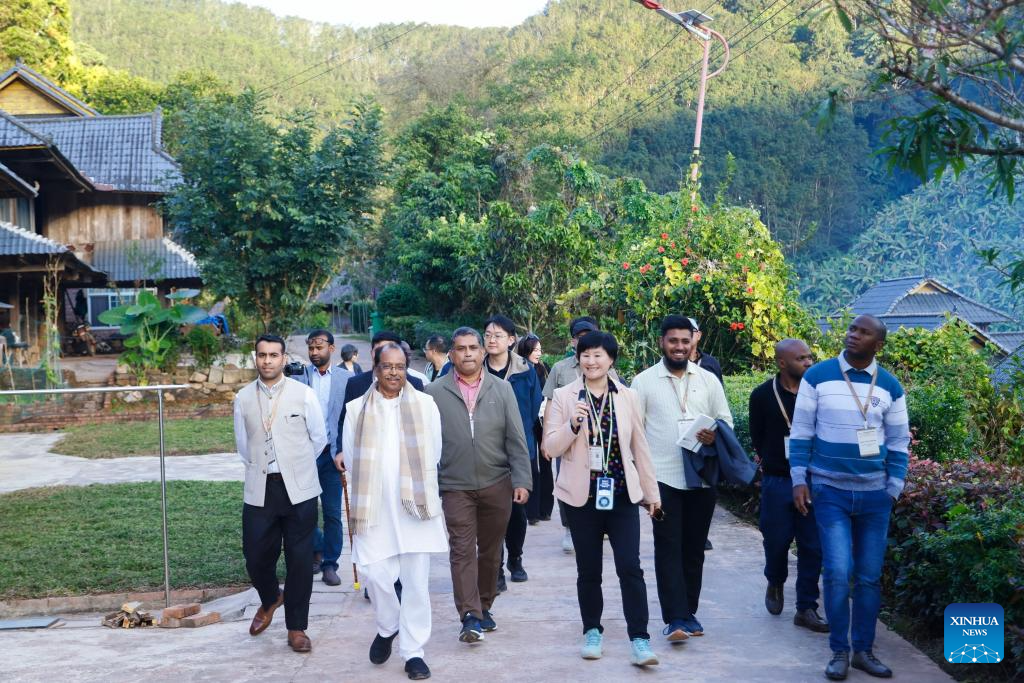
People from Global South countries visit Hebian Village in Mengla County, southwest China's Yunnan Province, Dec. 5, 2025. (Xinhua)


