
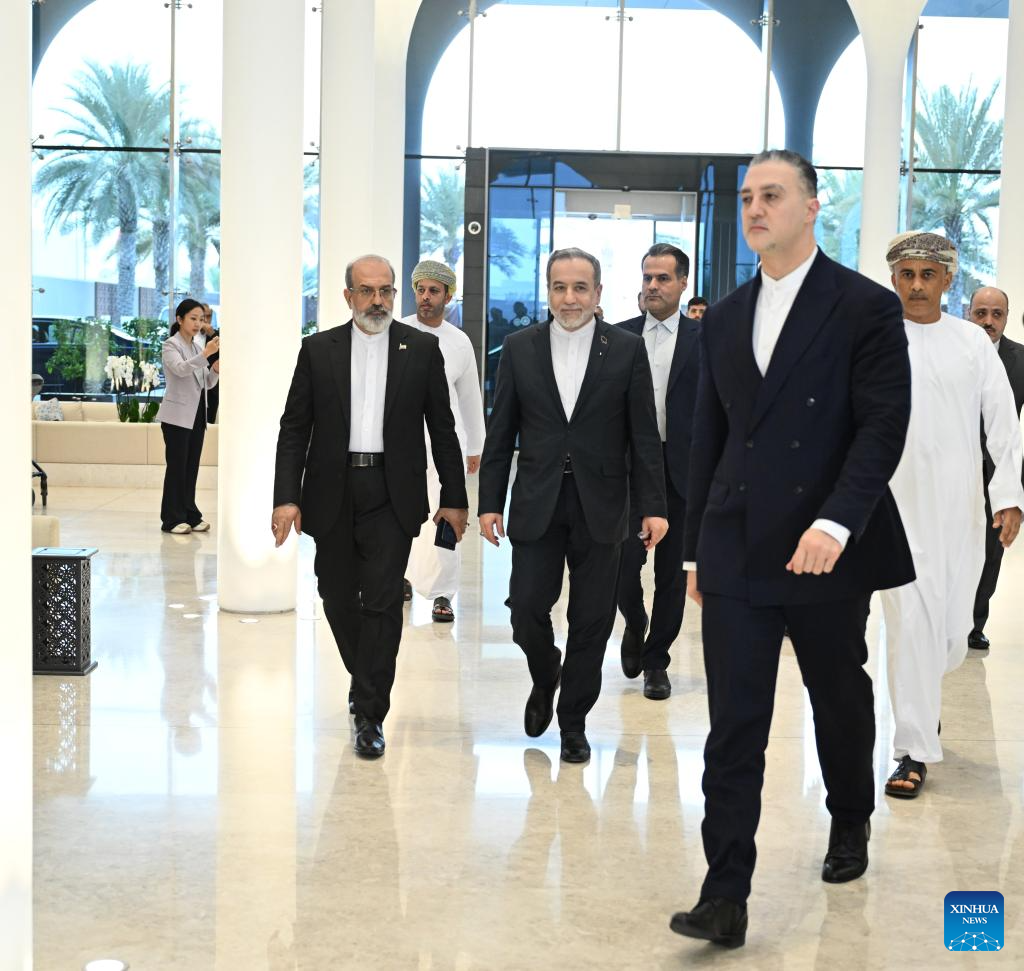
Iranian Foreign Minister Seyed Abbas Araghchi (C) and his accompanying delegation return to hotel after the talks with the United States in Muscat, Oman, Feb. 6, 2026. The indirect talks between Iran and the United States in Oman's Muscat were "a good start," with both sides agreeing to continue negotiations in the future, Iran's Fars News Agency reported Friday, citing Iranian Foreign Minister Seyed Abbas Araghchi. (Xinhua)
MUSCAT, Feb. 6 (Xinhua) -- The indirect talks between Iran and the United States in Oman's Muscat were "a good start," with both sides agreeing to continue negotiations in the future, Iran's Fars News Agency reported Friday, citing Iranian Foreign Minister Seyed Abbas Araghchi.
Noting that the talks took place in "a positive atmosphere," Araghchi, heading the Iranian delegation, told reporters after the hours-long talks that the two sides will first hold consultations back in their capitals, and then decide how and when it will be regarding the next round of talks.
Meanwhile, according to a report by Iran's official news agency IRNA, Araghchi said the Friday talks focused solely on the nuclear issues, and that Tehran did not discuss "any other topics" with Washington.
The Iranian delegation had pointed out in the talks that refraining from threat and pressure is the prerequisite for any dialogue, Araghchi said, adding that Iran expects that this point "definitely be observed to prepare the ground for the talks' continuation."
Also, Iran's state-run IRIB TV, quoting Araghchi, reported that Omani Foreign Minister Sayyid Badr bin Hamad Al Busaidi held several meetings with the Iranian and U.S. delegations, helping the two sides exchange their viewpoints.
The "very deep distrust" between Washington and Tehran formed in the past posed "a very big challenge to the negotiations, and we firstly have to overcome the pervading atmosphere of distrust and then, be able to design the framework for a new dialogue capable of safeguarding the Iranian people's interests," Araghchi noted.
Following the talks, Al Busaidi, the Omani foreign minister, posted a statement on social media platform X, calling the talks "very serious" and "useful."
The discussions helped clarify each side's position and identify potential areas for progress, he said, adding that the parties "aim to reconvene in due course, with the results to be considered carefully in Tehran and Washington."
Earlier in the day, IRIB TV reported that the talks ended "for now" in Muscat, and that the two delegations may return home, whereas Iran's Mehr News Agency reported that Iran rejected a "zero enrichment" demand during the talks.
The two sides centered on the dilution of Iran's existing uranium stockpile, Mehr reported, adding that the atmosphere of the talks was "more serious" than the previous rounds of talks between the two sides.
So far, the U.S. side has not issued any official statement regarding the talks, but Washington's subsequent moves have sent a signal somehow contradictory to Tehran's relatively positive rhetoric.
Hours after the conclusion of the talks, Washington announced new sanctions to curb Iran's oil exports, including targeting 14 vessels, reaffirming Washington's "maximum pressure" campaign against Iran.
The latest round of talks came amid heightened regional tensions, especially between Washington and Tehran. The United States has intensified its military presence in the Middle East in recent weeks, deploying a massive buildup of naval and air assets, including the aircraft carrier USS Abraham Lincoln and several guided-missile destroyers. Meanwhile, Iran is also ramping up its military preparations.
At the same time, both sides had gone through a hard time reaching an agreement over the venue, format and agenda of the talks, which laid bare their profound, seemingly irreconcilable negotiating positions.
They had initially agreed to meet in Istanbul, Türkiye, with some other Mideast countries participating as observers. Then, Iran reportedly proposed moving the talks to Oman and holding them in a bilateral format focused only on nuclear issues, a requirement the United States reportedly rejected. Washington had reportedly threatened to cancel the talks if Tehran did not stick to the original arrangement, but later okayed the new arrangement after being lobbied by at least nine Mideast countries.
Until the last minute before the start of the talks, Tehran had insisted that the talks must be limited to nuclear issues and the removal of U.S. sanctions, asserting that Iran's missile capabilities and regional activities are non-negotiable, whereas Washington had been bent on a broad agenda that must include Tehran's ballistic missiles, nuclear program, regional sponsorship of "terrorist organizations," and its treatment of the people.
The talks have revisited a diplomatic track that collapsed violently last June, culminating in U.S. airstrikes on Iran. Past negotiations between the two sides faltered over Washington's demands for zero uranium enrichment and curbs on missile development and support for regional proxies, all rejected by Tehran. ■


