

by Yi Ling
HARBIN, Feb. 6 (Xinhua) -- Beneath the dazzling aurora of laser lights and the grandeur of frozen palaces at the 27th edition of Harbin Ice-Snow World in northeast China's Harbin City, a quiet transformation is underway.
This year, the familiar symphony of hammers and chisels is joined by the low hum of servos and the precise whir of cutting blades.
At the world's largest ice and snow theme park, traditionally a showcase of human endurance and artistry, a new workforce has arrived. In an experimental zone, intelligent robots made their official debut on Tuesday, demonstrating the integration of high-tech innovation into the creation of the park's icy wonders.
On a simulated riverbank, a tracked ice-harvesting robot, a behemoth on tank-like treads, demonstrates its might. Its three high-strength cutting saws plunge into the ice, each pass carving out perfect blocks with an efficiency that humbles traditional methods.
"In the past, hundreds of workers lined up on the river, chiseling and pulling with hooks. The work was slow and carried the constant risk of falling into the freezing water," recalled a seasoned ice construction worker, his breath forming clouds in the cold air.
"We designed this technology to enhance efficiency and ensure safety. This harvester increases productivity by 80 percent and liberates workers from that dangerous environment," said Jiang Wenrui, an associate professor at Harbin Institute of Technology, who leads the robotics team.
This robotic lumberjack of the ice fields is just the first link in a seamless automated chain.
The harvested ice doesn't need a long, precarious journey. A mobile ice-shaping robot, contained within a unit no larger than a shipping container, can be driven directly to any construction site. There, it transforms raw, irregular chunks into flawlessly smooth, standard bricks with millimeter-level precision.
"Manual cutting often leaves scratches and chips. Our machine's mechanical control ensures precision that strictly meets the demands of high-accuracy construction," Jiang said.
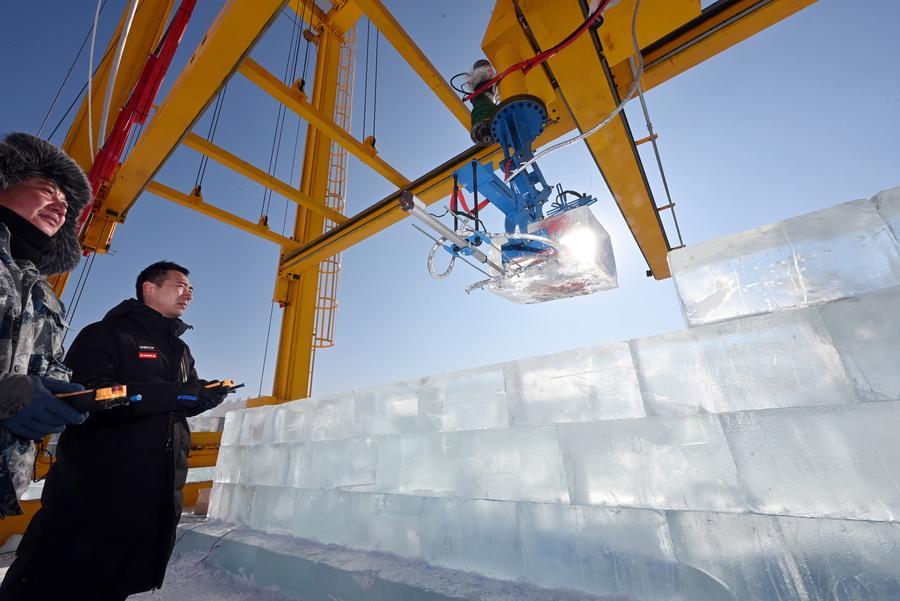
These perfect blocks then meet their "architect," a towering gantry-style assembly robot. This colossal unmanned craftsman, regarded as the core of the robot construction team, glides across the ice with surprising grace. Its automated arms perform a carefully choreographed routine, lifting, grinding, spraying and placing each block with an accuracy of less than two millimeters, all without a human hand ever touching the ice, Jiang explained.
"After thousands of experiments to optimize its algorithms, this robot has achieved construction positioning accuracy that is far higher than human hands. At the same time, it's more efficient and can shorten construction time," he said.
Structures in the tech-enabled experimental zone this year were built using this robot. Having completed prototype testing, the robot is now ready for mass production. In the future, it could be used not only at the park but also in a variety of ice and snow landscape construction projects, Jiang added.
The final touch of magic -- the breathtaking light shows that define the Harbin spectacle -- is also the result of robotic precision. As night falls, a vast 30,000-square-meter "Auspicious Cloud" pattern illuminates the ice of the Songhua River. This dazzling display is created by a pair of plotting and grooving robots, guided not by human hands but by the centimeter-level accuracy of China's BeiDou satellite navigation system.
They translate digital designs directly onto the ice canvas, etching channels for LED strips with an incredible precision of 0.5 mm.
"A task that would take 20 workers 10 days to groove by hand is now completed by robots in just three days. Now, every airplane passing over the river captures this wonder," said Li Changshan from the Heilongjiang Provincial Construction and Installation Group, who is in charge of the massive ice painting project.
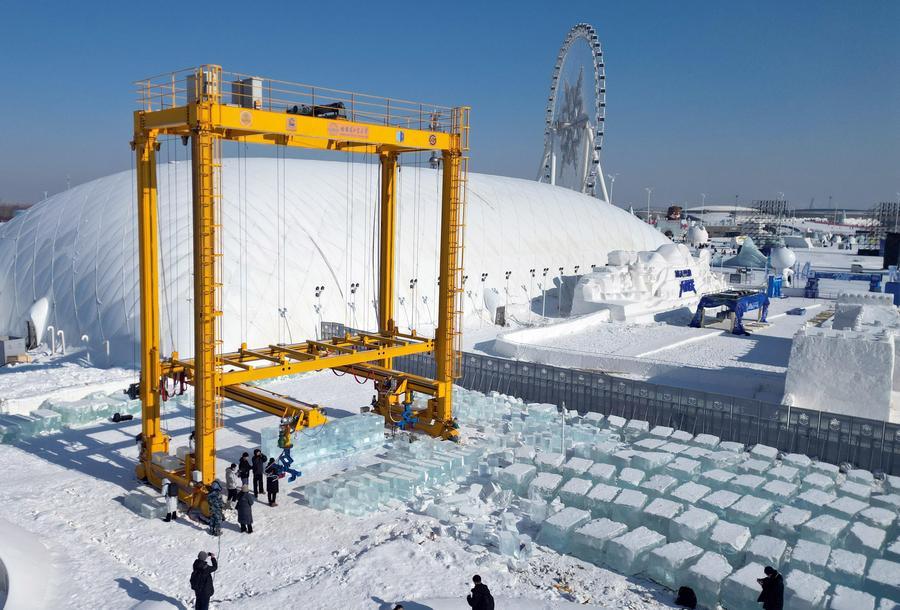
Li noted that the robots represent a complete, intelligent overhaul of the entire ice and snow industry supply chain, from harvesting and processing raw materials to construction and artistic finishing.
"This integrated robotic system is the perfect marriage of academic innovation and industrial application and propels the ice and snow industry from being labor-intensive to technology-driven," Li said.
The Harbin Ice-Snow World, a popular global winter tourist attraction, attracted a record-breaking 3.56 million tourist visits during its 68-day operation in the 2024 winter season, helping the ice and snow economy in Heilongjiang reach a market size of 266.17 billion yuan (38.26 billion U.S. dollars), according to the provincial bureau of statistics.
Next winter, Jiang said, more new robots are expected to join the park's construction. The R&D team is also developing more ice and snow equipment, such as a newly designed ice maker that addresses traditional issues like excessive bubbles and low strength or ductility. Its airflow regulation reduces energy consumption by 30 percent and allows for summer production, supporting year-round indoor ice venues. ■