
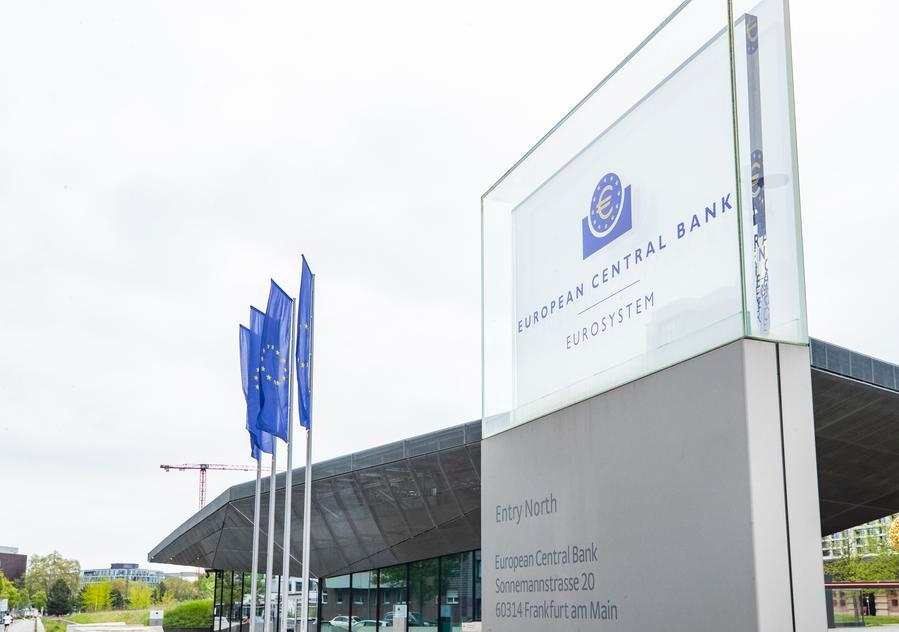
FRANKFURT, Feb. 6 (Xinhua) -- The European Central Bank (ECB) on Thursday decided to keep key interest rates on hold, reaffirming that monetary policy remains in a "good place."
It marked the fifth consecutive meeting at which the ECB left rates unchanged since last June. With inflation hovering around its medium-term target of 2 percent and the economy expected to grow close to its potential, the central bank has remained in a relatively comfortable position, seeing no immediate need to adjust its policy stance.
Nonetheless, the situation now appears somewhat less favorable than before, as inflation slipped moderately below two percent in January and the euro has strengthened.
STILL IN "GOOD PLACE"
The central bank announced on Thursday that key interest rates will be left unchanged. The deposit facility rate, the primary tool used by the ECB to steer monetary policy, remains unchanged at 2 percent; hence, the rates on the main refinancing operations and the marginal lending facility stay at 2.15 percent and 2.4 percent, respectively.
It elaborated in a statement that inflation should stabilize at 2 percent in the medium term and the economy remains resilient.
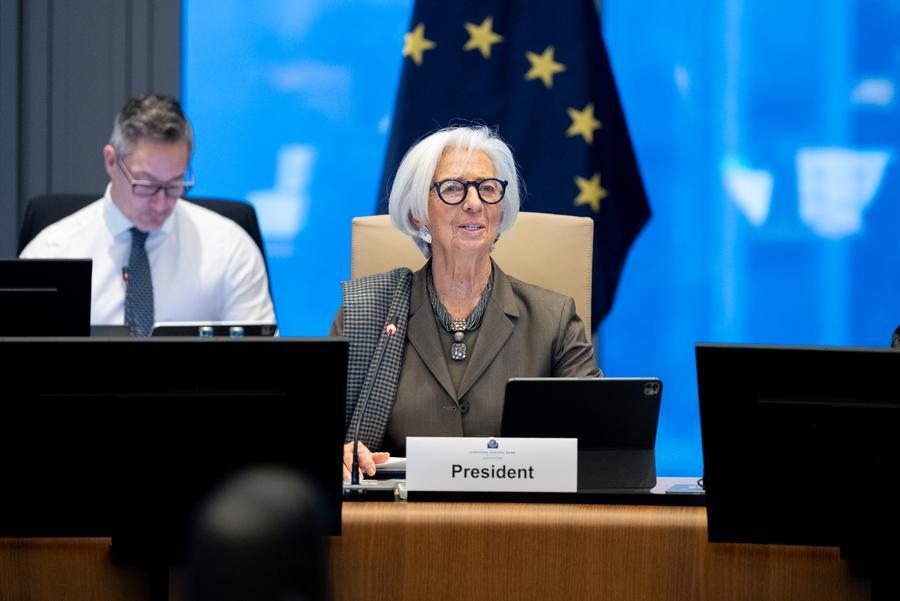
"I will certainly argue that we are in a good place and inflation is in a good place," said the ECB President Christine Lagarde at the press conference following the governing council meeting.
As the ECB is mandated to keep inflation in the euro area below but close to 2 percent in the medium term, Lagarde said, "We see it at target in the medium term."
UNDERSHOOTING RISKS DISMISSED
After hovering around 2 percent for 10 months in 2025, inflation in the euro area declined to 1.7 percent in January, the lowest level since September 2024.
To Lagarde, the January inflation reading did not come as a surprise but rather as a blip. She argued that inflation varies from month to month and remains in line with ECB staff projections.
In its statement, the central bank listed both upside and downside risks to inflation, acknowledging that a stronger euro could dampen price growth more than expected.
Lagarde explained that inflation risks are "broadly balanced" when all factors are considered.
Regarding the euro's appreciation against the U.S. dollar, Lagarde said the exchange rate has been on the ECB's radar, as it is important for both the growth and inflation outlook.
The euro recently rose above 1.2 U.S. dollars -- a 4.5-year high -- before edging lower. Lagarde revealed that the Governing Council discussed exchange rate developments and said the range in which the euro fluctuates against the dollar has remained broadly in line with historical averages.

RATE CUT NOT OFF TABLE
Amid heightened uncertainty, the central bank is sticking to its data-dependent, meeting-by-meeting approach in determining its future monetary policy stance.
"In any case, we stand ready to adjust all of our instruments within our mandate to ensure that inflation stabilizes sustainably at our medium-term target and to preserve the smooth functioning of monetary policy transmission," the ECB said in a statement -- wording that analysts view as a sign of vigilance.
Lagarde repeatedly stressed that the ECB is not pre-committing to a particular rate path, leaving all options open.
Her comments on Thursday led Carsten Brzeski, global head of macro at ING Research, to suggest that a stronger euro could prompt the central bank to resume its rate-cutting cycle.
Brzeski noted that a currency tends to appreciate as it becomes more attractive, while Lagarde argued that a bigger international role for the euro does not necessarily imply further appreciation.
In Brzeski's view, the stronger euro remains a "weak spot" in the ECB's otherwise comfortable position.
"If the ECB were to move away from its current stance, the first step would almost certainly be a cut rather than a hike -- at least in the near term," he said.■