
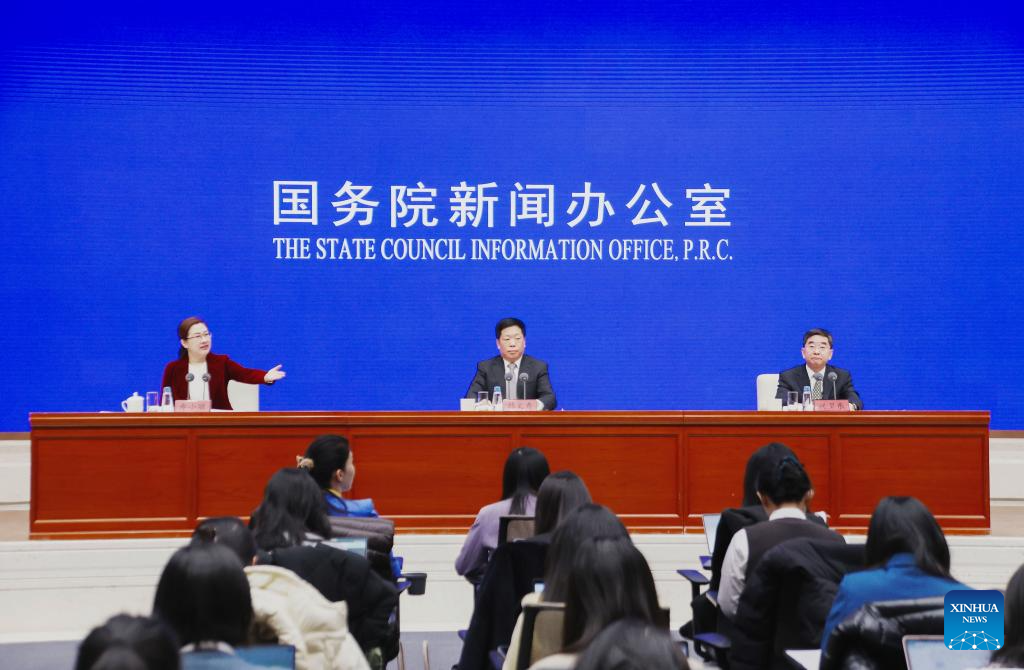
The State Council Information Office (SCIO) holds a press conference on advancing agricultural and rural modernization through solid steps in rural revitalization across the board in Beijing, capital of China, Feb. 4, 2026. (Xinhua/Pan Xu)
BEIJING, Feb. 4 (Xinhua) -- With the release of the 2026 "No. 1 central document," the first policy statement issued by China's central authorities each year, the country is set to advance agricultural and rural modernization while promoting comprehensive rural revitalization.
To achieve this goal, efforts should focus on safeguarding national food security, consolidating and expanding the achievements of poverty alleviation, and enhancing rural development across industries, infrastructure and governance, said Han Wenxiu, executive deputy director of the Office of the Central Committee for Financial and Economic Affairs.
Han, also head of the Office of the Central Rural Work Leading Group, made the remarks at a press conference on Wednesday.
China's grain production reached about 714.9 million tonnes in 2025, and the per capita grain supply was over 100 kilograms higher than the internationally recognized security line.
While the country enjoys sufficient supply, stable markets and ample reserves of grain and other major agricultural products, total grain demand will continue to grow in the coming period, said Han, adding that the focus on food security must never be relaxed.
The document stresses the enhancement of the overall production capacity, quality and performance of agriculture, said Han, noting that China will work to ensure the stable production of grain and edible oil, strengthen the development of high-standard farmland, enhance the efficacy of agricultural sci-tech innovation, and strengthen capacity-building for the prevention and mitigation of natural disasters.
The year 2025 marked the final year of the five-year transition period to consolidate and expand the achievements of poverty alleviation and integrate them with rural revitalization. In 2026, the focus shifts to the launch of regular, long-term support mechanisms, with specific implementation measures outlined in the document.
The document calls for improving regular support policies, strengthening more precise and timely assistance, improving the effectiveness of industrial and employment support programs, and adopting tiered, differentiated measures for underdeveloped areas.
These deployments aim to establish long-term mechanisms that transition assistance efforts from phased arrangements into stable, standardized systems, and ensure the continuity and stability of policies, thereby providing solid institutional safeguards against large-scale relapse into poverty over the long term, said Cheng Guoqiang, a professor at the Renmin University of China.
Targeted counties will receive concentrated support in terms of finance, land and human resources, Han said. Through policies such as improving infrastructure, enhancing public services and boosting county-level economies, supports will be concentrated on the overall development, with the purpose of enabling farmers in underdeveloped regions to get further away from poverty and increase their incomes, Han added.
County-level industries that boost local incomes serve as a key vehicle for farmers to increase their earnings locally, according to Zhong Yu, a researcher at the Chinese Academy of Agricultural Sciences. Zhong also noted that channels such as equity dividends and local employment should be expanded to enable farmers to participate in and fairly benefit from industrial development.
To advance the building of a beautiful and harmonious countryside that is desirable to live and work in based on local conditions, the document urged efforts to coordinate and improve the rural spatial layout, enhance infrastructure construction and maintenance, coordinate the provision of basic public services at the county level, and promote holistic ecological conservation and restoration.
It also stressed the necessity to deepen the campaign to foster civilized rural customs, and build safe and law-based villages.
Rural culture should be fostered to nurture a healthy and uplifting rural ethos, said Han, emphasizing the need to strengthen systematic protection of rural cultural heritage and promote changes in social customs and traditions, including curbing exorbitant betrothal gifts to nurture a simpler, more civilized wedding culture. ■


