* Hangzhou has been selected in 2026 as one of the "20 Cities Towards Zero Waste" by the United Nations Secretary-General's Advisory Board on Zero Waste for its strong commitment to zero-waste and its contributions to advancing inclusive, sustainable and innovative waste management solutions.
* Hangzhou has witnessed a revolution that transforms garbage into energy for homes, gas for municipal pipelines, and raw materials that return to production lines.
* From "zero-waste" classrooms to villages turning kitchen waste into peony fertilizer, green habits are becoming part of everyday life.
HANGZHOU, Jan. 30 (Xinhua) -- Wang Aifen starts her day with a simple act of green living, placing a bag of waste into a smart sorting bin as her phone pings, "Your disposal has been recorded."
With that text message on her phone, her trash begins its digital journey, tracked all the way to a waste-to-energy plant in Hangzhou, a tech hub in east China's Zhejiang Province.
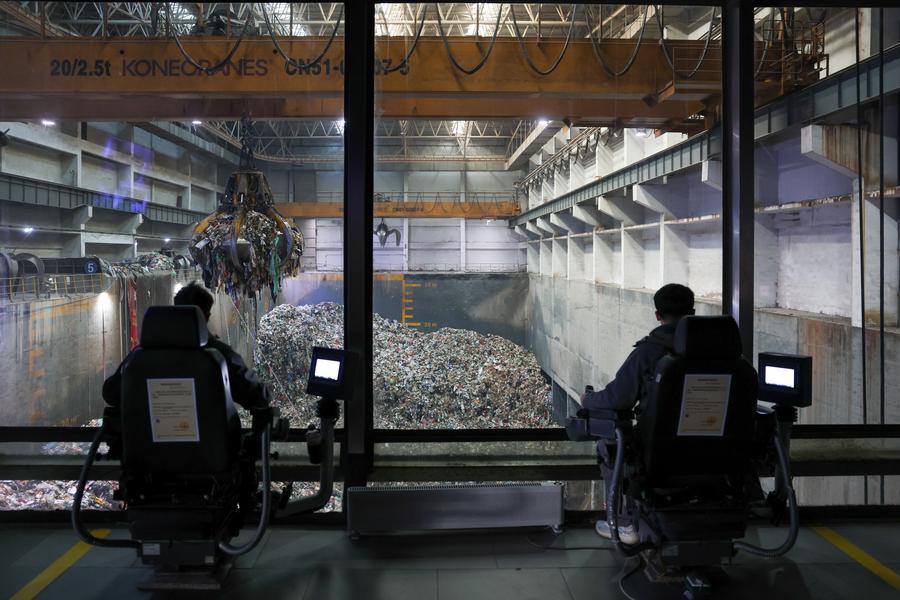
In the past, waste management operators had to manually monitor roaring furnaces, a grueling and imprecise task. Today, they oversee a giant screen where AI and nine temperature sensors guide the incineration in real time, boosting efficiency and sharply reducing harmful emissions such as dioxins.
"It's a metamorphosis," said Zheng Rendong, a former landfill engineer who has witnessed a revolution that transforms garbage into energy for homes, gas for municipal pipelines, and raw materials that return to production lines.
In 2024 alone, waste-to-energy electricity in Hangzhou reached 2.3 billion kilowatt-hours, meaning one in every 50 kilowatt-hours used in homes came from trash.
This is a major step in China's ambitious push toward "zero-waste" cities, combining digital innovation, circular economy and community mobilization to turn a challenge into an engine for sustainable growth.
SMART SOLUTIONS
Hangzhou, with an annual economic output exceeding 2 trillion yuan (about 287 billion U.S. dollars) and a population of more than 12.6 million, has been selected in 2026 as one of the "20 Cities Towards Zero Waste" by the United Nations Secretary-General's Advisory Board on Zero Waste.
The city stood out for its strong commitment to zero-waste and its contributions to advancing inclusive, sustainable and innovative waste management solutions, according to the board.
In Hangzhou, waste now carries a "digital passport." Huge Recycle, a company in Yuhang District handling household waste recovery and recycling, operates a smart recycling network. Data from every stage -- from collection at homes, sorting and processing, to delivery to downstream partners -- is fed in real time into the company's intelligent management platform.
Residents are encouraged to place used cartons, bottles and other recyclables into dedicated collection bags and schedule a pickup online. Collectors from the company arrive promptly, scan the items and upload the data, allowing residents to instantly earn redeemable eco-points that can be exchanged for goods.
"The main challenges were low participation. Our solution? To make it simple and rewarding," said Hu Shaoping, the company's vice president. Since its launch, the system has handled over 21 million pickups in Yuhang, collecting nearly 600,000 tonnes of household waste.
At Hangzhou's urban management bureau, a digital platform maps the city's entire waste system, covering 10,806 collection points, 1,785 sanitation vehicles, 10 incineration plants and 14 organic waste treatment facilities.
The model is now spreading beyond Hangzhou. In Shanghai's Xuhui District, a live digital map tracks hundreds of disposal sites, monitoring sorted waste volumes and recycling rates.
Several major cities, including Shanghai, Shenzhen and Guangzhou, are now processing household waste using smart solutions, said Yan Jianhua, a professor at the College of Energy Engineering, Zhejiang University. With landfills no longer in use, some cities are transforming old sites to improve the environment and recover valuable resources, he added.
CLOSING THE LOOP: FROM BURDEN TO ENGINE
Like many rapidly developing cities around the world, Hangzhou used to grapple with huge volumes of waste and insufficient processing capacities. In 2013, its urban areas generated over 3 million tonnes of household waste. If piled onto a standard football pitch, it would measure at least 400 meters in height, taller than a 140-story building.
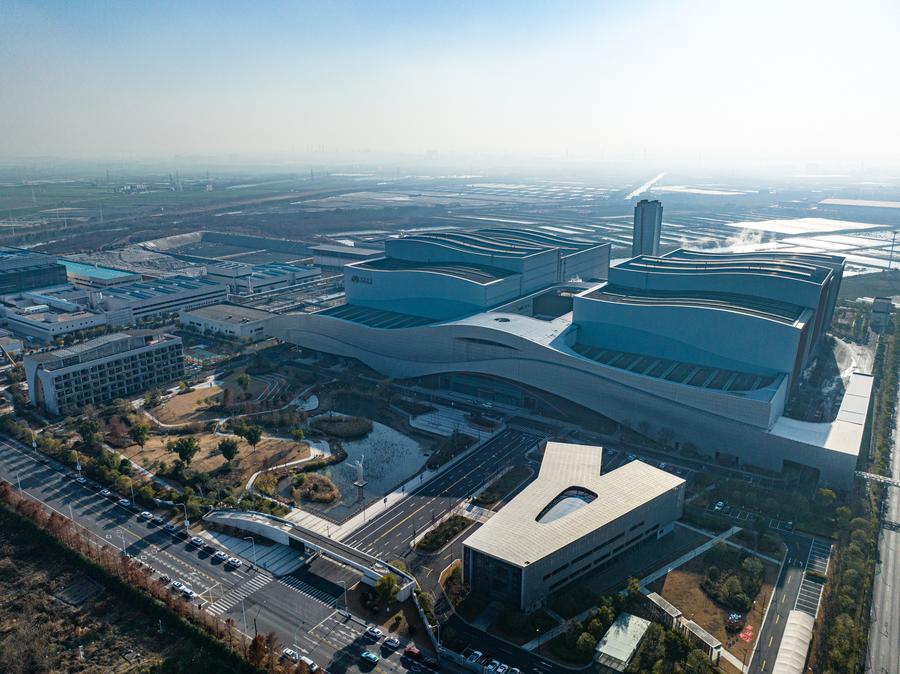
The turning point came in 2018, when Zheng Rendong and his colleagues launched a modern eco-industrial park by Hangzhou Linjiang Environmental Energy Co., Ltd. By the end of 2020, the facility was able to process 2 million tonnes of household waste annually, generating over 1 billion kilowatt-hours of electricity and transforming the resulting slag into eco-friendly construction materials.
Step by step, waste has been transformed from a burden into a driver of a complete circular economy.
In Hangzhou's Fuyang District, a centuries-old mining site has been transformed into an eco-park where nine enterprises carry out industrial symbiosis. Steam from waste incineration heats a neighboring company, saving 2 million yuan in annual costs. Food waste, after oil and biogas extraction, is used to feed black soldier flies, producing high-protein animal feed. The park's output value is projected to have hit 1.3 billion yuan in 2025.
"It's a system rebuild, not just a technological upgrade," said Cai Guoqiang, deputy director of Hangzhou's Ecology and Environment Bureau. As a result, 71.8 percent of the city's household waste is recycled and over 98 percent of general industrial solid waste has become useful.
Likewise, the Suzhou Industrial Park in east China's Jiangsu Province has linked seven facilities from waste treatment to power generation into a symbiotic ecosystem, creating a self-sufficient industrial chain that turns waste into resources and energy.
PUBLIC PARTICIPATION
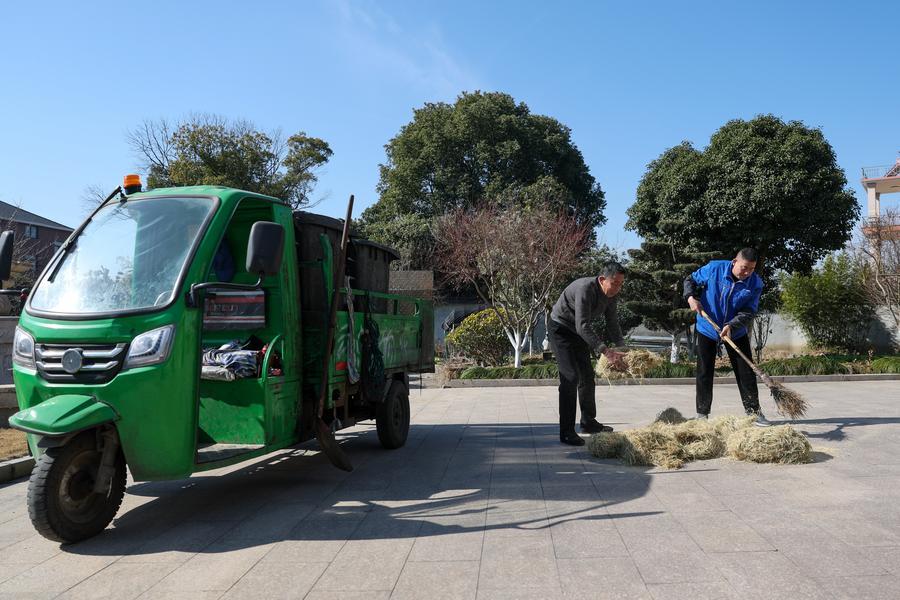
True transformation requires public buy-in, often the hardest part. At Hangzhou's Sijiqing clothing market, a merchant who once dismissed green slogans as empty talk has now embraced biodegradable packaging and waste reduction measures. She said waste has dropped significantly, noting that the number of trash bins at the market has been cut from 40 to 20.
From "zero-waste" classrooms to villages turning kitchen waste into peony fertilizer, green habits are becoming part of everyday life.
In Shanghai, mandatory waste sorting, once a novelty since its 2019 launch, is now a habit for millions of residents.
These local innovations are now scaling up, backed by national policy frameworks. Earlier in January, China released an action plan to achieve a notable increase in its solid waste treatment capacity in the next five years, as part of its broader efforts to propel a comprehensive green transition in its economy and society.
Meanwhile, the Communist Party of China Central Committee's recommendations for formulating the 15th Five-Year Plan (2026-2030) proposed initiatives for the comprehensive treatment of solid waste, intensified prevention and control of environmental risks, and substantial progress in treating new pollutants.
"Engaging everyone in low-carbon circular practices is no simple task," said Zhou Shifeng, deputy director of the Zhejiang Development and Planning Institute. "It requires persistent, concerted efforts." (Video reporters: Li Tao; video editors: Yang Zeyi, Hong Yan, Luo Hui and Zheng Qingbin) ■