"Cooperation between Egypt and China is no longer a matter of choice; it has become indispensable," said Abdel-Badie, head of the Egyptian Antiquities Sector at the Supreme Council of Antiquities. "Both countries are heirs to great ancient civilizations, which makes their continued rapprochement not only natural but necessary in light of the current global situation."
LUXOR, Egypt, Jan. 26 (Xinhua) -- A joint archaeological team comprising Egyptian and Chinese experts has recently uncovered a series of significant findings at the Montu Temple precinct in the Karnak Temple Complex in Luxor, a city renowned for its historic monuments in southern Egypt.
Among these discoveries are key revelations that fill critical gaps in the study of ancient Egyptian history. The findings are the latest testament to the deepening collaboration between China and Egypt, two ancient civilizations, in the modern era.
A SACRED LAKE UNSEEN BEFORE
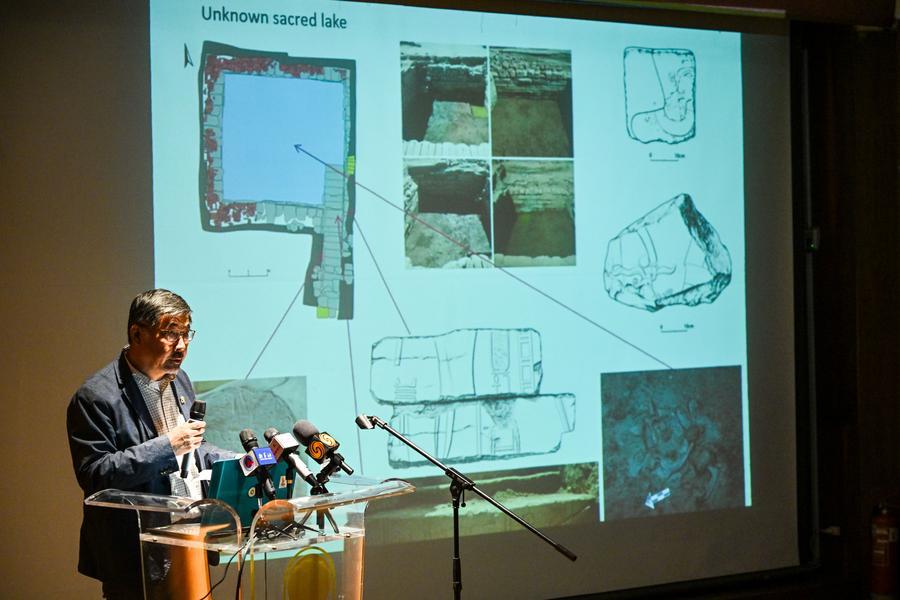
"This represents a dialogue based on mutual respect and understanding between two of the world's oldest civilizations," said Dong Xinlin, deputy director of the Institute of Archaeology at the Chinese Academy of Social Sciences (CASS), during a press conference on the discoveries held Saturday near the excavation site by the Egyptian-Chinese joint archaeological team.
According to the archaeologists, dozens of cow jaw remains and reused stone blocks associated with kings and the divine adoratrice (a high-ranking female religious official in ancient Egypt) from the Late Period of Ancient Egypt (747-332 BC) were uncovered during the recent excavation.
Among the discoveries, the most significant is the previously unknown sacred lake within the Montu Temple enclosure, located to the west of the Maat Temple, which was dedicated to Maat, the ancient Egyptian goddess of harmony, justice and truth.
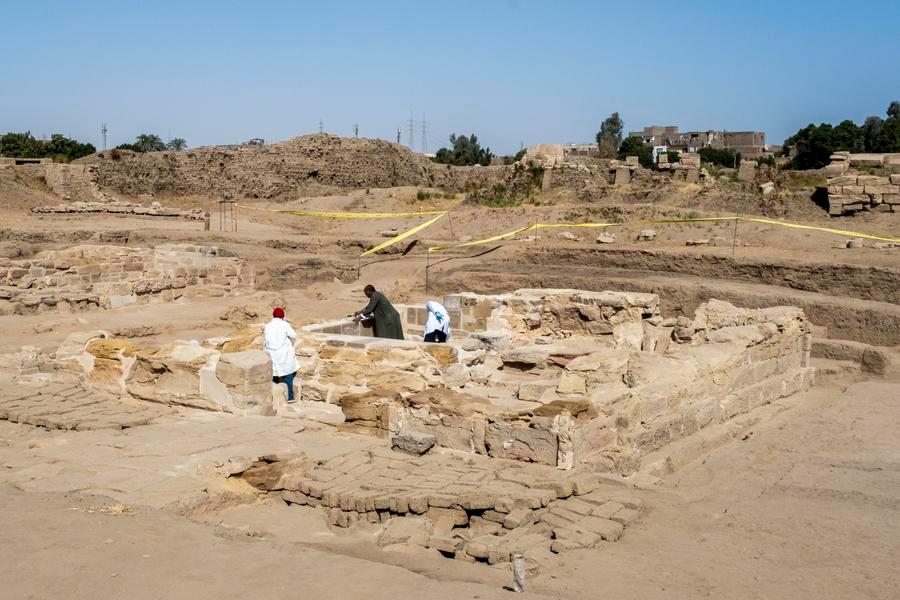
Covering more than 50 square meters, the lake is an ancient man-made water reservoir with a distinct structure and is well-preserved. According to archaeologists from the joint mission, the lake had not been recorded in earlier archaeological archives.
"This sacred lake not only sheds light on water ritual practices at the Montu Temple but also provides important architectural evidence linking it to the Maat Temple," said Jia Xiaobing, the Chinese head of the project and a scholar from the CASS. "It opens up new avenues for further research into ancient Egyptian religious life."
Beyond the sacred lake, excavations in the Osirian chapel area uncovered three chapels dedicated to the god Osiris, Jia said, adding that archaeologists also recovered dozens of Osiris statuettes of varying sizes and materials, along with fragments linked to the divine adoratrice.
These truly rare discoveries resulted from years of hard work by the joint archaeological team, said Hend Aly, senior inspector at the Montu Temple, who joined the mission in 2019.
A JOURNEY OF FRUITFUL RESULTS
The recent findings are just a part of the fruitful results from eight years of the Egyptian-Chinese joint archaeological mission, which was formed in 2018 by the Institute of Archaeology of the CASS and Egypt's Ministry of Tourism and Antiquities.
Since its founding, this collaborative team has been conducting excavations and research at the Montu Temple, making a series of important discoveries that have gradually uncovered the secrets of this ancient Egyptian site.
For the Chinese and Egyptian archaeologists involved, the most significant gain goes beyond the archaeological finds themselves. It lies in the mutual understanding and respect for each other's cultures that has grown through their cooperation.
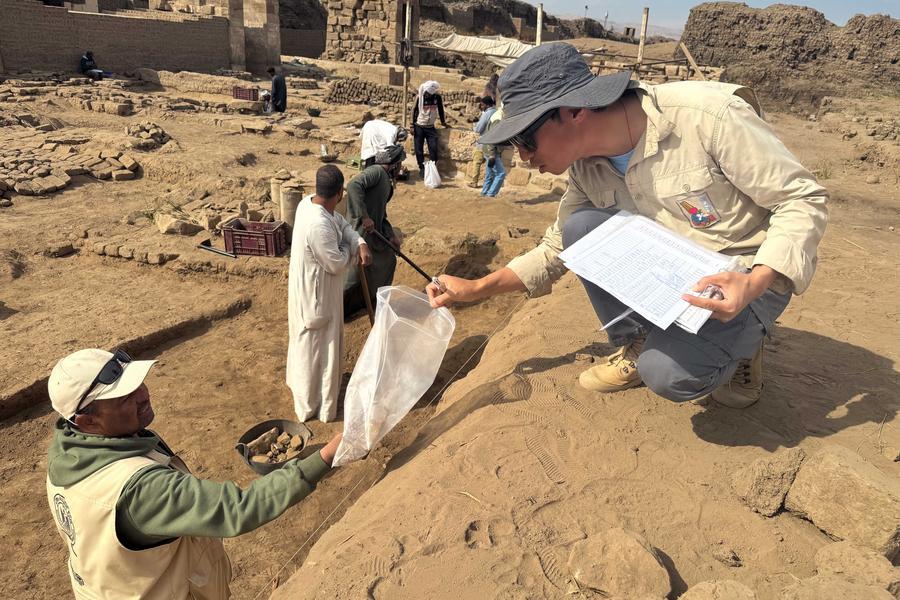
"Through this joint mission, we have developed a deeper understanding of Egypt, while our Egyptian colleagues have come to admire the brilliance of ancient Chinese civilization. We share a deep mutual appreciation," said Huang Fucheng, an archaeologist from the Zhengzhou municipal institute of cultural heritage and archaeology in Henan Province.
According to the team members, the collaboration initially faced a period of adjustment. After patient discussions and communication, both sides eventually established a smooth and efficient working process.
"Chinese archaeologists have a strong foundation in the field, with their own set of principles, methods and academic traditions," Jia said, adding that the methods were embraced by Egyptian colleagues.
"It can be said that the collaboration between the members of our joint archaeological team is a perfect example of the exchange and mutual learning between Chinese and Egyptian civilizations," said Ahmed Hassan, an Egyptian member of the joint mission.
A FUTURE WITH VAST POTENTIAL
"Excavation is not just about uncovering stones and artifacts," Aly said. "It is about building relationships, fostering friendship and bridging civilizations, both past and present."
Today, Chinese archaeologists are not only at the Montu Temple but are also actively engaged in sites across Egypt, including Luxor, Cairo and Alexandria.
For Mohamed Abdel-Badie, head of the Egyptian Antiquities Sector at the Supreme Council of Antiquities, the success of the Egyptian-Chinese archaeological collaboration reflects the vast potential for contemporary cooperation between the two great civilizations.
"Cooperation between Egypt and China is no longer a matter of choice; it has become indispensable," Abdel-Badie said. "Both countries are heirs to great ancient civilizations, which makes their continued rapprochement not only natural but necessary in light of the current global situation."
Today, cultural exchanges between China and Egypt have expanded into various fields, and the growing bonds between the two nations are laying a solid foundation for broader cooperation, ensuring that the ancient civilizational partnership continues to thrive.
"Through exchanges such as the joint archaeological mission, China is demonstrating its dedication to mutual respect and learning with other civilizations," Aly noted. "Mutual appreciation is a key reason that binds us together."
In November of last year, the Grand Egyptian Museum opened after two decades of construction. In a congratulatory message to Egyptian President Abdel-Fattah al-Sisi, Chinese President Xi Jinping said that it is encouraging to see the two ancient civilizations reaching out to each other, with the two peoples growing ever closer through mutual understanding and affinity.
"Both China and Egypt are ancient civilizations with a rich history. Our ancestors created brilliant cultures in the past, and today, through mutual cooperation, we are sure to achieve even greater development milestones," Huang said. "A new chapter of friendship and cooperation between our two nations has only just begun."■
(Video reporters: Yang Yiran, Dong Xiuzhu, Yao Bing, Zhang Jian, Ma Xiaocheng, Xin Mengchen, Adel Ahmed, Marwa Yahya; video editors: Wang Houyuan, Zhu Cong)■