
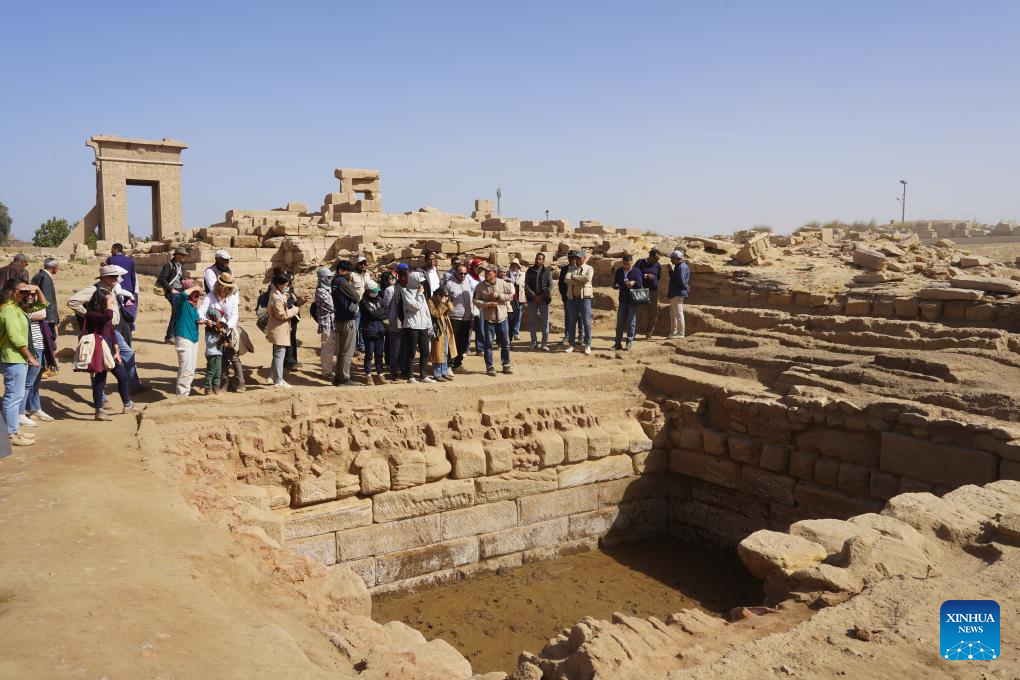
Guests visit the ruins of the "sacred lake" at the Montu Temple precinct in the Karnak Temple Complex in Luxor, Egypt, Jan. 24, 2026. An Egyptian-Chinese archaeological mission announced on Saturday that the team has uncovered an ancient "sacred lake" at the Montu Temple precinct in the Karnak Temple Complex in Luxor, a city renowned for its rich monuments in southern Egypt. (Xinhua/Xin Mengchen)
LUXOR, Egypt, Jan. 24 (Xinhua) -- An Egyptian-Chinese archaeological mission announced on Saturday that the team has uncovered an ancient "sacred lake" at the Montu Temple precinct in the Karnak Temple Complex in Luxor, a city renowned for its rich monuments in southern Egypt.
The newly uncovered sacred lake, within the Montu Temple enclosure, lies west of the Maat Temple, dedicated to Maat, the ancient Egyptian goddess of harmony, justice, and truth.
Covering more than 50 square meters, the lake is an ancient man-made water reservoir with a well-defined structure and is well-preserved. The lake has not been recorded in early archaeological archives, according to the joint mission archeologists.
Together with the previously known sacred lake of the Montu Temple, the discovery forms a unique layout of two sacred lakes aligned north and south within the Karnak enclosure walls, said Jia Xiaobing, the Chinese head of the project.
Terming the discovery as the Southern Sacred Lake, Jia told Xinhua that "the new find is the only sacred lake in the history of Egyptian archaeology that has undergone systematic and scientific excavation, providing a wealth of first-hand materials for research, especially studies of sacred lakes."
Sacred lakes were an essential component of ancient Egyptian temple architecture and were regarded as holy sources of water, distinct from domestic water supplies and reserved exclusively for ritual use within temples, he explained.
Hend Aly, a senior inspector at the Montu Temple and an Egyptian member of the project, said the discovery "is something rare that crowned the hard work of the joint mission for eight years."
She told Xinhua that the joint team successfully developed and applied an advanced technological methodology to carry out the work.
"We started with a big dump of sand and dust, and now you can see the fruits of our joint work; this beautiful and great sacred lake that will open new paths for more research and discoveries in the near future," Aly said.
However, due to limitations caused by the groundwater level, the foundational construction of the lake has not yet been fully explored, and its initial construction date remains to be determined through further excavation and research, Aly added.
Archaeologists also unearthed dozens of cow jaw remains and reused stone blocks associated with kings and the divine adoratrice from the Late Period (747-332 BC) in this area.
Beyond the sacred lake, excavations in the Osirian chapel area uncovered three chapels dedicated to the god Osiris, Jia said, adding that archaeologists also recovered dozens of Osiris statuettes of varying sizes and materials, along with fragments linked to the divine adoratrice.
The Divine Adoratrice of Amun (also called God's Wife of Amun) was a priestess title in ancient Egypt, held primarily by royal women like pharaohs' daughters, who served as the symbolic wife and chief ritual attendant of the god Amun at Thebes.
This discovery provides new archaeological evidence for further reconstructing the history of Thebes under the rule of the divine adoratrice of the 25th and 26th Dynasties, according to Jia.
The Montu Temple site is located in the northern part of Luxor, covering approximately 106,000 square meters, of which about 24,000 square meters lie within the enclosure walls of the temple precinct. To date, the joint mission has excavated a total area of about 2,300 square meters.
Since 2018, the first Egyptian-Chinese joint archaeological mission formed by the Institute of Archaeology of the Chinese Academy of Social Sciences and Egypt's Ministry of Tourism and Antiquities has been officially conducting archaeological excavations and research at the Montu Temple.
The project has also received support from the Zhengzhou Municipal Institute of Cultural Relics and Archaeology and the Institute of World History of the Chinese Academy of Social Sciences. ■
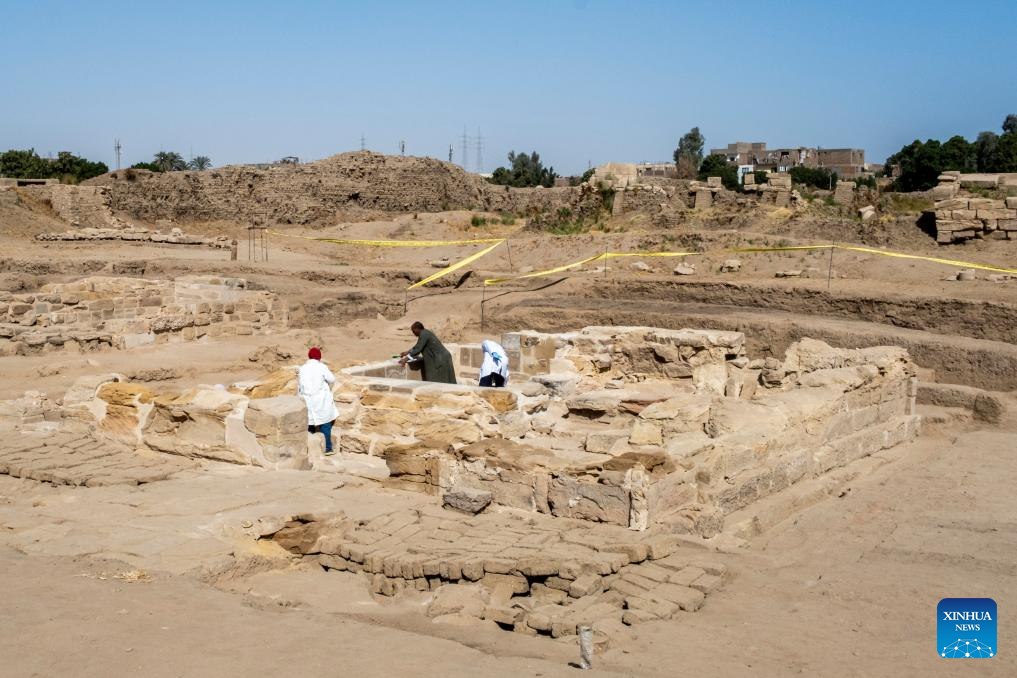
Staff members work at the Montu Temple precinct in the Karnak Temple Complex in Luxor, Egypt, Jan. 24, 2026. An Egyptian-Chinese archaeological mission announced on Saturday that the team has uncovered an ancient "sacred lake" at the Montu Temple precinct in the Karnak Temple Complex in Luxor, a city renowned for its rich monuments in southern Egypt. (Xinhua/Xin Mengchen)
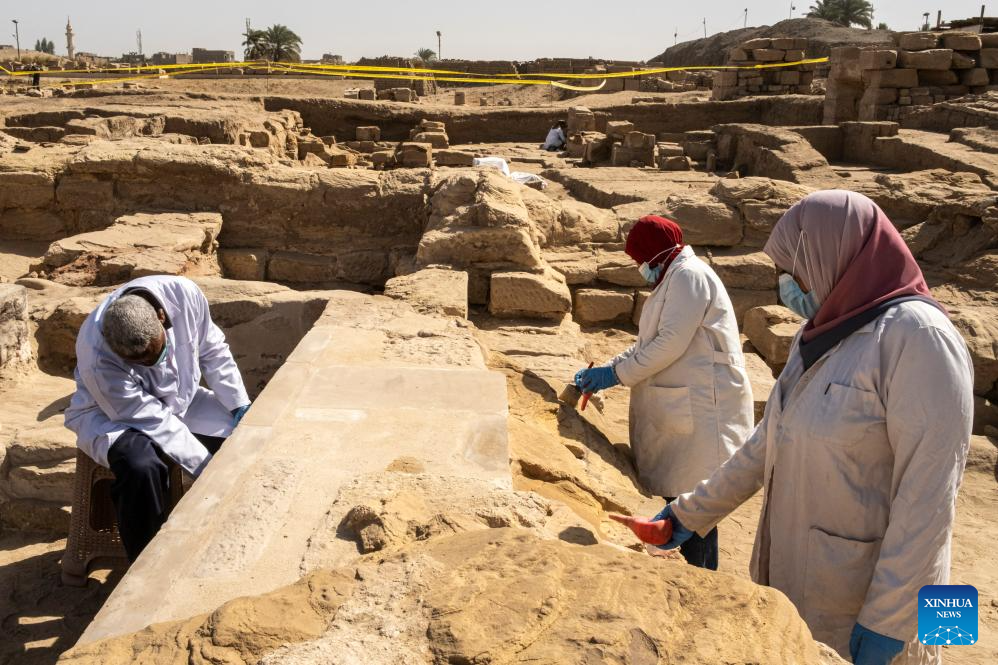
Staff members work at the Montu Temple precinct in the Karnak Temple Complex in Luxor, Egypt, Jan. 24, 2026. An Egyptian-Chinese archaeological mission announced on Saturday that the team has uncovered an ancient "sacred lake" at the Montu Temple precinct in the Karnak Temple Complex in Luxor, a city renowned for its rich monuments in southern Egypt. (Xinhua/Xin Mengchen)
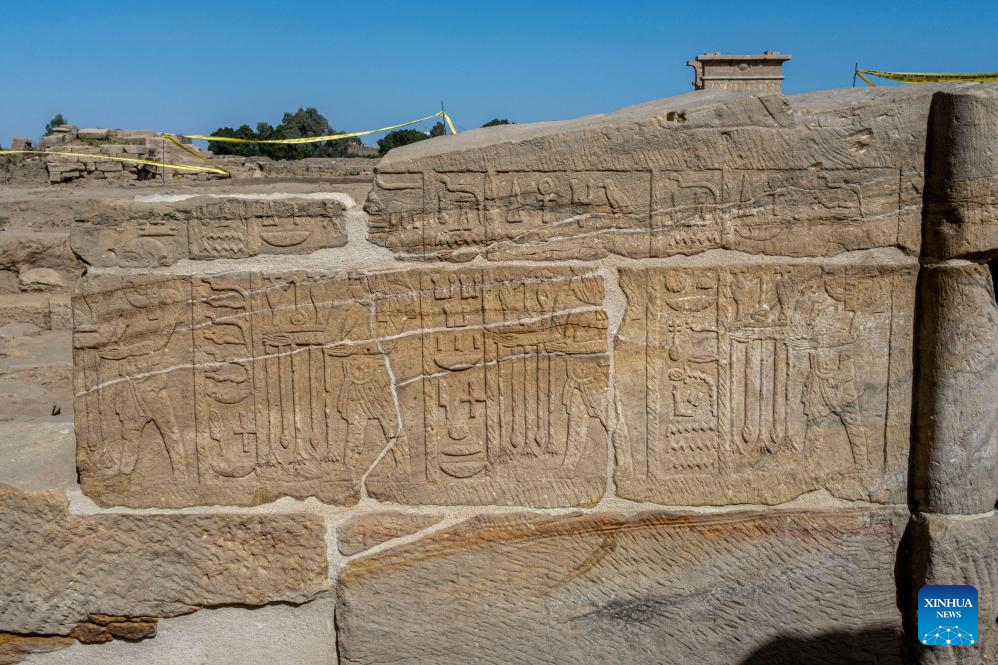
This photo taken on Jan. 24, 2026 shows relief-carved stone at the Montu Temple precinct in the Karnak Temple Complex in Luxor, Egypt. An Egyptian-Chinese archaeological mission announced on Saturday that the team has uncovered an ancient "sacred lake" at the Montu Temple precinct in the Karnak Temple Complex in Luxor, a city renowned for its rich monuments in southern Egypt. (Xinhua/Xin Mengchen)
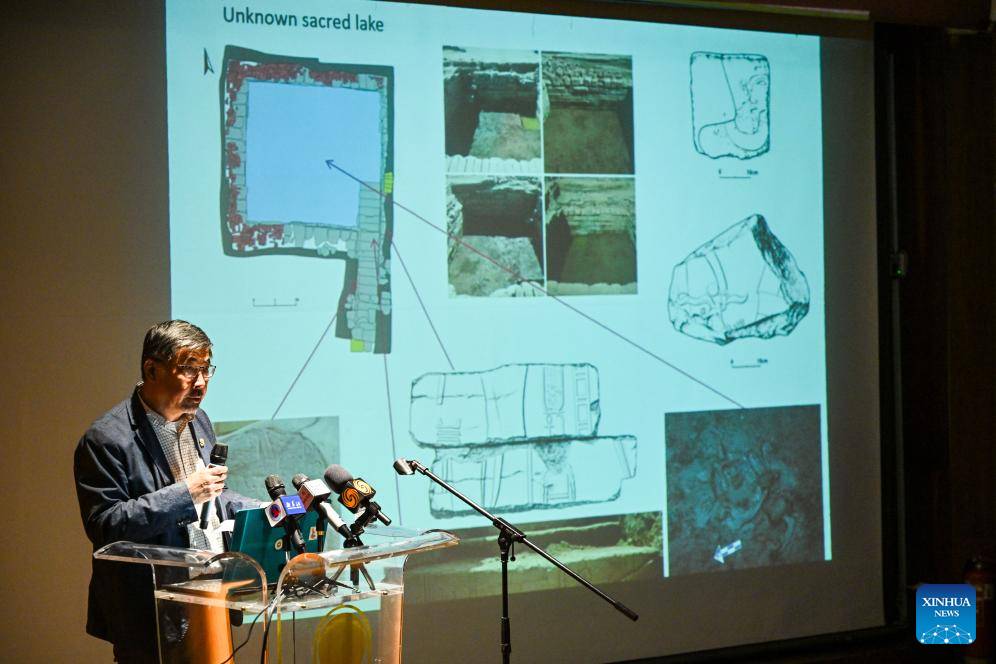
Jia Xiaobing, the Chinese head of the Egyptian-Chinese archaeological mission, presents archaeological discoveries in Luxor, Egypt, Jan. 24, 2026. An Egyptian-Chinese archaeological mission announced on Saturday that the team has uncovered an ancient "sacred lake" at the Montu Temple precinct in the Karnak Temple Complex in Luxor, a city renowned for its rich monuments in southern Egypt. (Xinhua/Xin Mengchen)


