
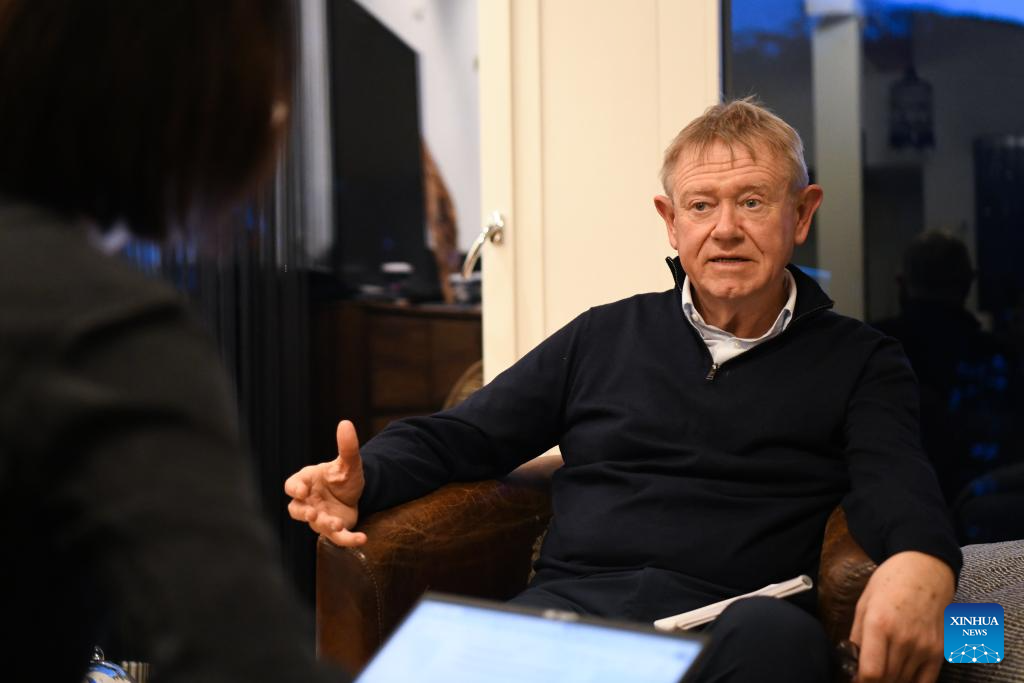
David Haigh, Chairman and CEO of Brand Finance, speaks during an exclusive interview with Xinhua at the WEF Annual Meeting 2026 in Davos, Switzerland, Jan. 19, 2026. (Xinhua/Lian Yi)
DAVOS, Switzerland, Jan. 20 (Xinhua) -- Chinese brands are in an "exciting" phase that coincides with the nation's rising influence in soft power, said a top business leader in an exclusive interview with Xinhua on Tuesday.
David Haigh, Chairman and CEO of Brand Finance, was speaking in Davos, Switzerland, at the release of two major reports by the global brand consultancy: "Brand Finance Global 500 2026" and "Global Soft Power Index 2026."
From the collective leap of commercial brands toward "innovation and quality" to China's national image topping global rankings in metrics like "easy to do business in and with" and "Future growth potential," Haigh believes China is showcasing a high-quality rise driven by brand building and soft power enhancement.
Over the past year, Brand Finance's research has shown that when it comes to most developed countries, "people as a whole don't feel confident that they are achieving what they say they will achieve, which is peace, stability, economic help."
Against this backdrop, "China has just quietly strengthened its position... It is getting very close in terms of the overall index with America," he said.
Haigh highlighted China's opening up to the world and friendly approach, noting its policy of non-interference in other countries' affairs. He also pointed to its support for developing countries through medical aid, economic assistance, and infrastructure projects.
Research for the "Global Soft Power Index 2026" was based on the views of 150,000 respondents in over 100 countries on all 193 UN member states. Notably, China has jumped 27 places in "friendliness" and 18 places in "fun." In 19 out of 35 individual attributes, China scores higher than the United States.
Specifically, Haigh praised the development of China's tourism industry, which he said has immense potential. "If people visit your country, they get to know it, they get to understand it, they like the people," he said. "I think we are all confident that that is exactly what will happen with China."
The construction of a nation's "grand brand" relies on the international image built by individual enterprises, Haigh said, applauding the strategic transformation of Chinese brands.
China has been committed to international brand building for many years, and therefore "the awareness of Chinese brands in the world is growing," Haigh noted.
"I have absolutely no doubt, 20 years from now, people will be quoting Chinese academics about how to run brands," he predicted.
China honors its words with actions, Haigh underlined. "When China decides to do something, it really does it thoroughly," he said, citing the example of TikTok, "a triple-A rated brand" that is "growing very fast."
He cited the rise of battery producers like CATL as a major contributor to China's leading position in the global EV landscape, adding that in the automotive sector, BYD has solidified its position as a global leader.
In the banking sector, European and American brands that once dominated the rankings "have now been overtaken to a large extent by Chinese banks," Haigh said. Meanwhile, in the spirits sector, Moutai and Wuliangye are considered "the strongest brands in the world," and in apparel Bosideng is "positioning itself above competitors," according to Haigh.
From industrial powerhouses to the growing visibility of cultural intellectual property (IP), Haigh concluded, "Chinese brands are going from strength to strength," no longer defined by price but by innovation and high quality. ■


