
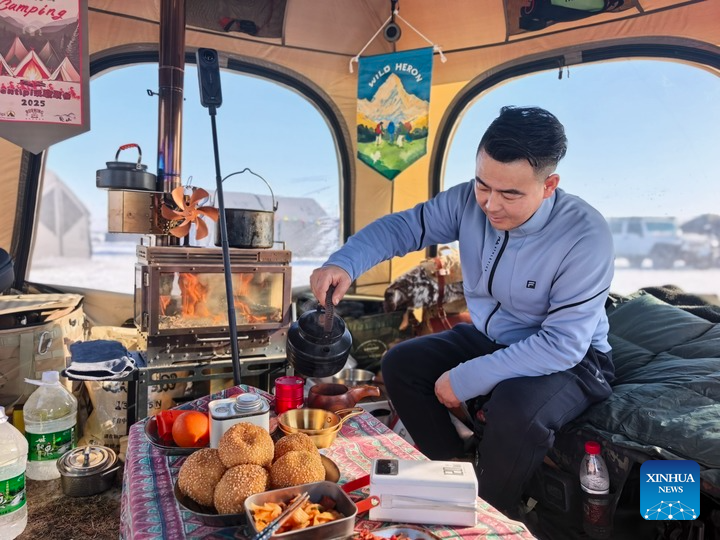
A camper enjoys tea and food inside a tent during the 4th Northeast Camping Carnival in Hala village in the Meilisi Daur Ethnic District of Qiqihar, northeast China's Heilongjiang Province, Jan. 13, 2026. (Xinhua/Zhang Yue)
HARBIN, Jan. 17 (Xinhua) -- Driving over 3,000 kilometers from the subtropical warmth of south China's Guangdong Province, Zhu Yongyu, a camping enthusiast, finally reached the country's frozen northeast and pitched his tent on a patch of snow-blanketed grassland.
For Zhu, a night spent camping at minus 30 degrees Celsius, a stark contrast to the lush, green campsites he was accustomed to, unlocked an exhilarating new level of challenge and adventure.
"I have tried all kinds of camping scenarios in Guangdong, but the snow is something we just don't have. I drove for six days only for this moment," said Zhu, while adjusting a gas stove inside his tent, which had raised the indoor temperature to a comfortable level, defying the extreme cold outside.
Zhu is among thousands of enthusiasts who have flocked to Hala village in the Meilisi Daur Ethnic District of Qiqihar, northeast China's Heilongjiang Province, for the 4th Northeast Camping Carnival. Running from Jan. 12 to 18, the event has this year seen the number of pitched tents exceed 1,000 for the first time, transforming the quiet, ice-sealed ethnic village into a vibrant hub for outdoor enthusiasts.
The view of such a vast array of tents blossoming like spring buds across the silver plains showcases a significant shift in China's winter tourism. What was once a season for locals to "hibernate," has become a golden period for economic vitality, driven by the integration of ice-and-snow sports, culture and outdoor leisure.
The surging popularity of winter camping has, notably, created new opportunities for domestic outdoor equipment manufacturers, who are also present at the carnival, which is a golden chance for them to engage with users and test products in such extreme conditions.
Han Wei, founder of the outdoor brand Yeying based in southwest China's Sichuan Province, sees the northern market as a new frontier.
"As a brand from the south, we initially found the northern environment challenging. Last year, we were unprepared for the cold, but this year we brought equipment featuring tech fabrics designed specifically to prevent condensation inside the tents, which is often considered a major headache for winter campers," Han said.
Han noted that listening to user feedback at such events allows his company to rapidly upgrade its products, adding that the unique ice-and-snow activities in the north offer experiences unavailable in the south, making this market vital for their future growth.
"The extreme cold used to be a challenge, but now it is the main attraction," Han exclaimed.
Wang Kai, a veteran camper from neighboring Jilin Province, also in China's northeast, believes the appeal of winter camping lies in modern people's pressing need to unwind.
Impressed by the sight of crowds of adults slipping, sliding and laughing heartily during ice games and snowball fights at the carnival, Wang noted: "After being cooped up in cities for too long, we need to let loose in the snow and rediscover this raw, rugged kind of joy."
Beyond equipment and scenery, the event has highlighted the deep integration of tourism with local culture.
During the carnival, Daur villagers hosted "village feasts," treating visitors to steaming dumplings and a traditional soup. Their warm hospitality bridged gaps between strangers, turning the campsite into a community.
Wang Fang, director of the culture and tourism bureau of Meilisi Daur Ethnic District, said the event serves as a prime example of how the district is expanding the scope of a single camping event into a multifaceted experience.
By combining camping with Daur folk customs, ice sports and local culinary traditions, the district has created a distinctive cultural tourism brand, Wang explained. This approach not only attracts tourists but also boosts local employment and income.
The success of the camping carnival in this ethnic village serves as a microcosm of China's booming winter tourism market. According to China Tourism Academy, the number of ice-and-snow leisure trips is expected to reach 360 million during the 2025-2026 winter season, with revenue projected to hit 450 billion yuan (about 62.6 billion U.S. dollars).
"This vast winter tourism market potential gives us confidence," Wang said. "It allows rural areas like ours to upgrade infrastructure, improve villagers' livelihoods, and ensure that our countryside remains vibrant and sustainable throughout the winter season." ■
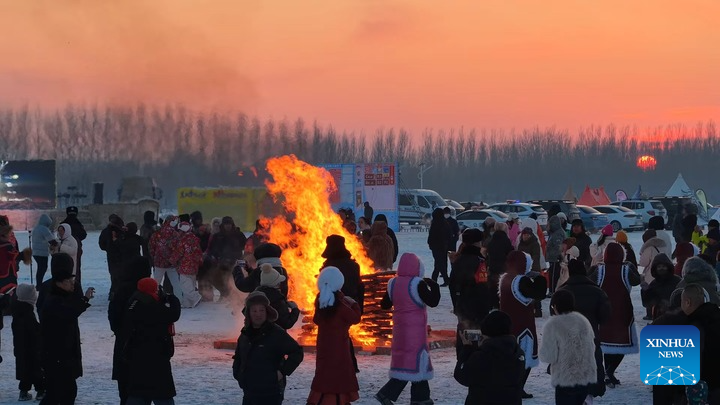
Tourists sing and dance during the 4th Northeast Camping Carnival in Hala village in the Meilisi Daur Ethnic District of Qiqihar, northeast China's Heilongjiang Province, Jan. 13, 2026. (Photo by Wu Han/Xinhua)


