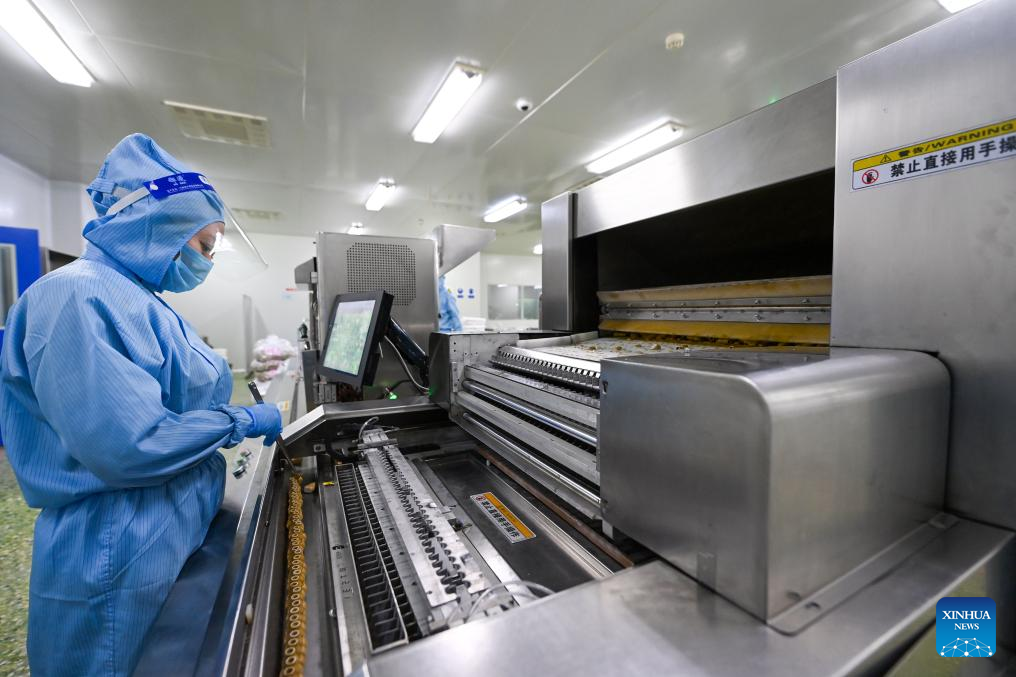
A staff member works at a workshop of the Tianjin Pharmaceutical Da Ren Tang Group Co., Ltd. in Tianjin, north China, Dec. 25, 2025. (Xinhua/Zhao Zishuo)
BEIJING, Jan. 16 (Xinhua) -- In the heart of Germany, a traditional Chinese herbal product has secured a lasting place on the shelves of the renowned Bahnhof-Apotheke pharmacy chain for over six years, with nearly 200,000 bottles of Shufeng Jiedu granules sold to date.
Priced at 39.9 euros per bottle, this respiratory relief formula is among more than a dozen products from Anhui Jiren Pharmaceutical Co., Ltd. in eastern China, exemplifying the global journey of Traditional Chinese Medicine (TCM).
This journey is no longer limited to classic remedies stored behind pharmacy counters. Since last year, a "Four Seasons Tea" based on TCM principles has been offered not only in German pharmacies but also on the menu of a tea house in Hamburg, serving as a daily wellness supplement.
"From treatment to wellness, we seek to integrate TCM's health-preserving culture into the daily lives of Europeans," said Zhu Qiang, deputy general manager of Anhui Jiren Pharmaceutical.
Once regarded as an exotic alternative, TCM is now expanding its global presence and joining the worldwide conversation on health and lifestyle.
BUILDING STANDARDS
To progress from cultural curiosity to global acceptance, TCM first had to tackle a fundamental challenge: making the "inexplicable" explicable.
The empirical nature of TCM, coupled with the complexity of herbal formulas, has long puzzled international regulators and scientists. For instance, the same herb may either promote or stanch blood flow, depending on its combination with other ingredients.
The response has been a systematic drive toward standardization. China has facilitated the establishment of a technical committee under the International Organization for Standardization, which has so far issued over 100 international standards for TCM.
Pioneering institutions have also played a key role. For example, Tianjin University of Traditional Chinese Medicine has led the creation of the world's first international educational standard for TCM undergraduate programs.
On the corporate front, major Chinese pharmaceutical companies have diligently pursued international certifications. Tianjin Pharmaceutical Da Ren Tang Group Co., Ltd. has obtained certifications recognized in Australia and Japan. As early as 1997, its product Suxiao Jiuxin Pills, a compound emergency medicine for heart attacks, was successfully registered as a prescription drug in Russia.
Anhui Jiren Pharmaceutical entered the European market in 2018, and 193 of its TCM granule varieties have passed official German quality inspections and are available in the EU market. "We are exploring new approaches to bring more products to the global market, including strengthening ties with overseas research institutions to prove TCM's efficacy with scientific evidence," Zhu Qiang said.
Data from China's National Administration of Traditional Chinese Medicine showed that TCM is now practiced in 196 countries and regions. China has also signed TCM cooperation agreements with over 40 foreign governments and international organizations.
TECH EMPOWERMENT
Beyond documentation, transformation is underway on factory floors and in research labs, where intelligent technology is decoding herbal wisdom and demonstrating its mechanisms through data.
At the digitalized workshop in a Tianjin Pharmaceutical Da Ren Tang plant, Suxiao Jiuxin Pills roll off automated production lines. Each bottle carries a QR code that allows consumers to trace the medicine's journey -- from the specific herb plantation to every step of processing, storage and quality control.
"We use digital control to tackle the pain point of batch-to-batch variation in herbal products, ensuring both efficacy and stability," explained Li Hongjiang, the plant's production deputy general manager.
The upcoming new generation intelligent workshop, with an investment exceeding 300 million yuan (about 43 million U.S. dollars), will use near-infrared spectroscopy and visual inspection systems to further enhance precision, Li added.
Artificial intelligence (AI) is also scaling up TCM production. In 2024, Tianjin-headquartered Tasly Pharma, in collaboration with Huawei Cloud, launched a TCM large language model. Trained on a massive corpus of classical texts and clinical data, it assists in formula optimization, mechanism explanation and the discovery of new clinical applications.
Similarly, a large model was jointly developed last year by organizations including the National SuperComputer Center in Tianjin and Tianjin University of Traditional Chinese Medicine, encompassing knowledge from over 20 TCM clinical disciplines.
"AI can synthesize the vast empirical knowledge recorded in ancient TCM texts, thereby supporting the standardization of TCM practice," said Guo Yi, vice president of Tianjin University of Traditional Chinese Medicine.
SOFT POWER
The ultimate test of TCM's global integration lies not only in clinics but also in its seamless adoption into daily life. This is evident in the growing trend among young Chinese who are embracing TCM-inspired beverages, foods and physical exercises. Meanwhile, Chinese companies are also actively introducing TCM as a modern lifestyle choice worldwide.
Anhui Jiren Pharmaceutical's Four Seasons Tea in Germany is a prime example. Each product in the series adapts its herbal composition to a specific season. Marketed as a food supplement, it lets consumers embrace TCM's concept of seasonal wellness through a simple and enjoyable daily ritual.
Another company, Anhui Bafang Health Industry Development Group Co., Ltd., has opened eight online stores in Malaysia, offering over 30 types of herbal teas, traditional medicinal soup packs and other food-therapy products within just two years.
Educational and experiential platforms amplify this soft power. Tianjin University of Traditional Chinese Medicine has been promoting TCM culture overseas through platforms such as Confucius Institutes. Meanwhile, Beijing Tong Ren Tang Chinese Medicine Co., Ltd. operates museums both in China and abroad to showcase the history, culture, products and services of TCM.
TCM is also merging with tourism to boost its global appeal. In the southern island province of Hainan, the Sanya Hospital of Traditional Chinese Medicine has designed customized treatment plans for foreign clients, offering services such as acupuncture, massage, herbal baths, medicinal cuisine and weight management services.
Konstantin, a Russian engineer, brought his parents to the hospital for therapies such as moxibustion and acupuncture. "TCM is miraculous! The techniques combined with Sanya's warm climate greatly alleviate neck and lumbar pain," he said.
Some community-based institutions in Hainan have also created one-stop "wellness communities" for international tourists by integrating residential environments, health services and healing therapies.
"With a history spanning thousands of years, TCM embodies profound wisdom and unique insights," said Zhang Boli, an academician with the Chinese Academy of Engineering and an expert in TCM. "As TCM continues to evolve and innovate while actively engaging with the global community, its value will be recognized by more people worldwide, contributing Chinese wisdom to the advancement of human health." ■
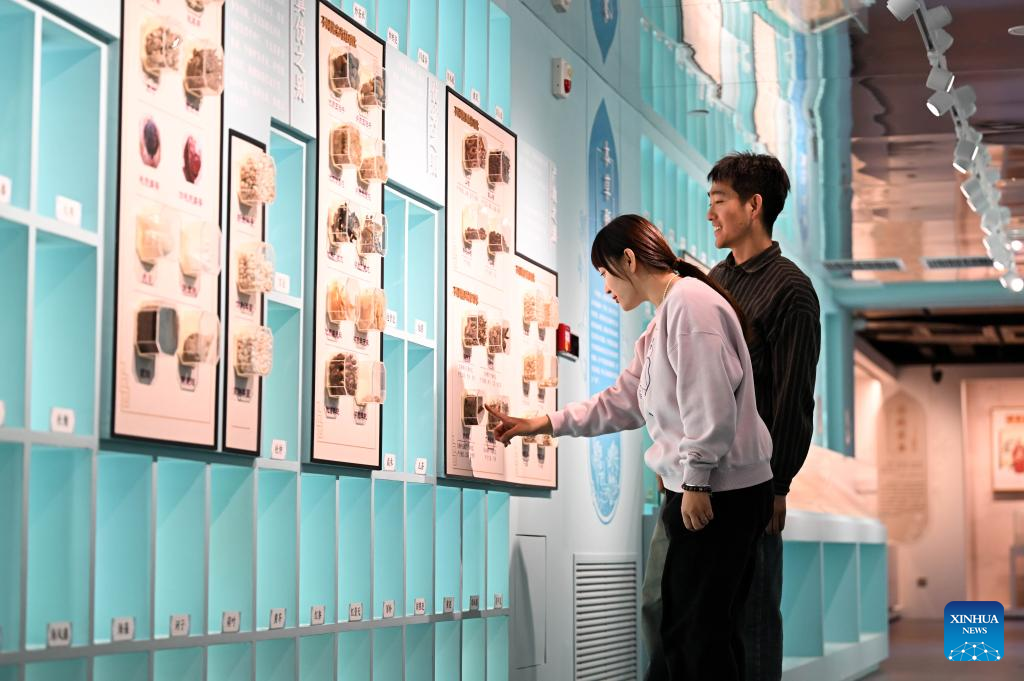
People visit a museum on traditional Chinese medicine under the Tianjin Pharmaceutical Da Ren Tang Group Co., Ltd. in Tianjin, north China, Dec. 25, 2025. (Xinhua/Zhao Zishuo)


