
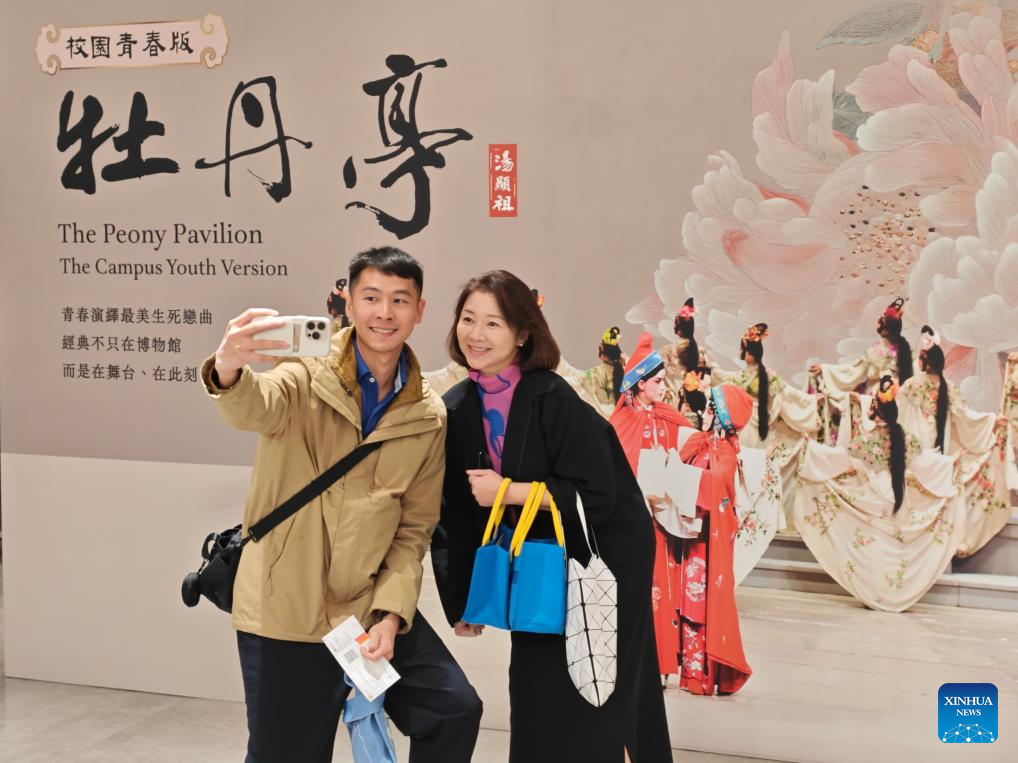
Audience take a selfie in front of a poster of a campus youth version of the Kunqu Opera masterpiece "The Peony Pavilion" in Taipei, southeast China's Taiwan, Jan. 15, 2026. (Xinhua/Wang Chenghao)
TAIPEI, Jan. 15 (Xinhua) -- Two decades after a youth version of the Kunqu Opera masterpiece "The Peony Pavilion" debuted in Taipei, a special "campus youth" edition performed entirely by college students from the Chinese mainland was staged in Taiwan for the first time on Thursday.
Created by renowned Taiwan-based novelist Pai Hsien-yung, the youth version of the 16th-century romantic tragicomedy features the refined costumes and stage design of the original youth Kunqu production, which premiered in 2004 and has since been staged more than 500 times.
The campus production is an abridged performance of the nine-hour youth version, which is usually staged over three consecutive days. It began with a project that was initiated in 2024 to encourage young people to participate in the passing down of Kunqu, a 600-year-old Chinese opera style inscribed on UNESCO's Intangible Cultural Heritage list.
The project selected 50 students from 29 universities and colleges. With little prior professional training in Kunqu, the students undertook nearly nine months of instruction before bringing the campus version of "The Peony Pavilion" to the stage in Suzhou of the eastern Jiangsu Province, the birthplace of Kunqu, in April 2025.
"The campus version represents a new model of today's young people passing on fine traditional Chinese culture," said Zhao Tianwei, the production's chief planner and a professor of art at Southeast University in Jiangsu.
"We hope that young audiences in Taiwan can enjoy and learn more about Kunqu by watching their peers performing the art on stage," Zhao said.
Young people have always been the primary target audience of the youth version of "The Peony Pavilion." Since its 2004 premiere, the production has toured more than a dozen universities. "The aim is to help college students appreciate the beauty of Kunqu and therefore grow closer to our traditional Chinese culture," 88-year-old Pai, who has spent years promoting Kunqu, said in a message written ahead of the campus version's Taipei performance.
Over the past 20 years, the youth version has attracted generations of young people, including people who were not even born when the production debuted in 2004, according to Hsieh Shan-shan, publicity coordinator of this week's event for its organizer, Taiwan-based Creative Performing Arts Co., Ltd.
"For many people, their first theater experience was the youth version of 'The Peony Pavilion,'" she said. "And many have been surprised that there can be such a beautiful thing and a performing art like that."
The campus youth version staged on Thursday sold out more than 900 seats priced from 300 to 1,500 New Taiwan dollars (about 9 to 47 U.S. dollars).
"Some people think traditional opera is something only older generations enjoy, but this 'youth-oriented' version of 'The Peony Pavilion' brings the classic closer to young people and makes it easier for us to connect with it emotionally," said Liao Wei-lun, a third-year college student and traditional theater fan, who also invited his classmates to the performance Thursday.
"There are many young people in Taiwan who enjoy Peking Opera and Kunqu opera, and many of my friends share this interest," Liao said. "I hope there will be more performances like this in the future, and also look forward to exchanging and learning with peers on the mainland who have the same passion."
"For more than 20 years, the enthusiasm and love for Kunqu among the people of Taiwan have remained unchanged. I was pleasantly surprised to see that many high school enthusiasts also enjoyed the performance very much," Pai said in an interview.
"Promoting traditional Chinese culture to the people of Taiwan, especially the youth, carries profound significance. Only when a nation understands its own past can it clearly chart the direction of its future," he said.
In Beijing, Taiwan and many other places -- even the United States -- the youth version of "The Peony Pavilion" has become a brand in its own right, Hsieh said. "Now we can see that the production has been passed down from one generation to the next."
Among the youngest generation of performers, Fan Yupeng plays the male protagonist, Liu Mengmei, in one segment. He believes they can bring a fresh perspective to the century-old classic.
"We live in a different era from 20 years ago, shaped by broader cultural exchange and influences, so we can present the characters to audiences in a different way," said Fan, who is a graduate student of pharmaceutical sciences from Beijing.
"I also hope that we can exchange with our peers in Taiwan through the art of Kunqu and encourage one another to work together to preserve our traditional culture," he said.
Yu Jiulin and Shen Fengying, both of whom were leading cast members of the youth version in 2004, served as art directors for the campus edition.
Yu remembers his first performance as Liu Mengmei in the youth version's Taipei premiere. "We had always heard that Kunqu audiences in Taiwan were the most discerning, so performing here back then felt like a test," he said. "The audiences in Taipei truly appreciated the show -- they knew exactly when to respond and some people even brought copies of the original script to the theater."
Behind these moments, the actors believe, lies a shared appreciation for Chinese culture rooted in people in both the mainland and Taiwan.
"We would take multiple curtain calls after each performance in Taiwan, through which we could feel the audience's recognition of our work," said Shen, who played the female protagonist, Du Liniang.
"Through traditional Chinese culture, the two sides of the Taiwan Strait are closely connected," she said. "As Kunqu actors, we are a bridge of cultural transmission -- whether through pure performances 20 years ago, or through performing and teaching today." ■
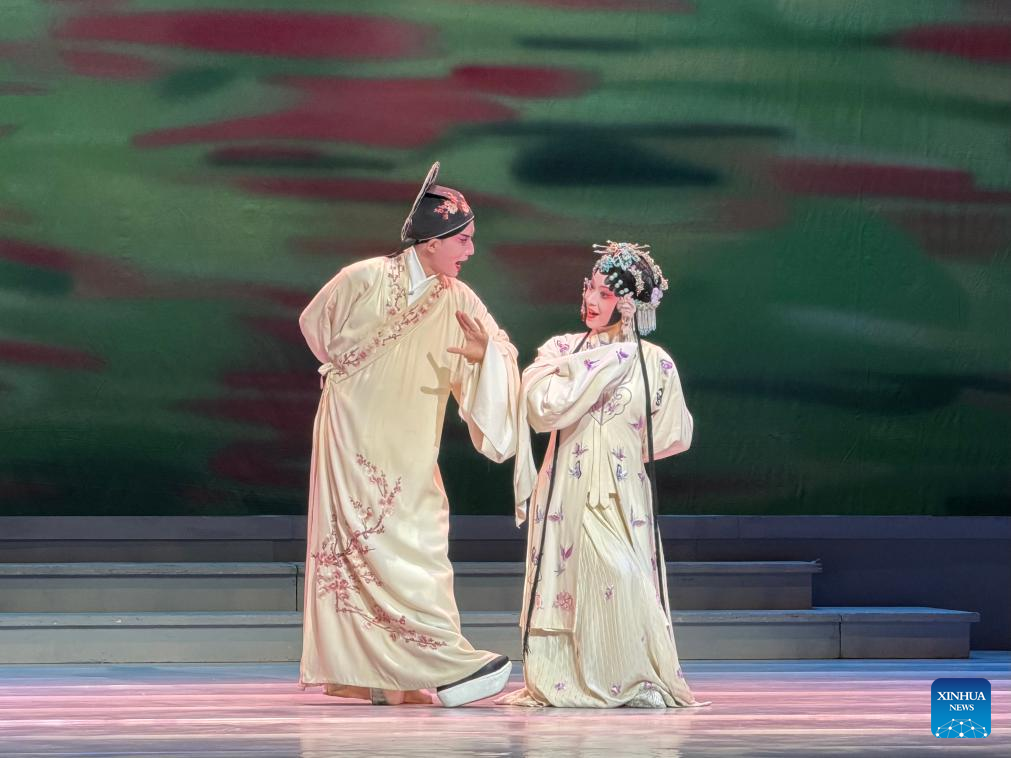
College student performers rehearse for a campus youth version of the Kunqu Opera masterpiece "The Peony Pavilion" in Taipei, southeast China's Taiwan, Jan. 14, 2026. (Xinhua/Huang Shuo)


