
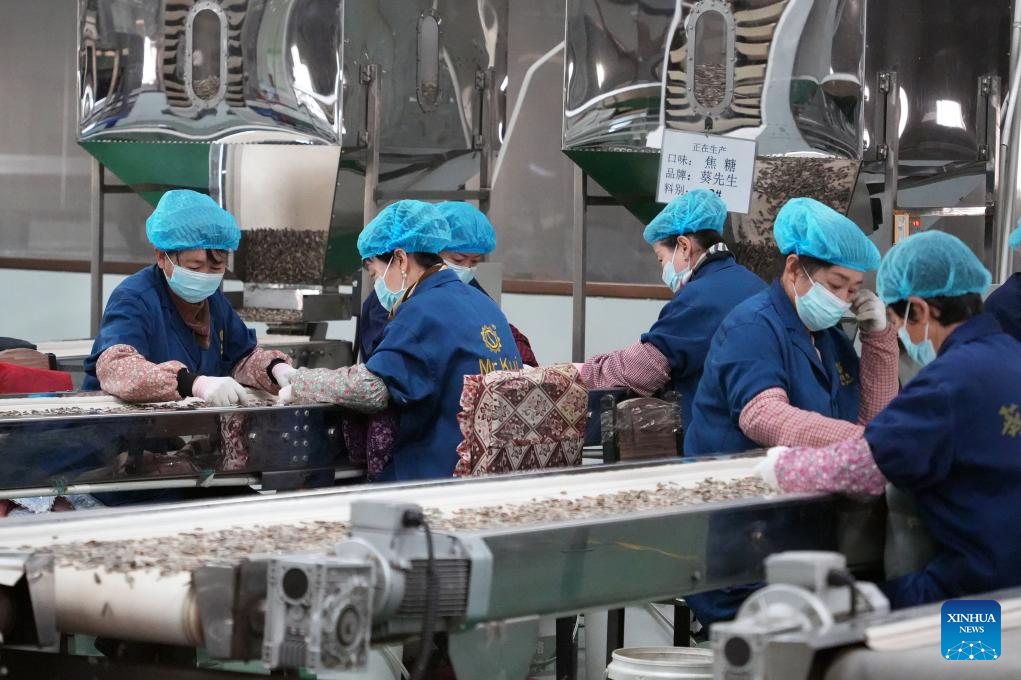
Workers sort sunflower seeds at a humming factory in Linhe District of Bayannur City, north China's Inner Mongolia Autonomous Region, Dec. 27, 2025. (Xinhua/Li Yunping)
HOHHOT, Jan. 15 (Xinhua) -- In a humming factory in north China's Inner Mongolia Autonomous Region, conveyor belts carry plump sunflower seeds through sorting machines, separating them by size and color before sealing them into export-ready bags.
Within days, these seeds will depart from Bayannur, a major agricultural hub in the region, destined for ports, ships and ultimately snack bowls thousands of miles away.
This scene has become routine in the city, where sunflower seeds, once a modest cash crop, are fueling a fast-growing export industry that links rural farmers to consumers across the Middle East, Europe and beyond.
At Le He Foodstuff Co., Ltd., workers are racing to meet peak-season demand. "We are now organizing workers to package and load the products, which are then shipped in batches to Tianjin Port for export to countries such as Türkiye and Egypt," said general manager Bo Le.
He added that the company exports about 60,000 tonnes of sunflower seeds annually, valued at more than 600 million yuan (about 85.64 million U.S. dollars).
At another factory, Inner Mongolia Li Niu Niu Food Technology Co., Ltd. is operating five production lines at full capacity, transforming raw seeds into roasted, packaged snacks. Chairman Li Wen said export orders are already booked through March.
The company's annual export value totals about 500 million yuan, Li said, driven by measures such as the introduction of advanced production lines and the expansion of its product portfolio.
From January to November 2025, Bayannur exported nearly 395,000 tonnes of sunflower seeds, up more than 23 percent from a year earlier. Export value rose nearly 22 percent to 4.55 billion yuan, according to city commerce officials.
Behind the surge is a quiet transformation in customs clearance. Local authorities have swapped out traditional on-site inspections for remote digital checks, making it possible for exporters to apply, get inspected, and clear their goods more efficiently.
"Customs inspections that once took three days can now be finished in two hours," Li said. "That has bought us valuable time to expand into international markets."
Bayannur was once burdened by nearly 4.8 million mu (320,000 hectares) of saline-alkali land, where traditional crops like wheat and corn struggled to thrive. The introduction of sunflowers in the 1970s marked a turning point for the city, which has a permanent population of 1.5 million.
With its distinct seasons, abundant sunshine, vast plains and ample water resources, Bayannur offered an environment strikingly similar to the sunflower's native habitat in North America, making it an ideal location for this resilient crop.
The city produces sunflower seeds renowned for their large size, uniform color and rich taste. In recent years, Bayannur has planted more than 4 million mu of sunflowers annually, accounting for roughly half of China's total edible sunflower acreage.
Sunflowers are the world's fourth-largest oilseed crop, trailing only soybeans, rapeseed and peanuts. In China, they have risen to prominence as a key specialty oilseed crop in northern regions, prized for their high nutritional and aesthetic value.
According to agricultural monitoring data, the sunflower industry's entire value chain in Bayannur generated about 20 billion yuan in output in 2025.
The impact extends far beyond factory walls.
In Xinyi Village, sunflowers have become what locals call a "hardcore crop" -- reliable and highly profitable. Party secretary Cao Zhigang said villagers planted about 15,000 mu last year, mostly with domestically bred varieties. Each mu yields about 250 kilograms, generating net income of more than 1,500 yuan.
The Communist Party of China Central Committee has released its recommendations for formulating the 15th Five-Year Plan for National Economic and Social Development (2026-2030), which emphasize the development of county economies with unique characteristics.
Across China, diverse regions have cultivated industries tailored to their local conditions. For instance, oranges from Ganzhou in Jiangxi Province and strawberries from Dandong in Liaoning Province have emerged as key drivers of social and economic development.
Following a similar approach, Bayannur has attracted a cluster of 120 sunflower processing enterprises to capitalize on market opportunities.
By upgrading foreign trade and building strong brands, Bayannur is pushing sunflower seeds and processed products into more than 40 overseas markets, said Sun Lixin, head of the city's agriculture and animal husbandry bureau. ■
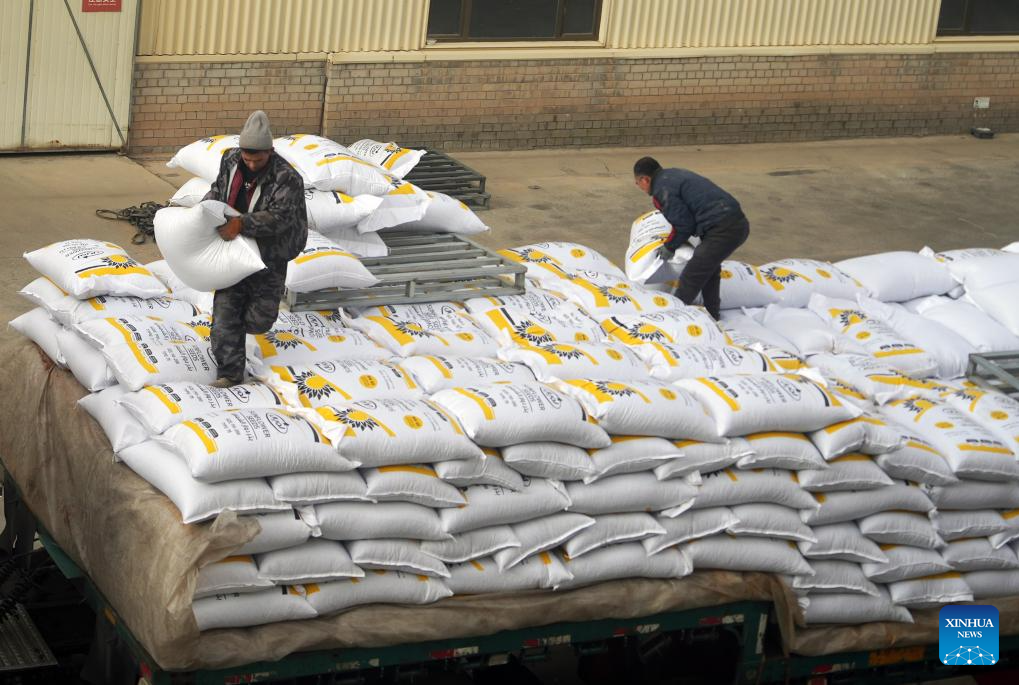
Workers transport bags of sunflower seeds at a humming factory in Linhe District of Bayannur City, north China's Inner Mongolia Autonomous Region, Dec. 27, 2025. (Xinhua/Li Yunping)
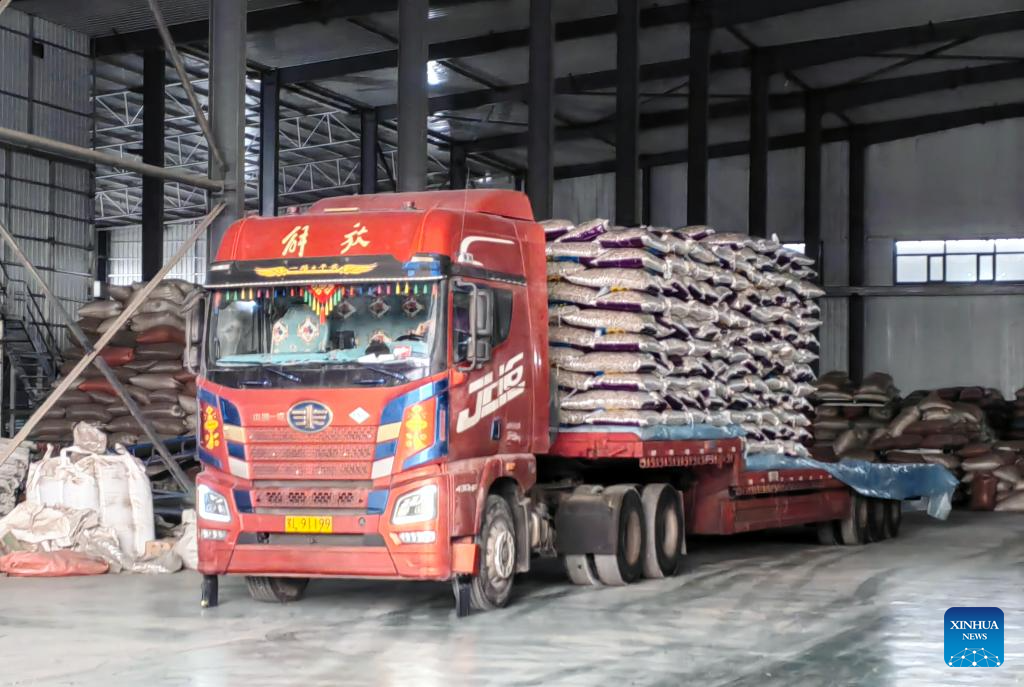
This photo taken on Dec. 22, 2025 shows a truck transporting sunflower seeds at a humming factory in Linhe District of Bayannur City, north China's Inner Mongolia Autonomous Region. (Xinhua/Li Yunping)


