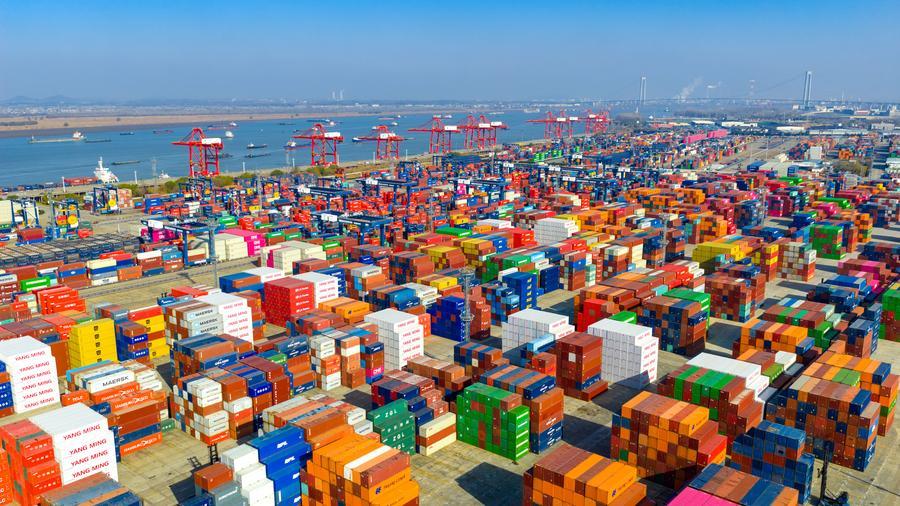
BEIJING, Jan. 15 (Xinhua) -- Over the past five years, China's foreign trade volume has successively surpassed the thresholds of 40 trillion yuan (about 5.71 trillion U.S. dollars) and 45 trillion yuan, hitting 45.47 trillion yuan in 2025. This marks nine consecutive years of foreign trade expansion since 2017, according to customs data.
The country's robust foreign trade performance is far more than just impressive numbers. From high-tech and green product exports to tariff cuts and institutional opening-up, China's foreign trade is translating into more open, win-win and sustainable development opportunities for the world.
China's exports serve as a driver of win-win cooperation, with foreign-invested enterprises standing as key beneficiaries. Customs data indicates that in 2025, foreign-funded enterprises' foreign trade reached 13.27 trillion yuan, growing by 3.7 percent and maintaining expansion for seven consecutive quarters.
Notably, high-tech sectors, including semiconductors and auto parts, constitute the majority of these enterprises' exports. This trend is exemplified by Intel's Chengdu chip factory and Tesla's Shanghai Gigafactory, both of which deliver cutting-edge technologies to global markets.
Analysts believe that this model of manufacturing in China, and selling to global markets allows foreign enterprises to leverage China's complete industrial chain advantages and reap substantial profits. A 2025 KPMG report reveals that 64 percent of multinational enterprises plan to increase investment in China to expand production capacity and enhance local R&D capabilities.
Beyond benefiting businesses, "Made in China" products -- from photovoltaic panels and new energy vehicles (NEVs) to household appliances and consumer electronics -- also meet global market demands with cost efficiency and rapid delivery, easing living costs for consumers worldwide amid inflation.
The impact is confirmed by findings from the Australia China Business Council. A report released by the council shows that without access to Chinese imports, Australian households would have paid 4.2 percent more for the same basket of goods between 2022 and 2023.
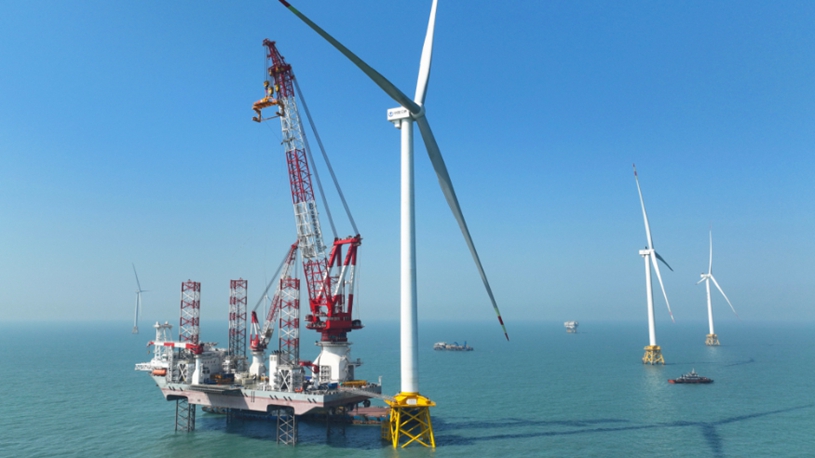
China's exports of NEVs and photovoltaic equipments are driving the global green transition. U.S. academic journal Science in last December named the renewable energy surge as the 2025 Breakthrough of the Year, citing the notable growth of China's renewable technologies with the help of the scale of its economy and manufacturing capacity. Thanks to this, "wind and solar became the cheapest energy in much of the world," the magazine noted.
Despite its strong manufacturing capabilities, China does not pursue trade surpluses but advocates for healthy, mutually beneficial and sustainable international trade, through continued efforts to expand imports over recent years.
In 2025, China's imports hit a historic high of 18.48 trillion yuan, cementing its position as the world's second-largest import market for 17 consecutive years. Notably, Starting from June 2025, imports have maintained year-on-year growth for seven consecutive months, with December imports accelerating by 4.4 percent, according to customs data.
Beyond goods trade, China's service sector stands as another testament to its commitment -- a facet often overlooked. Ministry of Commerce data shows that in the first 11 months of 2025, China's service trade deficit reached 806.35 billion yuan, driven by steady imports of high-quality services to meet domestic demand.
Concrete policy measures are reinforcing China's dedication to expanding imports. To date, China's overall tariff level has been cut to 7.3 percent -- a level nearing the average of developed countries. China continues to offer zero-tariff treatment on 100 percent of tariff lines to all the least developed countries having diplomatic relations with China. Moreover, it is the first major developing country and a major global economy to implement such a unilateral opening-up initiative.
Meanwhile, steady progress has been made in expanding access to foreign markets, aligning with high-standard international economic and trade rules, and advancing institutional opening-up to improve the investment environment and foster mutually beneficial cooperation between China and its trading partners.
Last month, Hainan Free Trade Port, a pivotal gateway for advancing China's high-standard opening-up, officially launched its full-island special customs operation. The move will bring numerous benefits to enterprises operating within the port. Notably, the proportion of tariff-free product lines has surged to 74 percent, now encompassing most production equipment and raw materials.
On the same day, Siemens Energy held a groundbreaking ceremony for its gas turbine assembly base and service center in Danzhou City, Hainan Province. "Hainan FTZ boasts a robust institutional framework, which provides a stable and efficient platform for cooperation and helps Siemens Energy build a full-industry-chain ecosystem," said Joern Schmuecker, senior vice president of Gas Services Central, Siemens Energy.
Commerce Minister Wang Wentao emphasized that during the 15th Five-Year Plan period (2026-2030), China will prioritize the balanced development of imports and exports, vowing measures such as promoting innovative trade development, advancing market diversification, and smoothing the domestic and international dual circulations.
"Not only should we attach importance to exports, but also actively expand imports," Wang said. To achieve this goal, China will foster an internationalized consumption environment, build the "Shop in China" brand, further improve the tax refund policy for departing tourists, and advance the development of international consumption center cities, he added.
As the global economy grapples with lingering uncertainties, China's robust foreign trade remains a beacon of stability. Analysts note that by adhering to high-standard opening-up and win-win cooperation, China is not only consolidating the fundamentals of its foreign trade but also steering global prosperity toward a more inclusive and sustainable future. ■