
KHARTOUM, Jan. 15 (Xinhua) -- As war has reshaped daily life across Sudan in recent years, forcing millions from their homes and hollowing out urban economies, a quieter story has been unfolding far from the front lines--one not only of loss, but of resilience, as young Sudanese turn away from city life and back to the land in search of survival and renewal.
Across farming regions such as Gezira, Kordofan and Gedaref, as well as the outskirts of Khartoum and the Northern State, young people who once worked in offices, schools and construction sites are building new livelihoods in agriculture. What began as a necessity has, for many, become a path toward stability and a modest rural revival.
In Al-Aylafun, on the eastern edge of Khartoum, 35-year-old Mohamed Al-Rayah stands among rows of vegetables on a small family plot of land. A business administration graduate, he once worked for a private company in the capital.
"When work stopped and income disappeared, staying in the city no longer made sense," Al-Rayah told Xinhua. "I returned to land my family had neglected and started growing tomatoes and onions. I had little experience, but I learned quickly."
Farming, he said, helped him regain a sense of purpose and stability. "I'm now able to support my family, sell part of the harvest locally, and provide seasonal work for other young people."
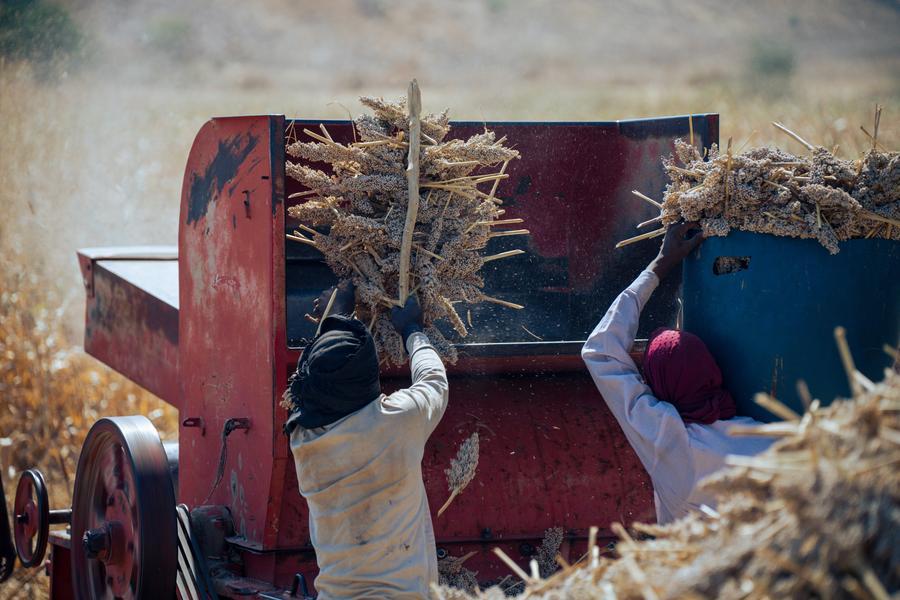
A similar story can be heard in Gedaref State, where 38-year-old Ahmed Yousif left his job as a private-school teacher in Khartoum to return to his village and farm with his father.
"When the schools closed, it felt like my future closed with them," Ahmed said. "Going back to the village and working the land gave me direction again."
The experience, he added, has changed how he views rural life. "We used to see farming as a last option. Now we see it as the foundation of stability. The village feels more alive, and young people are starting to talk about small cooperative projects."
In Sudan's Northern State, where the desert meets the narrow green belt along the Nile, former construction engineer Khalid Abdel-Rahim, 37, has launched a wheat and vegetable farming project using pump irrigation.
"When construction projects stopped, returning to the land was the only real alternative," Abdel-Rahim said, adding, "The challenges are many, but the Nile still offers opportunity."
Though individual in scale, such efforts are beginning to have wider effects -- reviving local markets, creating seasonal jobs and improving food security in communities hit hard by the war.
Observers say the return of young people to agriculture is restoring the importance of rural areas after years of development focused heavily on cities.
Sudanese economic analyst Abdul-Khaliq Mahjoub described the trend as "one of the most realistic responses to an economic crisis worsened by war."
"For decades, rural Sudan was marginalized," he told Xinhua. "The conflict exposed how fragile the urban economy is and how dependent it was on non-productive service sectors."
He added that youth-led farming initiatives help redistribute population, stimulate local economies and strengthen food security -- all essential elements for gradual economic recovery.
Al-Khatim Fadl Al-Mawla, acting Agriculture Minister in Khartoum State, said authorities view these youth projects as "a genuine foundation for sustainable rural development."
Speaking to Xinhua, he said the ministry is supporting farmers by providing improved seeds, agricultural guidance and better access to water, particularly in outlying areas that have absorbed large numbers of returnees from the cities.
"Agriculture is no longer a traditional fallback," the minister said, adding, "It is a tool for stabilizing war-affected communities. Supporting young farmers means supporting stability, reducing displacement and strengthening food security." ■