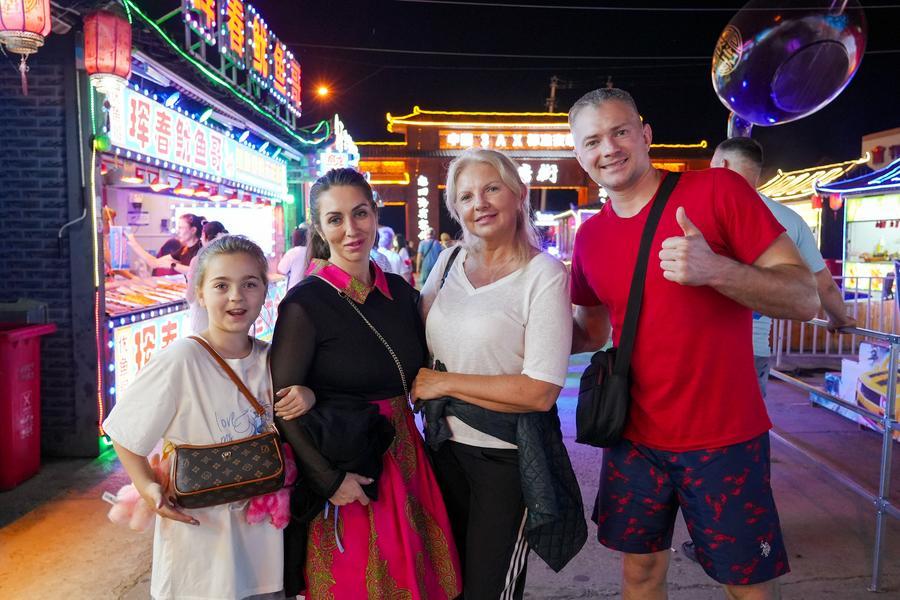
Nowhere is this cross-border dynamism more visible than in Hunchun, a city in Jilin Province that borders China, Russia and the Democratic People's Republic of Korea. Wander its streets and trilingual signs in Chinese, Russian and Korean can be spotted everywhere.
VLADIVOSTOK/CHANGCHUN, Jan. 15 (Xinhua) -- Waiters dash between tables at a Georgian-style restaurant in downtown Vladivostok, greeting Chinese customers amid Russia's ongoing New Year holiday celebrations.
"The number of Chinese customers has gone up noticeably over the past month, especially during the holiday," beamed Karina, a waitress at the restaurant. "Many Chinese tourists are drawn to our distinctive local cuisine."
Just a stone's throw from the eatery, Zhou, a tourist hailing from Beijing, checked into a local hotel with nothing more than his passport and a customs-issued document, kicking off his adventure in this vibrant Russian border city.
"The visa-free policy has made weekend getaways to Vladivostok so much easier. You can just pack up and go on a whim," Zhou said, noting that the entire process was smooth and hassle-free.
In an interview with Xinhua in May 2025, Russian President Vladimir Putin emphasized that tourism is a vital avenue for boosting cooperation.
On Dec. 1, 2025, Putin signed a decree allowing Chinese citizens to enter Russia visa-free for tourism and business trips, with stays of up to 30 days.
Polina, a front desk staff member at a Vladivostok hotel, said that while winter is traditionally the off-season for tourism, the number of Chinese guests has risen sharply since the visa-free policy took effect.
Shortly after the decree was issued, Primorsky Krai, a coastal Russian region bordering northeast China, confirmed that the policy had driven a surge in Chinese tourist arrivals. The region also announced plans to launch its first Far East cruise route this year.
According to Russia's Ministry of Economic Development, the country aims to attract 5.5 million Chinese tourists annually by 2030, including 1.8 million to the Far East, seven times the current figure. Meanwhile, weekly direct flights between the Far East and China are expected to swell from the current 50 to 350.
Across the border in Chinese frontier cities, uniformed border control officers work diligently in arrival halls, assisting Russian tourists as they pass through customs control.
Russian citizens holding ordinary passports have been eligible for visa-free entry to China for stays of up to 30 days since September last year for business, tourism, visiting relatives and friends, exchanges or transit.
Nowhere is this cross-border dynamism more visible than in Hunchun, a city in Jilin Province that borders China, Russia and the Democratic People's Republic of Korea. Wander its streets and trilingual signs in Chinese, Russian and Korean can be spotted everywhere. Foreign visitors meander through shops and restaurants, infusing the city with a distinct international flair.
Home to just over 220,000 residents, this small city is a key hub for China-Russia trade and travel.
"We've definitely noticed a growing interest among Russian tourists in China, with short weekend trips here gaining huge popularity," said Zheng Mingya, deputy head of the first duty team at Hunchun border checkpoint.
As evening falls, Hunchun's Bohai Town, which showcases Tang Dynasty history, is teeming with visitors. Donning traditional Chinese Hanfu has become popular among foreign tourists.
"I feel like I've traveled back to ancient China, like I'm a Chinese princess for a day," said Maria, a visitor from Russia's Siberian Federal District, who is dressed in elegant Hanfu, with flowers tucked in her hair and a silk fan in hand.
Beyond historical reenactments, traditional Chinese medicine, once known primarily for treating illnesses, has now emerged as a major tourism highlight. Inside a local traditional Chinese medicine clinic, the air is thick with the earthy aroma of medicinal herbs. Alexey, a 53-year-old Russian, lies on a treatment couch receiving therapy with smoldering moxa sticks.
Troubled by insomnia and cervical spondylosis, Alexey traveled all the way from Vladivostok for treatment to undergo at least four days of therapy. "Before, my hands and feet were constantly numb. It's incredible not only that my symptoms eased, but my sleep quality has also improved," he said, adding that the visa-free policy has made frequent trips to China a realistic option.
"Every year, thousands of Russian tourists come to us, some even from Moscow and St. Petersburg, to improve their health through traditional Chinese medicine therapies," said Han Shiming, head of the clinic.
According to Maria Kostyuk, governor of Russia's Jewish Autonomous Region, tourism has become a key pillar of bilateral ties. The visa-free policy between China and Russia, she noted, is opening new doors for cultural exchanges.
Elena Vasilyevna, general manager of Vladivostok's Mirabel Travel Agency, said she sees enormous potential for tourism during the upcoming Chinese New Year.
As border cities opened up in recent years, tourism has evolved from simple sightseeing and shopping to more immersive, interactive and culture-focused experiences.
"From deer hunting and winter fishing trips to cruise routes tailored specifically for Chinese tourists, we're rolling out an expanding range of activities to enrich cross-border travel experiences," Elena added.■