
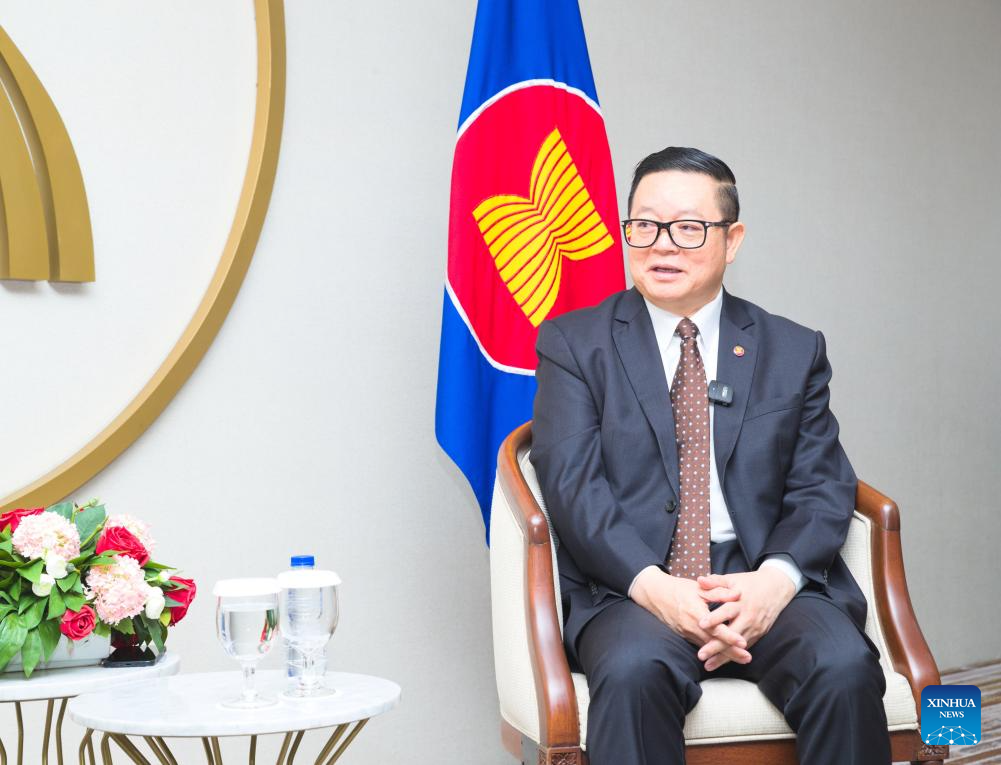
ASEAN Secretary-General Kao Kim Hourn speaks in an exclusive interview with Xinhua in Jakarta, Indonesia, Jan. 12, 2026. (Xinhua/Cen Yunpeng)
JAKARTA, Jan. 14 (Xinhua) -- Despite a complex and evolving global environment over the past year, ASEAN and China have continued to maintain strong cooperation momentum across economic, energy, digital and people-to-people fields, contributing to regional peace, stability and prosperity, said ASEAN Secretary-General Kao Kim Hourn in an exclusive interview with Xinhua.
According to Kao, ASEAN and China have sustained positive momentum under the framework of the Comprehensive Strategic Partnership. Both sides have continued implementing ongoing cooperation initiatives and have adopted the Plan of Action to Implement the ASEAN-China Comprehensive Strategic Partnership (2026-2030), which will serve as a guiding framework for bilateral cooperation in the coming years.
One major milestone, he noted, was the successful signing of the ASEAN-China Free Trade Area (FTA) 3.0 Upgrade Protocol, which was not easy and took a lot of work done by both sides. "We reached another level of cooperation, particularly in economic cooperation."
Kao highlighted that the upgraded ASEAN-China FTA will have a far-reaching impact on bilateral economic cooperation.
"This will have a significant impact on the economic cooperation between the two sides because we will do more in digital trade, digital services, digital payments and e-commerce," he noted.
He emphasized that ASEAN and China are important trading partners to each other, with bilateral trade continuing to grow.
He expressed hope that under the ASEAN-China FTA and the Regional Comprehensive Economic Partnership, both sides would continue to maintain momentum in trade and investment cooperation. "What we want to see is that trade continues to move forward, and that investment is also maintained."
Kao said energy has become "a matter of top priority for ASEAN," highlighting China's growing interest and investment in ASEAN's energy sector, particularly in renewable energy and electric vehicle (EV) production.
"It's good that we are working together in this regard, particularly as more investment moves into the energy sector. This is especially the case with EV production in ASEAN, which will enable more ASEAN citizens to use EVs," he said.
As bilateral cooperation has expanded in many sectors, Kao said no single area defines ASEAN-China relations, but emerging sectors will play an increasingly important role.
"There's no single issue that will define our relationship," he said. "But for the long term, digital economy, artificial intelligence and emerging technologies will be defining the growing relationship between us."
On political and security issues, Kao reaffirmed that ASEAN has been very consistent in its relations and policy towards China, noting that ASEAN's approach and position have been consistent on the one-China policy.
He stressed that ASEAN places great importance on regional peace and stability and has always been a strong proponent of dialogue diplomacy and constructive engagement. "If you read the ASEAN Charter very clearly, ASEAN supports sovereignty and territorial integrity," he said, adding that ASEAN believes its relationship with China contributes to long-term peace and stability in the region.
Kao also highlighted the unique nature of ASEAN-China relations, noting that the two sides are close neighbors, as defined by geography, land and maritime, culture and civilization, and people-to-people connectivity.
Over more than three decades, he noted, the two sides have built cooperation based on mutual respect, mutual understanding and mutual benefit. China was among the earliest partners to establish a free trade area with ASEAN, and the two sides now maintain one of ASEAN's most extensive cooperation mechanisms.
He said China remains one of ASEAN's major sources of tourists, with strong aviation connectivity and frequent two-way people flows. Many Chinese nationals live, work and study in ASEAN countries, while many ASEAN citizens pursue opportunities in China, forming a solid foundation for people-to-people ties.
Looking to the future, Kao said ASEAN will mark its 60th anniversary next year, and people-to-people exchanges are the foundation of lasting ties between ASEAN and China.
"People are the makers and drivers of long-lasting relationships. Our partnership should be defined by peace, by our people and by shared prosperity," he added.
"In a world where global economic and political dynamics are constantly changing, what we need to do is maintain the momentum of positive cooperation," Kao said. "Trust is always the most powerful factor in our relationship, and we must focus on it as the key to our long-term relations." ■
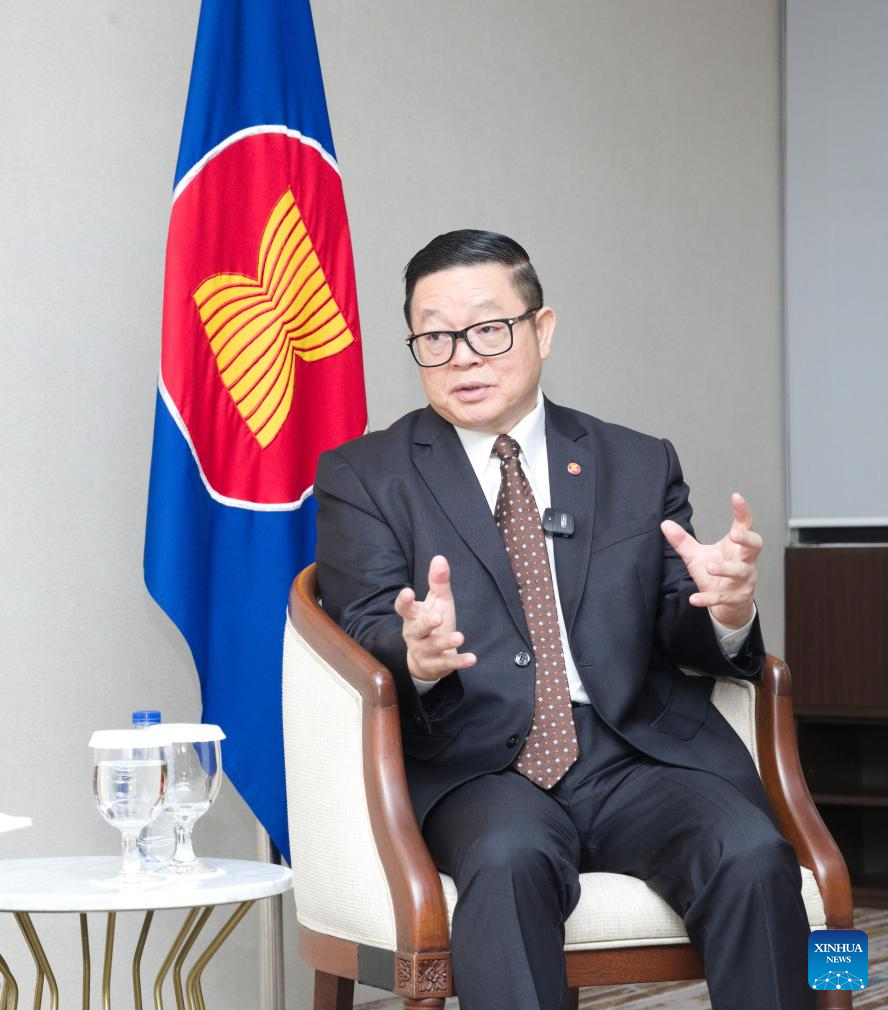
ASEAN Secretary-General Kao Kim Hourn speaks in an exclusive interview with Xinhua in Jakarta, Indonesia, Jan. 12, 2026. (Xinhua/Cen Yunpeng)


