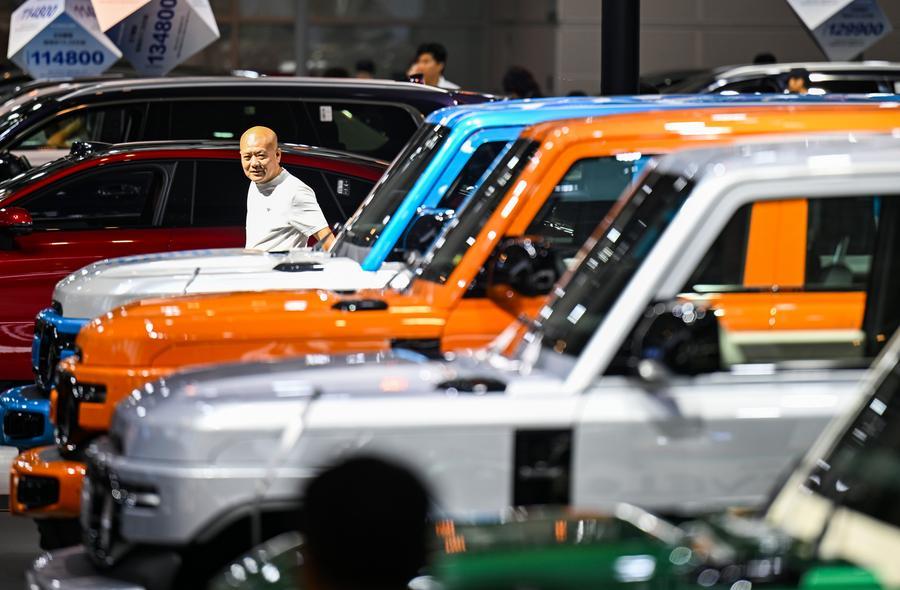
BEIJING, Jan. 14 (Xinhua) -- China's automobile production and sales both exceeded 34 million units last year, setting a new record high, industry data showed on Wednesday, offering new cooperation opportunities and helping to establish a global win-win ecosystem in this sector.
Total auto output reached 34.531 million units last year, up 10.4 percent compared with the 2024 level, while sales rose 9.4 percent year on year to 34.4 million units, according to the China Association of Automobile Manufacturers (CAAM).
China's auto output and sales remained first globally for 17 consecutive years, the association noted. Automobile production and sales have remained above 30 million units for three consecutive years.
New energy vehicles (NEVs) accelerated their growth momentum, with production and sales totaling 16.626 million and 16.49 million units, respectively, marking respective year-on-year increases of 29 percent and 28.2 percent, and maintaining the top position in the world for 11 straight years, the CAAM confirmed.
"China's automotive industry continues to demonstrate strong resilience and vitality, with multiple indicators reaching new highs, marking a successful conclusion to the 14th Five-Year Plan period (2021-2025)," said Chen Shihua, deputy secretary general of the CAAM.
In 2025, with intensified and expanded implementation of the new round of large-scale equipment upgrades and consumer goods trade-in programs, a surge in new product launches by enterprises, and sustained release of user demand, annual automobile production and sales increased more than expected, Chen said.
Last year, the country exported 7.098 million vehicles, surging 21.1 percent year on year, the data showed.
In 2025, automakers paid more attention to expanding overseas markets, leading to continuous enhancement of the international competitiveness of Chinese brands. Joint ventures also achieved strong export performance, according to the CAAM.
WORLDWIDE WIN-WIN ECOSYSTEM
China's export data includes exports from joint ventures operating within the country, which is a showcase for a global win-win ecosystem in this sector, experts noted.
China's auto exports remained resilient in 2025, particularly in new energy vehicles. In 2025, exports of NEVs doubled year on year to 2.615 million units, while exports of traditional fuel vehicles totaled 4.483 million units, down 2 percent year on year.
China's competitiveness stems not from low prices, but from technological innovation and advantages in the industrial chain. This explains why foreign automakers are actively enhancing their investment and cooperation in China, benefiting from technological innovation and sharing the gains, according to experts.
Wang Qing, deputy director of the institute of market economy of the Development Research Center of the State Council, said the global competitiveness of China's automotive industry is concentrated in the comprehensive industrial chain advantages within its NEV sector, spanning from batteries and supply chains to intelligent cockpits.
Experts dismissed so-called "overcapacity" in the NEV sector, saying that from a practical demand perspective, China's production capacity is not "excessive" but insufficient. According to the International Energy Agency, global demand for NEVs is expected to hit 45 million units by 2030, while the demand for power batteries will reach 3,500 GWh -- far exceeding the current global supply capacity.
To meet the market demand, many European and American automobile brands have relocated their supply chains to China for production purposes, and have subsequently exported these products back to their home countries, Sun Xiaohong, secretary general of automotive internationalization professional committee under the China Chamber of Commerce for Import and Export of Machinery and Electronic Products, told Xinhua in an exclusive interview.
Capitalizing on its technological and industrial chain advantages, China is attracting global enterprises, including Tesla, Mercedes-Benz, BMW and Volkswagen, with these enterprises opting to integrate deeply into the development of China's auto production and supply chains, thereby contributing to the building of a stable and efficient global industrial chain.
Volkswagen Group recently inaugurated its first full-process R&D base outside Germany in Anhui, featuring comprehensive testing facilities. This center enables end-to-end development, from software to vehicle validation, slashing new model development cycles in China to 24-30 months.
China's experience is empowering Volkswagen's global growth, noted Ralf Brandstaetter, chairman and CEO of Volkswagen Group China, adding that European development cycles have accelerated from 48 to 30-36 months, driven by insights from China.
BMW China deepened its local AI ecosystem by integrating China's AI startup DeepSeek, while Porsche launched its first strategic overseas R&D center in Shanghai.
Making use of China's supply chain advantage, many foreign automotive companies have long seized cooperation opportunities, according to experts.
Japanese automakers, including Toyota and Honda, have leveraged the Chinese supply chain and cooperation with Guangzhou Automobile Group Co., Ltd. (GAC Group) to achieve growth. It is reported that in 2025, GAC Toyota's annual sales reached 756,000 vehicles, representing a year-on-year increase of 2.4 percent. GAC Honda's sales exceeded 50,000 units in December 2025, marking month-on-month growth of 23.3 percent.
Ford China leveraged the Chinese supply chain to reverse losses and achieved annual profit in 2024 and is expected to have achieved growth in 2025, Sun noted.
Ford China exported nearly 170,000 vehicles in 2024, an increase of over 60 percent year on year, ending seven consecutive years of losses, by introducing new strategies including collaborating with China's industrial chain to develop localized NEVs to accelerate its electrification transformation in China, and expanding Ford China's complete vehicle export business to provide high-quality automotive products to global users, according to a statement on Ford China's official website.
Meanwhile, Chinese automakers are increasing overseas investments, bringing new technologies, business models, and employment opportunities to local markets, and sharing new opportunities and building a mutually beneficial ecosystem, experts noted.
The Sino-German Standardization Cooperation Innovation Center in Frankfurt commenced operations in June 2025, fostering standardized outcomes in smart manufacturing.
Chinese automaker Chery has established a global R&D center network and 16 production bases, deeply integrating into the international market. Its production network spans key markets including Brazil, Iran, and Russia, while actively expanding into Southeast Asia and Europe.
Meanwhile, Chery has also fostered deep integration with local industrial chains, aiming to build an ecosystem that is win-win in nature. For example, the partnership with Spain's EV Motors exemplifies its typical practice of localizing its brand through technology sharing and joint production.
"Localized production overseas, joint ventures with foreign enterprises, and the joint construction of industrial ecosystems have become new models and highlights for Chinese automakers participating in the development of the global automobile industry," said Zhang Yongwei from China EV100, a non-governmental policy research institute. ■