
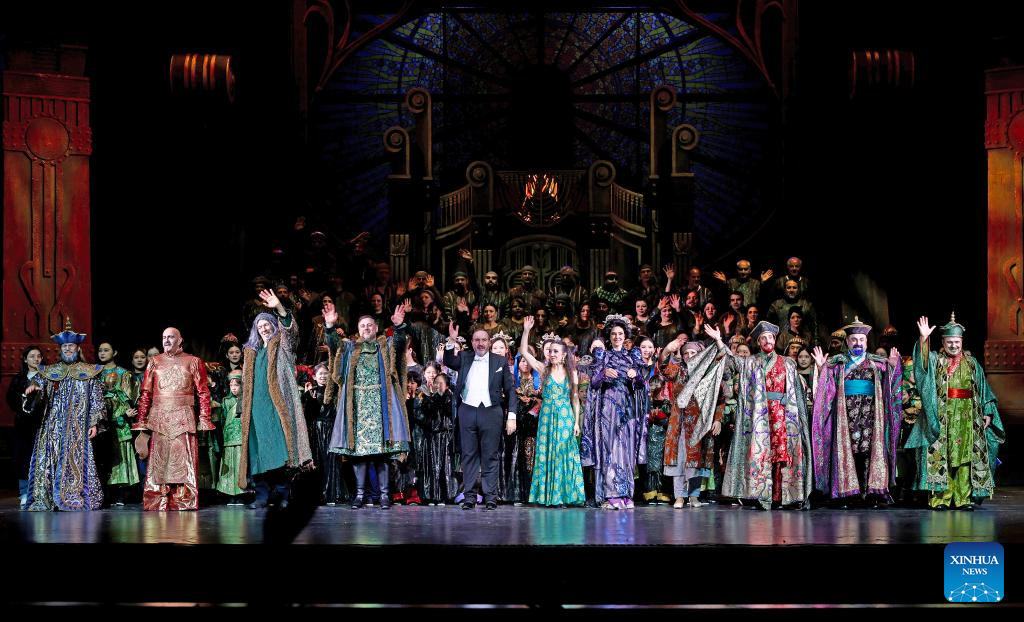
The cast and crew of the opera Turandot acknowledges the audience after the performance at the Chongqing Grand Theatre in southwest China's Chongqing, Jan. 10, 2026. (Xinhua)
CHONGQING, Jan. 12 (Xinhua) -- On Saturday evening, the main auditorium of the Chongqing Grand Theatre in southwest China was at maximum capacity. As a familiar melody rose, a tenor delivered one of Giacomo Puccini's most celebrated arias, Nessun dorma, drawing sustained applause from the audience after the final note.
From Jan. 10 to 11, the classic Italian opera Turandot, produced by the Puccini Festival, was staged for two performances at the Chongqing Grand Theatre. Since the start of the new year, the Italy-born opera, set against a Chinese backdrop, has toured several Chinese cities, including Xiamen, Wuhan and Chongqing, continuing a long-standing tradition of cultural exchange between China and Italy.
Premiered in 1926, Turandot has remained a cornerstone of the global operatic repertoire. By blending the grand traditions of Western opera with his own interpretation of the East, Puccini crafted a work that continues to inspire fresh interpretations across diverse cultural contexts, securing its enduring presence on stages worldwide.
One of the most distinctive elements of Turandot is the recurring use of the Chinese folk song Jasmine Flower. During this year's China tour, the song became even more special when local children joined the Italian performers on stage, turning the familiar melody into a lively celebration of cultural exchange.
In Chongqing, 41 local children formed a choir to perform alongside the Italian artists. One choir member told Xinhua that she had previously sung Jasmine Flower only in Chinese, but for this production, the Italian instructors taught her how to perform the song in Italian. "Singing the same song in a different language felt very special," she said.
Principal conductor Stefano Vignati said that close cooperation with local Chinese dancers, extras and stage technicians was among the most rewarding aspects of the production. "Everyone worked together on the same stage for the same opera," he said. "This is the most authentic charm of opera."
"For more than a century, Turandot has been continuously reinterpreted," the conductor said. "Yet its themes of love, choice, and redemption remain universally understood across cultures."
The city of Chongqing itself also left a strong impression on the Italian cast and crew. Luca Bruno, who played Ping, said he was struck by the city's multi-layered urban landscape, noting that its mountains and rivers reminded him of his hometown, Cosenza.
Andrea Tanzillo, who portrayed Pang, said he was fascinated by how Chongqing blends tradition and modernity, with ancient-style architecture, contemporary buildings and urban life coexisting in harmony throughout the city.
After the performance, many audience members were drawn to an exhibition outside the theatre showcasing more than 20 artworks created by Chongqing middle school students, each illustrating their unique visions of Princess Turandot.
Zheng Yayun, a local middle school student, incorporated elements of traditional Peking Opera costumes into her design of Turandot's attire. "Princess Turandot is strong and resilient," she said. "Her ability to grow and transform through love and trust is something I truly admire."
In recent years, exchanges between Italy and China in the performing arts have continued to deepen, expanding from stage productions into education and youth engagement. For many Italian artists, China has become not only a significant destination for performances, but also a vibrant space for sharing, reimagining, and passing on operatic traditions.
Noting the China tour as his fifth visit to the country, Vignati said: "I hope to return again to introduce Italian opera to more young Chinese artists. I believe such cooperation will continue to bear fruit in the years to come." ■


