
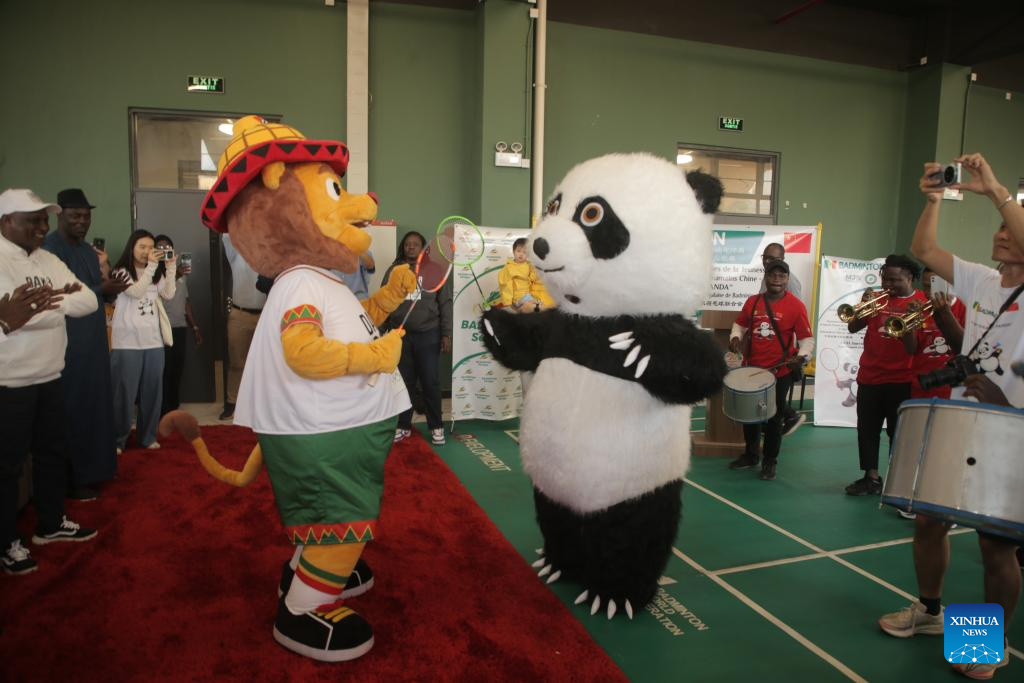
Ayo (front L), the lion mascot of the Dakar 2026 Youth Olympic Games, and a Chinese panda mascot prepared by the Chinese Embassy in Senegal interact during the second "Panda Cup" China-Senegal Badminton Friendship Tournament at the Leopold Sedar Senghor Stadium in Dakar, Senegal, Jan. 11, 2026. (Photo by Aliou Mbaye/Xinhua)
DAKAR, Jan. 11 (Xinhua) -- Cheers erupted at the Leopold Sedar Senghor Stadium as the final rally ended, with one player raising his arms in triumph while his opponent lay on the court in tears. Moments later, laughter spread through the stands when two mascots entered the venue, Ayo, the lion mascot of the Dakar 2026 Youth Olympic Games, and a smiling Chinese panda prepared by the Chinese Embassy in Senegal.
Spectators and players paused to wave, shout and take photos. The brief scene added warmth to the final day of the second "Panda Cup" China-Senegal Badminton Friendship Tournament, which concluded here on Sunday after two days of competition.
The tournament featured both professional and amateur categories, with events ranging from singles and doubles to mixed doubles, has attracted more than 100 players, including around 40 Chinese and 60 Senegalese participants.
Speaking at the event, Li Zhigang, Chinese ambassador to Senegal, said the tournament went beyond competition. "Sport is a universal language," he said. "Through events like the Panda Cup, young people from China and Senegal meet, compete and build friendship naturally. This is a vivid example of people-to-people exchange at the opening of the China-Africa Year of People-to-People Exchanges."
Ibrahima Wade, general coordinator of the 2026 Youth Olympic Games organizing committee, said the tournament offers young athletes valuable opportunities to compete, learn and interact. "It helps improve performance, but also strengthen our capacity to organize events and develop badminton sustainably in Senegal," he added.
From the perspective of the sport's governing body, Antoine Jean Joseph Diandy, president of the Senegalese Badminton Federation, emphasized the importance of long-term cooperation. "Badminton is increasingly becoming a concrete vehicle for sports exchange and practical cooperation between Senegal and China," Diandy said. "Our goal is to raise competitive standards, at the same time to build high-quality badminton facilities in Dakar and expand participation across the country."
On court, the men's singles final in the professional category showcased that progress. 16-year-old Moussa Sow, who won the title, said the victory was hard-earned. "Winning a tournament like this is not easy," Sow said. "I faced very strong opponents, and I had to stay focused to avoid technical mistakes."
He also pointed to the impact of his previous training in China. "We had qualified Chinese coaches," he said. "They taught us a lot, especially through repetition of basic technical movements. That really helped me improve."
Runner-up Cheikh Ahmadou Bamba Diagne, 14, said the defeat was painful but instructive. "I was very nervous, and that's why I lost the final," he said. "But next time it will be better." Also referring to his training experience in China, he added, "We learned many new things there, and with that experience, I want to win a medal at Dakar 2026."
Referee Edmond Bassene described the tournament as competitive and well organized, noting the commitment of the players and the enthusiasm of the audience. "We are seeing real progress in badminton in Senegal," he said.
Organizers also arranged mixed China-Senegal doubles exhibition matches, a showcase involving Senegalese para-athletes, and interactive badminton activities for children from both countries. ■


