
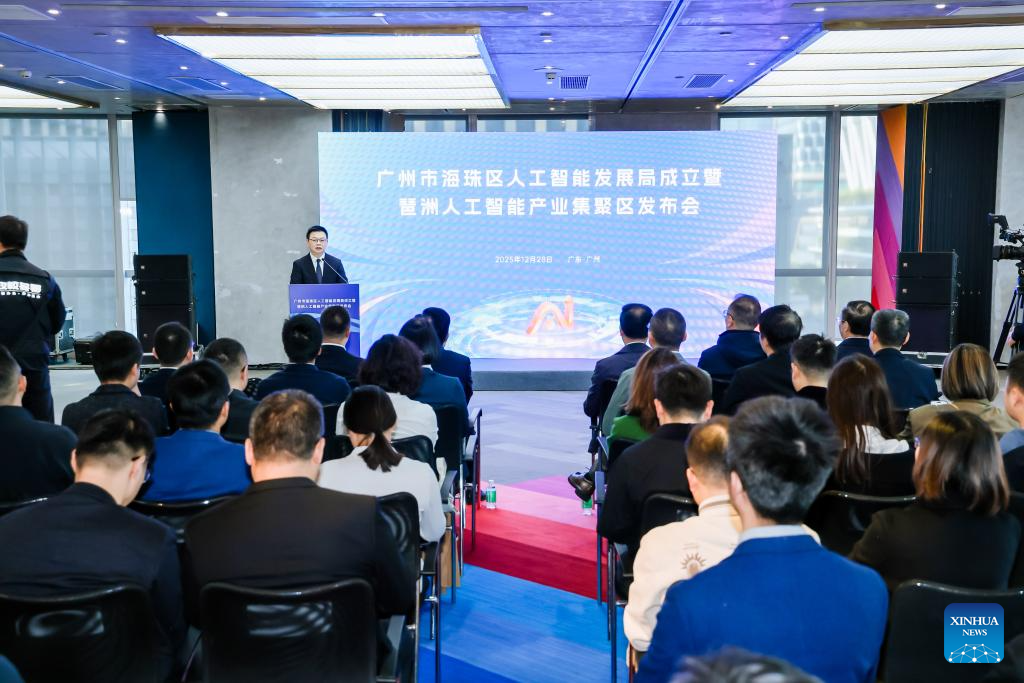
A press conference on the inauguration of the AI development bureau is held in Haizhu District of Guangzhou, south China's Guangdong Province, Dec. 28, 2025.(Xinhua)
GUANGZHOU, Dec. 31 (Xinhua) -- Several local governments in China have recently established artificial intelligence (AI) development bureaus, which are specialized agencies to coordinate and advance the development of AI, accelerating the formation of new business forms in the intelligent economy.
On Sunday, the AI development bureau was inaugurated in Haizhu District of Guangzhou, the capital of south China's Guangdong Province. It is the first district-level government department in China established independently as a functional entity specifically focused on AI development.
"Establishing the bureau and assigning dedicated personnel will help address potential challenges in the AI industry, such as fragmented management, scattered resources and a lack of strategic coordination," said Yu Lihui, a representative of the newly established bureau.
According to Yu, the bureau will plan the integration of cutting-edge AI technologies proactively, and work to attract and nurture leading enterprises, as well as specialized, innovative companies that master core technologies. Additionally, given the crucial role of scenario innovation in industrial and technological advancement, the district plans to introduce high-value application scenarios in such fields as fashion design, the low-altitude economy and intelligent connected vehicles.
Haizhu District has solid foundations for AI development. Pazhou -- one of the three major AI industry clusters planned by the Guangdong provincial government -- is located within Haizhu.
The district has attracted nearly 8,000 AI-related enterprises, launched over 200 large-scale AI model and algorithm projects, and driven rapid growth in the district's next-generation information technology services for three consecutive years.
ZJTECH, a leading internet platform in the textiles and apparel industry, is actively developing AI applications for the sector in Haizhu, driving digitalization within the supply chain. Clients can now match fabrics in thousands of categories accurately within two minutes, and with a single click, they can generate fashion designs that meet market demand using AI models.
The South China Brain-Computer Interface Technology Co., which is also based in Haizhu, has developed a brain-computer AI mouse that allows paralyzed patients to control a virtual mouse without using their hands. The technology enables people to browse short videos, use computer tablets, and more.
On Sunday, Haizhu also unveiled the Pazhou space intelligent computing center plan, with the first phase of the center expected to establish a 100-petaflop-scale computing cluster to provide a foundation for enterprise innovation and R&D.
Space computing is a technological innovation that deploys computing capacity to satellites in orbit, enabling data processing and collaborative computing through satellites and onboard intelligent hardware.
"The establishment of the Haizhu AI development bureau underscores the government's commitment to the AI industry. It is expected that the new bureau will explore innovative solutions in industrial ecosystem development and institutional reform," said Zhang Yaqin, founding dean of the Institute for AI Industry Research at Tsinghua University.
The Chinese government has placed significant emphasis on AI development. In August 2025, the State Council released a document on the deep implementation of the "AI Plus" initiative, outlining plans for China to lead the deep integration of AI with six key sectors by 2027. By 2030, AI is expected to fully empower China's high-quality development, with the adoption rate of new-generation intelligent terminals and other AI-driven applications exceeding 90 percent.
Local governments are also taking advantage of these opportunities by launching dedicated AI departments to foster the growth of the industry. Wenzhou City in Zhejiang Province, for example, took the lead in establishing a municipal AI bureau in September 2025. The bureau is responsible for formulating and implementing the city's AI development plans, and for coordinating the construction of citywide infrastructure related to computing power, data and algorithms.
On Dec. 9, the municipal AI development bureau was inaugurated in the city of Zhuhai, Guangdong. The city has been vigorously advancing its "cloud intelligent city" strategy and the new bureau will work closely with AI enterprises, opening up high-value application scenarios and planning policies to support intelligent transformation across all sectors.
Qiu Weiming, deputy secretary-general of the Asia-Pacific Artificial Intelligence Association, said dedicated AI bureaus in local governments are able to coordinate and integrate resources, implement AI development policies, foster AI industry ecosystems and promote sustainable industry growth.
Furthermore, as an emerging field, AI faces challenges related to safety, ethics and privacy. Establishing dedicated bureaus will help address these issues and ensure the steady, sustainable development of the industry, Qiu added. ■
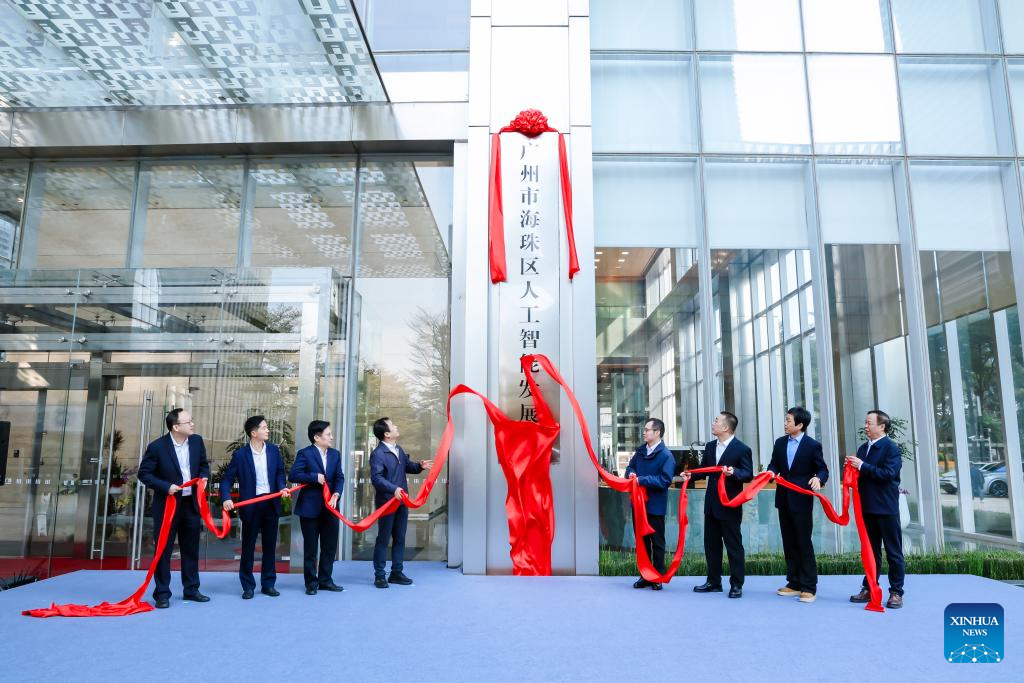
The AI development bureau is inaugurated in Haizhu District of Guangzhou, south China's Guangdong Province, Dec. 28, 2025.(Xinhua)


