
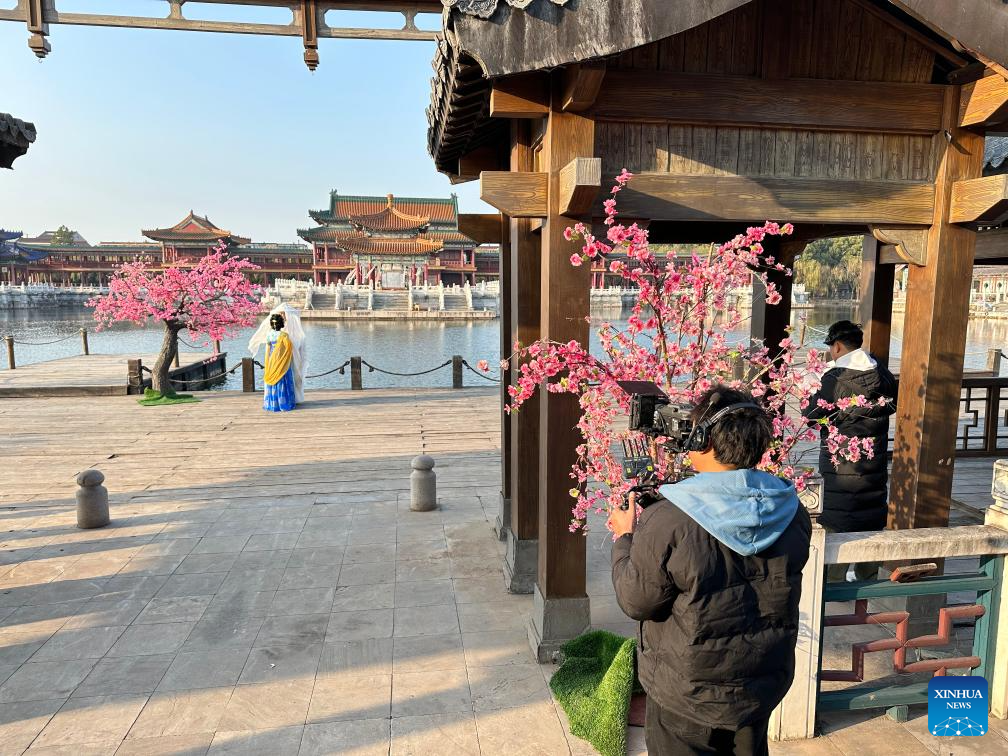
Crew of a micro-short drama shoot at Hengdian World Studio in Dongyang, east China's Zhejiang Province, Dec. 25, 2025. (Xinhua/Liu Ziyi)
HANGZHOU, Dec. 28 (Xinhua) -- What is a filmmaker to do when they need to film epic battles for a budget micro-short drama, but they have few actors and even less time? This is a worry of the past, with artificial intelligence (AI) now capable of summoning entire armies of digital performers.
This was a recent experience for post-production technician Zhang Shiyu. "Especially with the leap in AI large language models this year, the process has become smoother, more precise and strikingly efficient. What used to take me long days to create, AI can deliver in mere minutes with even greater continuity and realism," said Zhang, who works for Dongyang Gewuzhizhi Culture Media.
AI-generated high-quality visuals are seamlessly integrated into the editing pipeline. Through techniques like precise texture mapping, AI-enabled visual effects blend virtual elements with live-action footage, delivering realistic and visually striking results.
Zhang is not the only one at the company using AI to streamline micro-short drama production. "AI plays a crucial role in every step of post-production," said its chairman, Lu Caijian.
Hengdian World Studios -- often referred to as "China's Hollywood" -- is where the company is located, and it now has a solid industrial chain. "This year, we have prioritized integrating technology with film and television, powering the industry's growth," said Lu Pingping, deputy director of the Hengdian Film and Television Cultural Industry Development Service Center.
Lu noted that in one example, tech services firm Dongyang Yuanying Technology Co. established operations in Hengdian in October and has since participated in the production of over 20 short dramas.
Lin Ju, Yuanying's operations manager, noted that AI is currently being used to create grand scenes, science fiction and fantasy genres, and to add special effects to footage that has already been shot.
For companies like Yuanying, which is in the process of developing an original series, the next challenge is finding and shaping winning stories. This is where the role of AI is expanding upstream into scriptwriting and project evaluation.
According to a report from the China Society of Motion Picture and Television Engineers, AI is reshaping the industry's workflow everywhere from scriptwriting to marketing. Its influence transcends the role of a mere tool, actively redefining creative practices, industry structures and cultural values.
"AI significantly enhances production efficiency. But more importantly, AI is expanding the boundaries of visual expression. It is likely to give rise to entirely new cinematic styles and narrative methods that are unimaginable today," said Li Zhenlin, dean of the College of Film at the Shanghai Theatre Academy.
Some companies have even developed their own large language models to increase proficiency. Hangzhou-based Chinese media company Huace Group, for example, has developed an in-house AI model for script summarization, evaluation and creation.
Huace's resources -- which include 50,000 hours of film, television copyright assets, and data accumulated over 30 years, such as scripts, evaluation reports and industry data -- are the core training data for the model.
It can produce rapid preliminary evaluations of novels of up to 1.2 million words. Tasks that previously took a human team 10 to 14 days can be completed by AI in just one or two hours. Combining AI screening and manual assessment, overall efficiency has increased by over 50 percent.
"The model helps efficiently identify suitable projects during the initial stages, and inspires creators by optimizing scripts," said Fu Binxing, president of Huace Group, noting that the company is refining the model's accuracy, which has reached about 90 percent, and enhancing the tool by following industry trends and expanding genre coverage.
"AI is not meant to replace humans. It has altered certain production processes, but in the short term, the core of creation is still people," Lin said. "What matters is the ability to harness AI. Screenwriters still need to control the visual language and final presentation of each shot."
"For new directors, AI lowers the barriers to entry into the industry. They can use AI tools to translate their creative vision into visual presentations for investors and potential collaborators. Innovation is at the heart of filmmaking. By delegating routine assistant-like tasks to AI, people can be free to focus on true innovation," Fu said.
As AI dramatically increases the accessibility of creation and accelerates content output, protecting intellectual property with AI has become a parallel frontier. In response, the industry is deploying AI as a guardian.
This year, Hengdian launched an AI-powered monitoring system that automates the entire process of identifying and collecting evidence of copyright infringement online, effectively addressing the long-standing challenges of low efficiency and limited coverage in manual monitoring.
East China's Jiangxi Province has established its first agency to protect the copyright of micro-short dramas by using AI to safeguard creation and distribution. From its establishment in 2024 to May this year, the agency had resolved eight infringement cases, recovering tens of millions of yuan in losses. ■
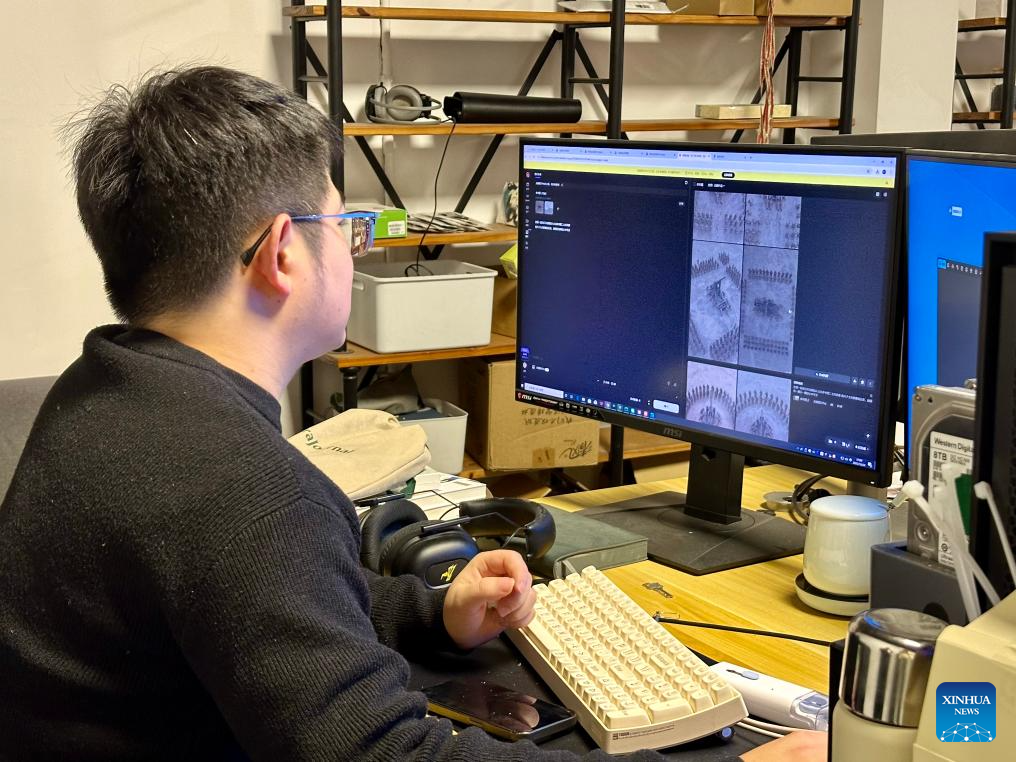
Post-production technician Zhang Shiyu works at Dongyang Gewuzhizhi Culture Media in Dongyang, east China's Zhejiang Province, Dec. 24, 2025. (Xinhua/Liu Ziyi)


