
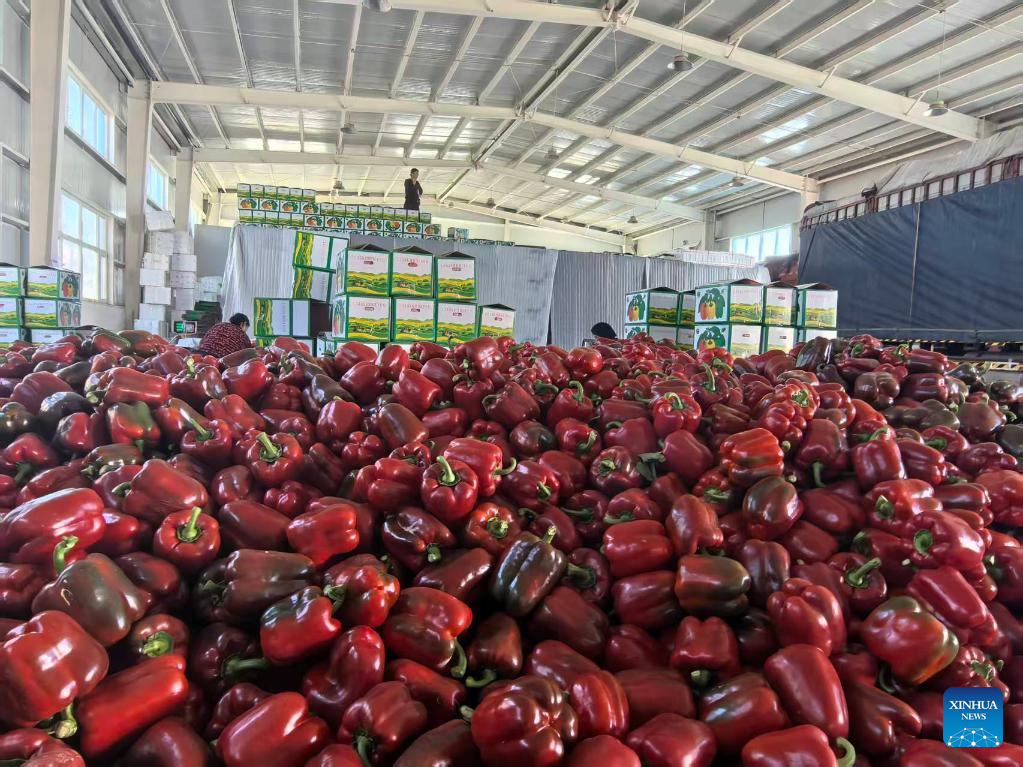
Harvested bell peppers to be exported to Kazakhstan are seen in Fengzhuang Village, Zhongwei City, northwest China's Ningxia Hui Autonomous Region, Nov. 27, 2025. (Xinhua)
YINCHUAN, Dec. 26 (Xinhua) -- Truck driver Tewekkul Tur recently completed another routine delivery to Bishkek, the capital of Kyrgyzstan. His refrigerated vehicle carried over 20 tonnes of fresh vegetables, including leeks, eggplants, celery, peppers and spinach, from an export base in Kashgar, in northwest China's Xinjiang Uygur Autonomous Region.
The Kashgar facility, with nearly 3,000 greenhouses, sends over half of its output to Central Asian countries like Kyrgyzstan and Uzbekistan. Its deliveries are part of a growing trade trend: fresh vegetables from northwestern China are becoming increasingly popular in Central Asian markets, due to improving geographical proximity and trade facilitation.
"From January to October this year, our company exported 24,599 tonnes of fruits and vegetables in 1,183 truckloads, with a total value exceeding 140 million yuan (about 20 million U.S. dollars)," said Peng Yongjian, a manager at the Kashgar Jiangnan Agricultural and Sideline Products Wholesale Market Co., Ltd.
"We operate on a distribution model and supply directly to local supermarkets and stores. Shipments can depart in the morning and arrive by evening so that local residents can quickly enjoy fresh Chinese vegetables," Peng added.
This vegetable corridor extends beyond Xinjiang, China's gateway to Central Asia. Across the broader northwestern region, high-quality agricultural products are reaching Central Asian dining tables in growing volumes, thanks to increasingly efficient international logistics and steadily improving trade policies.
In Fengzhuang Village, Zhongwei City, northwest China's Ningxia Hui Autonomous Region, a truck laden with 22 tonnes of bell peppers recently embarked on a long journey north.
"The 'bell pepper express' starts from Zhongwei City, travels through the Horgos Port, and heads to Kazakhstan," explained Shang Jinhua, general manager of Ningxia Zhonghui Agricultural Technology Co., Ltd. "The entire trip takes about 70 hours before these peppers arrive at wholesale markets in Almaty." So far this year, his company has exported over 1,000 tonnes of bell peppers to Kazakhstan and Kyrgyzstan, valued at more than 12 million yuan.
Despite its inland location, Ningxia boasts abundant sunlight, a cool climate, and significant daily temperature variation. These conditions yield cold-climate vegetables with fewer pests, lower pesticide residue, and superior quality, making the region a prime vegetable production zone.
Government policies are accelerating this export drive, with measures rolled out to support agricultural exports, including tax incentives, quality control, brand building and financial services. Customs authorities have streamlined procedures at ports, facilitating faster and smoother passage for perishable goods.
The enhanced efficiency directly supports the growth of related industries. "This year, we have exported 107 tonnes of cold-climate vegetables in 22 shipments via direct flights from Yinchuan to Dubai," said Wei Xinmin, chairman of Ningxia Xing Yun Tian Modern Agricultural Development Co., Ltd. "From our facility to stores and restaurants in Dubai, the fastest delivery takes just 36 hours."
With fruits and vegetables relatively scarce in Dubai, Chinese exporters see significant potential. "Seven Arab countries, including Saudi Arabia and Oman, are in talks with us about importing vegetables," Wei added.
Customs data for Ningxia reflects this momentum. In the first ten months of the year, the region's export value reached 12.78 billion yuan, a 7.2 percent year-on-year increase. Exports of cold-climate vegetables surged 65.4 percent, while exports of beef and lamb showed strong growth of 44.4 percent.
Back in Zhongwei City, the bell pepper industry is scaling up. The Shapotou district has expanded demonstration planting to 1,000 greenhouses. Local authorities are providing targeted support for seedlings, fertilizers, technical services, and export packaging. This initiative is helping to create an integrated system for large-scale cultivation, standardized production, and strong sales.
"We operate under an integrated model that connects our company with agricultural cooperatives and local farmers through purchase orders. This approach involves over 800 villagers in bell pepper cultivation," Shang said.
At the district's bell pepper service center, farmers arrive with their harvest. Shang noted that Shapotou peppers are prized in Kazakhstan for their firmness, durability during transportation, and good taste.
The district has certified 530 mu (about 35 hectares) of vegetable bases for export and implemented a comprehensive quality traceability system to align with international standards. "We aim to build a green, organic production base, establish a long-term mechanism for export orders in facility agriculture, and help more high-quality products reach global markets," said Ding Zhijun, head of Shapotou district.
As trade links strengthen, the journey from greenhouses in northwest China to international markets is becoming shorter, ensuring that fresh, quality vegetables continue to speed onto tables across Central Asia and beyond. ■
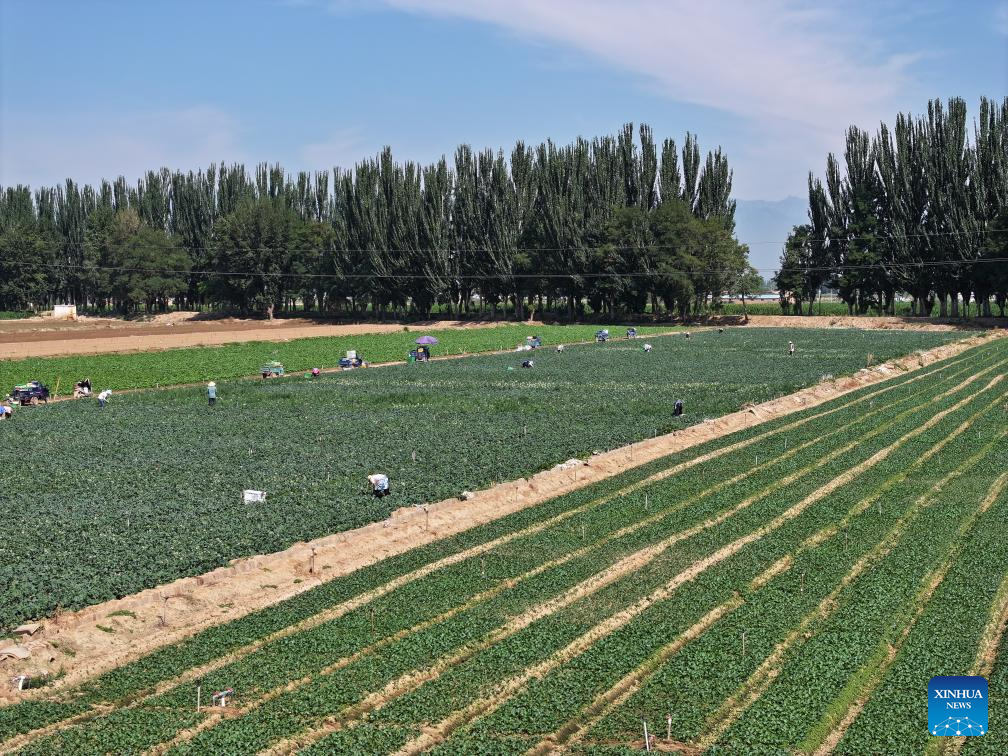
A plantation for cold-climate vegetables is pictured in Changxin Township of Helan County, Yinchuan City, northwest China's Ningxia Hui Autonomous Region, July 4, 2024. TO GO WITH "Across China: China's fresh produce finds favor in Central Asian market" (Xinhua/Liu Hai)
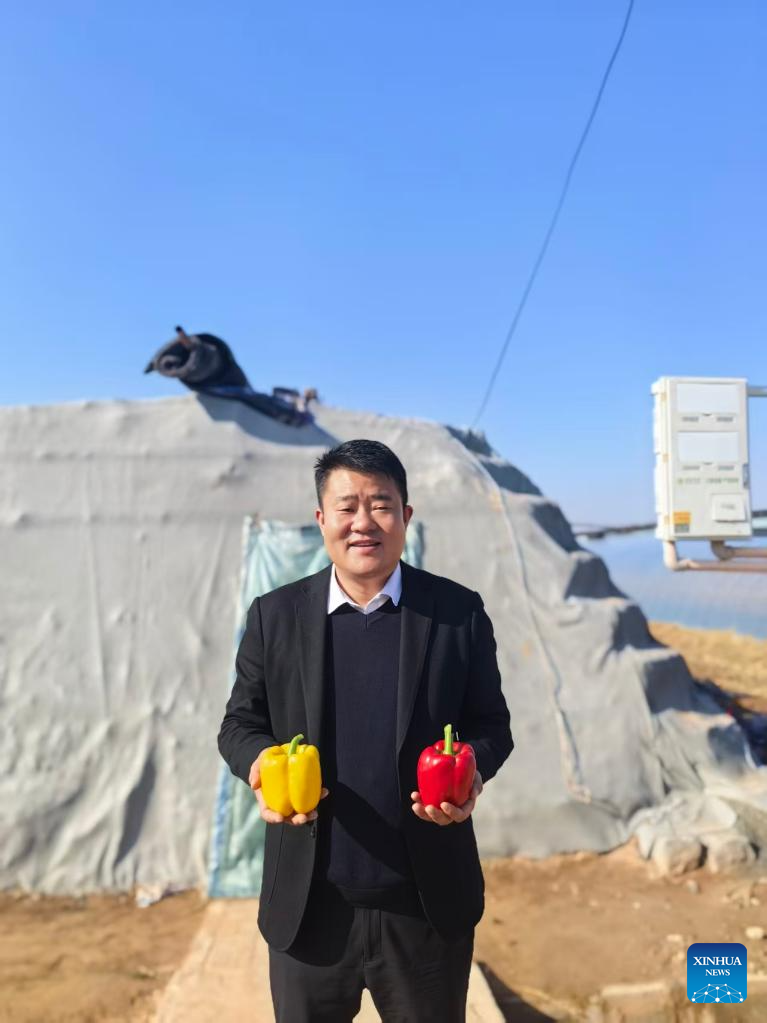
Shang Jinhua, general manager of Ningxia Zhonghui Agricultural Technology Co., Ltd., displays bell peppers at a plantation in Fengzhuang Village, Zhongwei City, northwest China's Ningxia Hui Autonomous Region, Nov. 27, 2025. TO GO WITH "Across China: China's fresh produce finds favor in Central Asian market" (Xinhua)


