
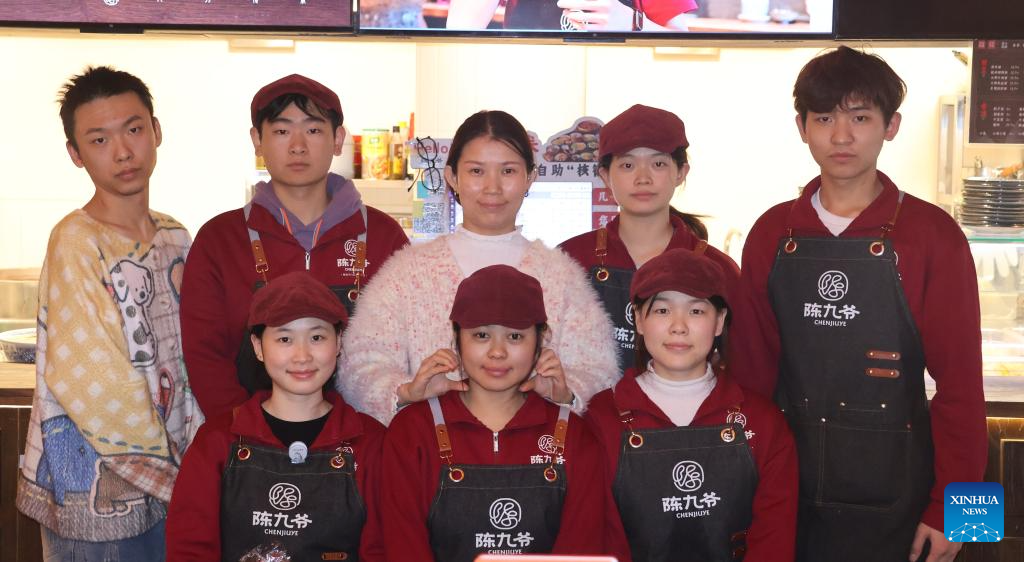
Staff members of Chenjiuye noodle shop pose for a group photo at the shop in Zhengzhou, central China's Henan Province, Dec. 11, 2025. (Xinhua/Wang Qianhui)
ZHENGZHOU, Dec. 25 (Xinhua) -- Each day at 9:30 a.m., the kitchen of Chenjiuye noodle shop slowly comes to life. Zhonghang and his girlfriend are the first to arrive. He unlocks the door, dons his apron and chef's hat before gathering kitchen utensils from the storage cabinet -- a small, familiar ritual that marks the start of another day.
Zhonghang is one of the eight employees -- all suffering from hearing impairment -- who are entrusted with running this nicely decorated neighborhood noodle shop in Zhengzhou, central China's Henan Province. Here, a small step by this 19-year-old into the world beyond silence ignites greater hopes for the community of tens of millions of hearing-impaired people in China.
By 11:00 a.m., the first customers enter -- a group of young women, greeted not with a shouted welcome but with hearty smiles from the waiting staff. "We come here often. It feels cozy, and we love it here," says one to the reporter, calling it their "secret sanctuary."
The noodle shop now attracts a mix of regulars and newcomers, along with an increasing number of visitors drawn to the heartwarming stories that accompany each bowl of steaming noodle soup.
By noon, the restaurant is bustling, packed during every rush hour since its opening on June 27.
A customer steps up to the counter and asks, "Hello! How do I order?" The employee behind the counter smiles, points to her ear, and gestures with her hands. "Oh," the customer replies, instinctively lowering his voice.
For newcomers, the moment might feel puzzling at first, but it doesn't take long to understand: communication here takes a different form.
Communication here is both minimal and effective. A gesture, a smile, and a tap on the shoulder all convey the message perfectly. Meanwhile, modern tools, including QR codes for scanning menus, vibrating call bracelets for service, and speech-to-text apps on tablets, ensure that staff and their customers communicate without barriers.
Still, rush hour brings its own set of challenges. Meimei, the head staff member, shares in sign language, "Some first-time customers may sit and wait for about 15 minutes, repeatedly calling out for service. Since we can't hear, we don't respond, which can frustrate them. But once they realize we are deaf, most of them apologize."
"As hearing-impaired individuals, we worry about disappointing our customers, so we make up for it by providing exceptional service or offering a free drink," she adds, emphasizing their commitment to customer satisfaction.
As a token of goodwill, each guest receives three small cups of tea upon being seated and handwritten cards with uplifting messages, penned by the staff. For female diners, a single stem rose often serves as a silent gift, earning heartfelt "thank yous" in signed responses from touched customers.
QR code ordering is now the norm across Chinese restaurants. Yet in this noodle shop, the modern convenience truly plays an empowering role. They enabled the hearing-impaired to work with autonomy, even in a service role that demands constant interaction, opening a door for this community to a world beyond silence.
Zhonghang cherishes this job opportunity enormously. At age 19, his journey has already taken him through multiple jobs: factory worker, hair salon assistant, bakery apprentice and dishwasher. "It's tough for us to find suitable work. I often struggle to think of what jobs I could do," he gestures. "Then I saw the hiring ads for the noodle shop on social media and felt it was the right fit."
After discovering that the entire staff was hearing-impaired, he encouraged his once-isolated girlfriend, who also has a hearing impairment, to join him, helping her engage more with society. "I have plans to start my own business one day. I think entrepreneurship is a great path. I want to marry my girlfriend," he shares with a hopeful but shy smile.
The vision for this unique space comes from Jin Xing, the brand founder. "China has 27.8 million people with hearing impairments -- one in every 50 people. When I heard this statistic, I was shocked," he says.
However, the idea of running a restaurant staffed entirely by hearing-impaired people faced skepticism. Jin recalls that some initially worried about customers' tolerance. Those doubts quickly faded as the shop experienced commercial success, reporting daily revenues exceeding 5,000 yuan (about 710.3 U.S. dollars).
The noodle shop has proven that its "all-hearing-impaired crew" model works wonderfully with customers. "This shop is just one template, and I hope to replicate it," Jin says.
On the lifestyle-sharing platform, Xiaohongshu, many have shared their experiences with Chenjiuye noodle shop, some pledging their support and asking for the address. One blogger named "Yudaguanren" recalls, "I only went there for a quick lunch, unaware of what made this place special. It wasn't until I noticed the staff that I understood. Even though we were communicating silently, the service was great. I felt a bit inexplicably emotional and wanted to cry."
However, the shop manager, Li Liya, is adamant about not capitalizing on people's sympathy. "What we sell is noodles, not sympathy," he stresses. The philosophy is evident. Aside from the staff's aprons, which feature the gentle instruction "If needed, please tap me," there are no obvious signs indicating the shop's uniqueness.
On a wall near the kitchen, a small blackboard is filled with sticky notes from guests: "It was just a regular rainy day when I came for a meal and received a flower... I was so surprised and happy." "Thank you for the warmth of this bowl of noodles." "The food was delicious, and the flower was lovely. Thank you!"
At 10:30 p.m., the last lights are switched off, and the door is locked. Under a skyline of countless glowing windows, the staff head home. ■
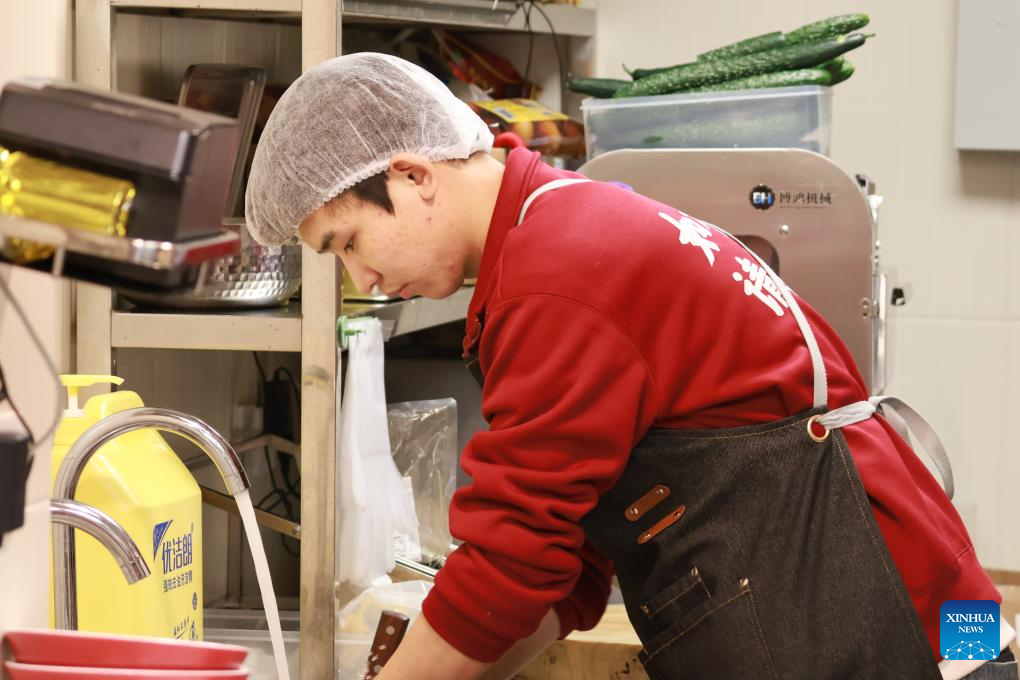
Zhonghang, chef of Chenjiuye noodle shop, works at the kitchen of the shop in Zhengzhou, central China's Henan Province, Dec. 11, 2025. (Xinhua/Wang Qianhui)


