
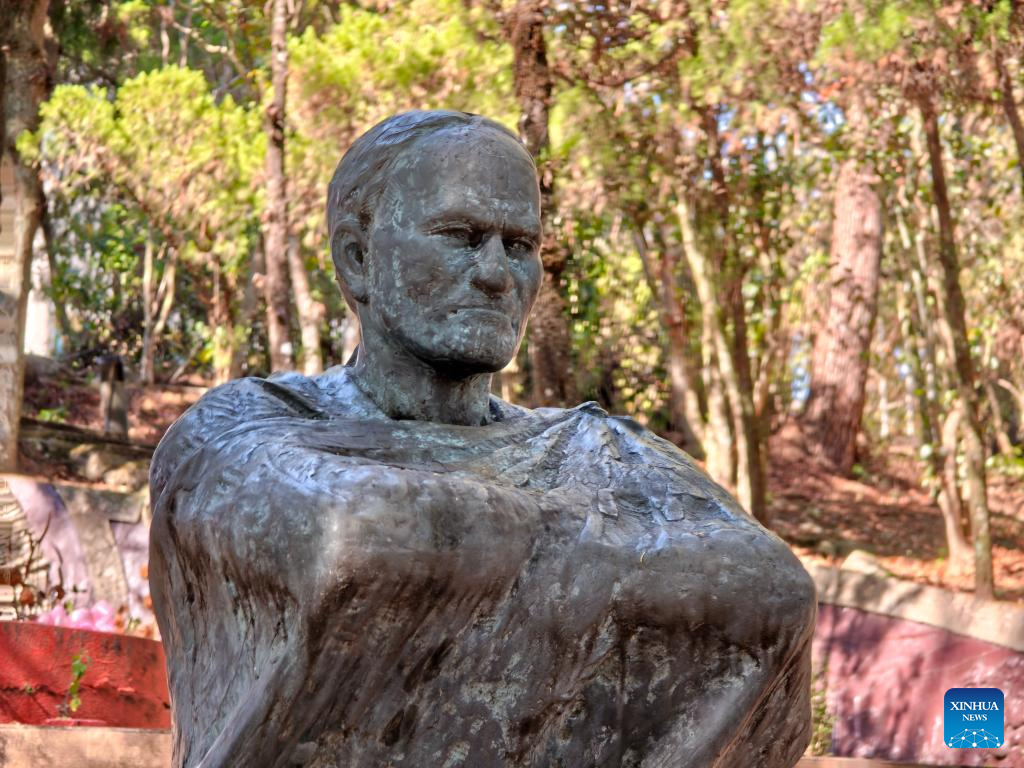
This photo taken with a mobile phone on Dec. 8, 2025 shows a statue of Mona Rudao in a memorial park in Nantou County, southeast China's Taiwan. (Xinhua/Wang Chenghao)
TAIPEI, Dec. 13 (Xinhua) -- About an hour's drive southeast of Taichung, a major city in Taiwan's central-west, deep into the mountains lies the Qingliu Tribe, a quiet home of about 600 Seediq ethnic people carrying a heroic yet tragic family memory.
The story of their legendary ancestors has been depicted in numerous literary and media works. Among the most widely recognized is the film "Seediq Bale," directed by Wei Te-sheng, which premiered in Taiwan in 2011 and is being re-released on the mainland on Friday and Saturday.
In 1930, after more than three decades of Japanese colonial rule in Taiwan, members of six villages, belonging to a branch of the Seediq ethnic people, killed more than 100 Japanese people in an uprising in Wushe -- now part of Nantou County -- following longtime harsh governance and discriminatory treatment by the colonial authorities.
They were swiftly and brutally suppressed, with Japanese forces deploying artillery and poison gas. In 1931, the survivors of the six villages were forcibly relocated to what is now Qingliu, dozens of kilometers from Wushe, and merged into one. They never returned to their ancestral lands.
The uprising, later known as the Wushe Incident, was one of the most thrilling and heartbreaking events in more than 100 resistance uprisings against the Japanese colonial rule by ethnic minority people in Taiwan between 1895 and 1930.
The film "Seediq Bale" originally screened in Taiwan in two parts, totaling 276 minutes, while its mainland release in 2012 was a single, edited 153-minute version. The re-release this time, however, will present both parts separately over the two days.
"It's a good thing that more people from the mainland can get to know these stories, which remain resonant (today)," said 61-year-old Mahung Pawan, a member of the Qingliu Tribe.
Her mother, a descendant of the Wushe survivors, was adopted by the daughter of the widely known anti-Japanese hero Mona Rudao, who led the fight in Wushe and is also the central figure in "Seediq Bale."
"The words 'Seediq Bale' mean 'real human' -- a real human would not likely be able to carry on living under such humiliation," she said. "We would rather fight on a path of no return than live like that -- at least we would be worthy of our ancestors."
Under Japanese colonial rule, Seediq communities in Wushe were forced to abandon their customs and surrender the shotguns and ammunition they had relied on for generations for hunting. Men were turned into laborers for the Japanese, while many women were married to Japanese policemen and later abandoned.
"There was so-called voluntary labor for transporting timber, and it was painful for our people. They were used to carrying loads on their backs, not on their shoulders," said 74-year-old local resident Takun Walis, who is also a descendant of the Wushe survivors.
As a deterrent to those they called "savages," the colonists took ethnic minority community leaders to Japan to visit the military facilities and view modern weapons. As a village chief, Mona Rudao was among them. Upon returning, he told his people that Japan had more soldiers than "pebbles in the Zhuoshui River and leaves in the forest."
"But his resolve to fight was stronger than Mount Qilai," Mahung said. On the other hand, she insists that her great-grandfather, who took his own life in the uprising rather than be captured, should not be seen as the sole hero.
"Mona Rudao could never have carried out the uprising alone -- it was all the villagers with him," she said. "Every family here has its own memories -- and sorrow -- from the events."
Mahung began to pick up those memories after appearing in "Seediq Bale" as one of the many amateur actors recruited for the film. She returned to Qingliu from Taipei, where she had lived for years, to collect the tribe's stories and pass them on to younger generations.
"The film certainly helped promote our (history), but our next generation cannot learn about their past solely from a movie. Many things can only be interpreted by us, and we need to sort out our own history," she said.
She began to listen more closely to her parents' stories and interview other elderly residents. It turned out that the wounds had left a lasting, muted pain within the community. Many elderly residents were still reluctant to speak about it, fearing the colonists even years after Japan's surrender.
"Some elderly residents just told me that the Japanese said they would come back," Mahung said.
Today, the painful stories are no longer taboo for the younger generation in Qingliu. Mahung now runs a Seediq cultural experience hub in the village to introduce their traditional culture. For the past decade, she has shared them with local children, as well as visitors from various regions and countries, including Japan.
Many of the residents in Qingliu have received higher education and worked as civil servants. "We don't dwell on the trauma; instead, we find a way through the tragedy and carry on," said Mahung.
"But at the same time, the Wushe Incident should always remain a warning to people today," she stressed.
The community holds several memorial events each year to honor the ancestors who fought against Japanese colonial rule, including on the anniversary of the Wushe Incident's outbreak. A memorial building has also been established in the community to introduce the Wushe Incident and the life of Seediq people under Japanese rule.
However, the building is currently closed to the public due to a lack of funding for maintenance and repairs, according to Takun Walis.
"Many people have now forgotten how their ancestors were killed during the Japanese colonial rule in Taiwan, and remember only the infrastructure the Japanese left behind," Takun said.
Taiwan's Democratic Progressive Party authorities are widely regarded as pro-Japan. On Aug. 15 this year, the 80th anniversary of Japan's unconditional surrender in World War II, the island's leader Lai Ching-te posted on social media, referring to the day as "the memorial day for the end of the war," a term used by the Japanese government.
Takun, who returned to his hometown after university and then worked for local authorities for decades, has written a prayer for his ancestors that is printed on a panel inside the memorial building, which can now only be read with a cellphone flashlight in the powerless room.
"Beloved Mona and all our elders, the feats you accomplished are beyond what words can fully describe... No matter how the Japanese imperial authorities humiliated our people at the time, you struck back through our ancestral code," the prayer reads. "We will keep your honorable deeds forever in our hearts and pass them on to generations to come." ■
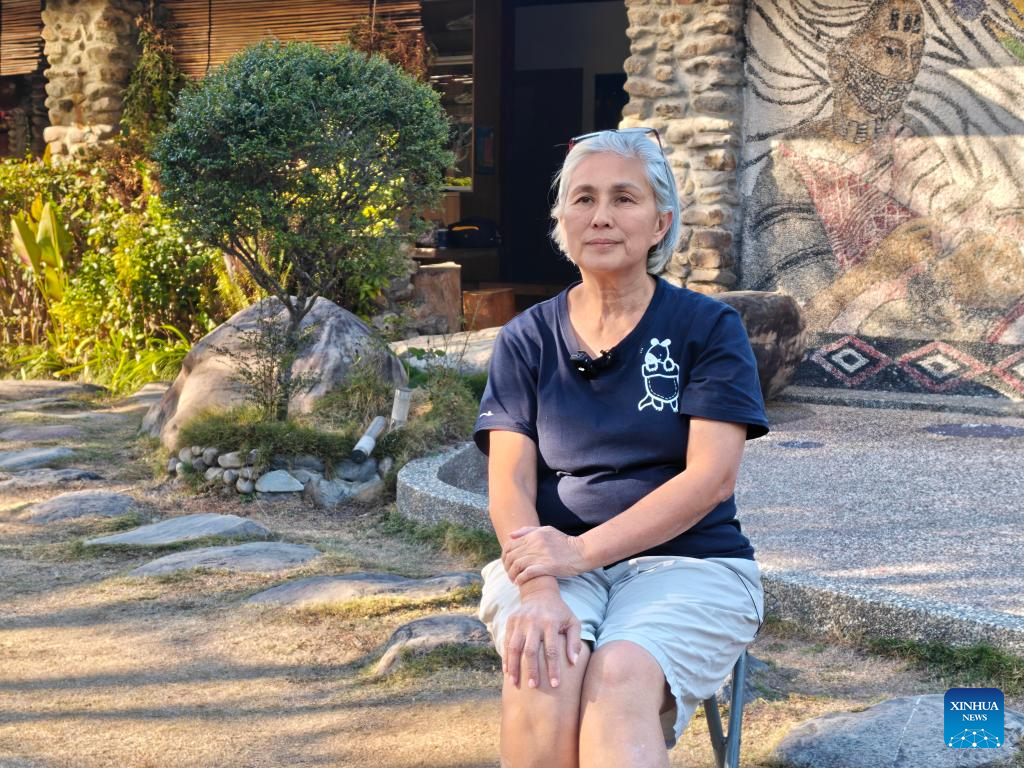
This photo taken with a mobile phone shows Mahung Pawan speaking in an interview with Xinhua in Nantou County, southeast China's Taiwan, Dec. 8, 2025. (Xinhua/Wang Chenghao)


