

People shop at a local market in Ankara, Türkiye, on Jan. 22, 2026. Türkiye's central bank cut its benchmark interest rate by 100 basis points to 37 percent on Thursday, continuing a gradual cycle of easing as inflation shows signs of cooling. The move marks the fifth reduction since last summer, signaling a cautious shift away from the tight monetary policy previously used to curb soaring prices. (Mustafa Kaya/Handout via Xinhua)
ANKARA, Dec. 11 (Xinhua) -- Türkiye's central bank on Thursday made its last interest rate decision of the year, reducing the policy rate by 150 basis points, wrapping up a year marked by shifting economic pressures and a gradual decline in inflation.
The bank's Monetary Policy Committee (MPC) lowered the one-week repo rate to 38 percent from 39.5 percent, matching market predictions. The repo rate, or repurchase rate, is the rate at which central banks lend to commercial banks.
It was the fourth rate cut since the summer, when the bank cautiously transitioned from tight policy to a slow easing cycle.
Analysts said the decision fits the pattern of the past several months. "The latest inflation data strengthened the bank's hand," Senol Babuscu, finance professor at Baskent University, told Xinhua.
"Markets view this step as broadly appropriate. But with inflation still above 30 percent, higher than most countries, policymakers cannot afford to move too fast," he pointed out.
The analyst added that many households and firms affected by the cost of living still face high borrowing and cost pressures despite the improving headline figures.
Istanbul-based economist Atilla Yesilada agreed that the bank is trying to balance support for the economy with its disinflation mandate.
"A 150-basis-point cut is a signal of confidence without risking the progress made so far," he said.
With consumer prices gradually easing, the central bank determined that moderate monetary easing could now help stimulate economic activity, particularly as domestic demand remains subdued, preventing demand-side inflationary pressures, according to both economists.
At the same time, the bank emphasized that it remains alert to risks associated with food, energy and administered prices, and noted that further easing will depend on incoming data in the early months of 2026.
"The tight monetary policy stance, which will be maintained until price stability is achieved, will strengthen the disinflation process through demand, exchange rate, and expectation channels," the bank said in a statement.
At the start of the year, Türkiye's annual inflation remained above 40 percent, elevated but significantly below the peak of over 75 percent reached in mid-2024.
The central bank began the year with a firm anti-inflation stance, maintaining tight financial conditions to solidify earlier improvements.
In spring, annual price increases began to moderate as inflation softened and domestic demand indicators showed signs of easing.
By early summer, underlying metrics showed more convincing progress. Annual inflation eased toward the low-40 percent range, and core indicators also improved.
These trends prompted the first rate cut of the year in July, followed by additional reductions in September and October.
The bank's latest adjustment followed new figures showing that annual consumer inflation dropped to around 31 percent in November, the lowest rate in nearly four years.
Softer food prices and weaker goods inflation contributed to the decline, offering policymakers the flexibility to act in either direction.
Despite the progress, some economists argue that Türkiye's medium-term inflation targets, 16 percent for the end of 2026 and 9 percent for 2027, remain ambitious. They suggest that the 2026 target may need to be revised due to persistent price rigidity.
"For the end of next year, it would be best to revise the 16 percent target to a range of 22-26 percent," Hakan Kara, an economist and scholar at Ankara's Bilkent University, said on his X account following the latest MPC rate decision. ■
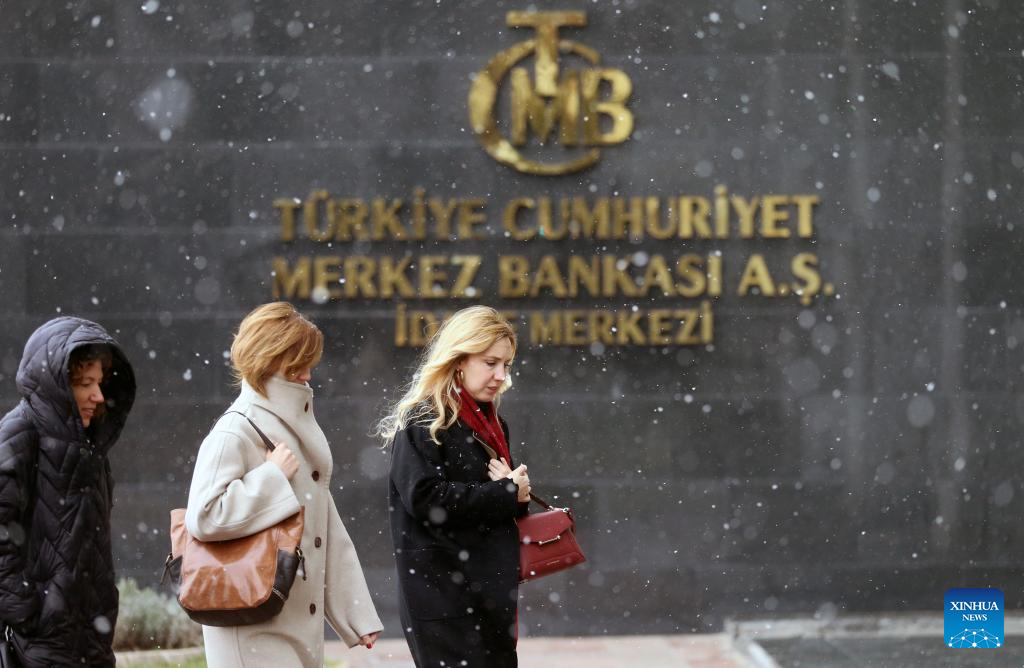
People walk past the Turkish central bank in Ankara, Türkiye, on Jan. 22, 2026. Türkiye's central bank cut its benchmark interest rate by 100 basis points to 37 percent on Thursday, continuing a gradual cycle of easing as inflation shows signs of cooling.
The move marks the fifth reduction since last summer, signaling a cautious shift away from the tight monetary policy previously used to curb soaring prices. (Mustafa Kaya/Handout via Xinhua)


