
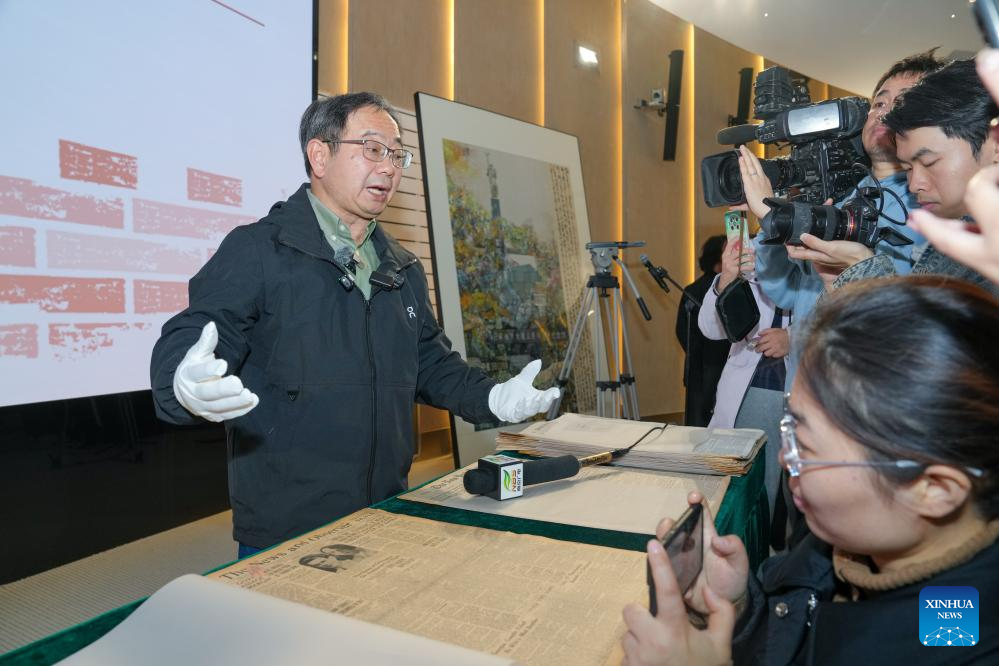
Nanjing-born Chinese-American Lu Zhaoning introduces artifacts and historical materials at a press briefing held by the Memorial Hall of the Victims in Nanjing Massacre by Japanese Invaders in Nanjing, east China's Jiangsu Province, Dec. 5, 2025. (Xinhua/Li Bo)
NANJING, Dec. 5 (Xinhua) -- A memorial hall in east China dedicated to the victims of the Nanjing Massacre on Friday said that it has collected 573 artifacts or sets of artifacts and historical materials this year, providing new evidence of war crimes related to the massacre that was perpetrated by invading Japanese troops during World War II.
Among the new items is a four-page letter written in pencil and dated Jan. 8, 1938, from a Japanese soldier, who described killings in Nanjing in chillingly casual terms, the Memorial Hall of the Victims in Nanjing Massacre by Japanese Invaders said at a press briefing.
In the letter to his father, the soldier recounted what he called a "very interesting" execution pier in Nanjing, where the invading Japanese troops killed defeated or wounded Chinese soldiers with knives and guns each day and then dumped all the bodies into the Yangtze River.
The memorial hall said it had collected the letter from a Japanese researcher.
Ai Delin, director of the memorial hall's cultural heritage department, said that staff had checked and confirmed the sender's identity, military unit, home address and death record, confirming the letter's authenticity.
Wang Weixing, a researcher at the Jiangsu Academy of Social Sciences, said the soldier's lighthearted tone when discussing the killings and disposal of bodies revealed how some Japanese troops had considered the massacre a pleasurable experience, which reflects the invaders' complete loss of humanity.
Nanjing-born Chinese-American Lu Zhaoning has made many donations to the memorial hall, including a batch of important historical materials donated this year.
They include the U.S. newspaper The News & Observer published on Dec. 18, 1937, which carried an Associated Press report on mass killings after Japan captured Nanjing, as well as the French newspaper Excelsior published on Dec. 8, 1937, which reported that the city had a population of 1 million before it fell.
The French newspaper's report echoes the testimony of American surgeon Robert Wilson before the International Military Tribunal for the Far East in Tokyo after the surrender of Japan and delivers a forceful rebuttal to erroneous statements from Japanese right-wing forces, said Zhang Sheng, head of the Research Society of the History of Nanjing Massacre by Japanese Invaders.
Wilson testified that Nanjing had a population of about one million before the war, but the population decreased sharply to less than 500,000 after Japan's occupation, Zhang said.
"Japan's right-wing forces have long denied the massacre by claiming that Nanjing's population had been under 300,000," said Zhang.
Other notable items include files on a military doctor killed during the city's resistance, a group of photos showing Nanjing after it was occupied by Japanese troops, a U.S. magazine featuring four photos documenting Japanese atrocities, and another letter written by a Japanese soldier.
The Nanjing Massacre took place when Japanese troops captured the then-Chinese capital on Dec. 13, 1937. Over six weeks, they killed approximately 300,000 Chinese civilians and unarmed soldiers in one of the most barbaric episodes of World War II. ■
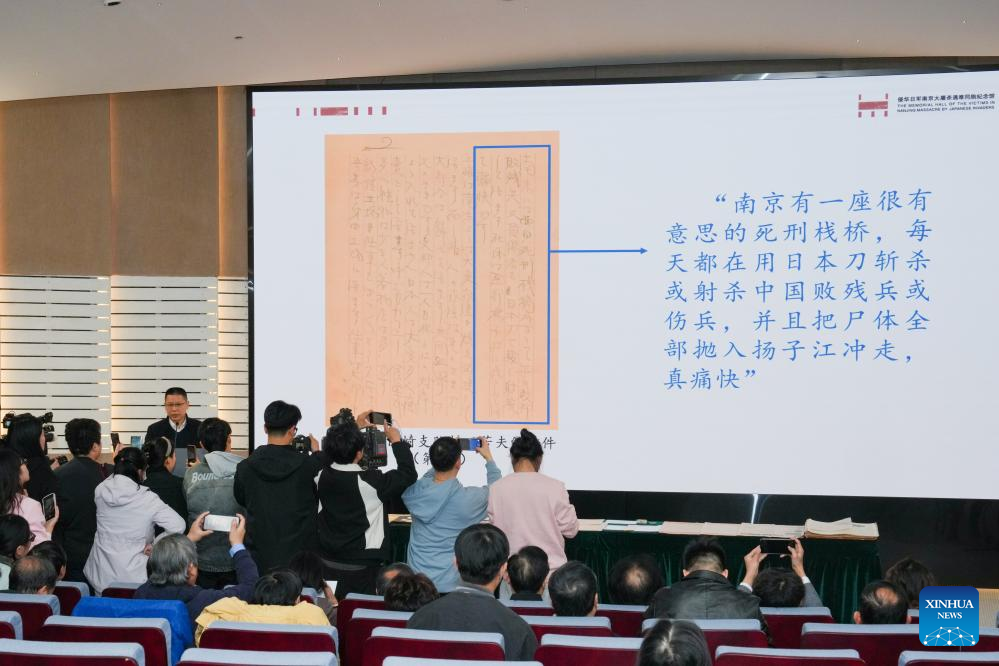
A staff member introduces artifacts and historical materials collected in 2025 at a press briefing held by the Memorial Hall of the Victims in Nanjing Massacre by Japanese Invaders in Nanjing, east China's Jiangsu Province, Dec. 5, 2025. (Xinhua/Li Bo)
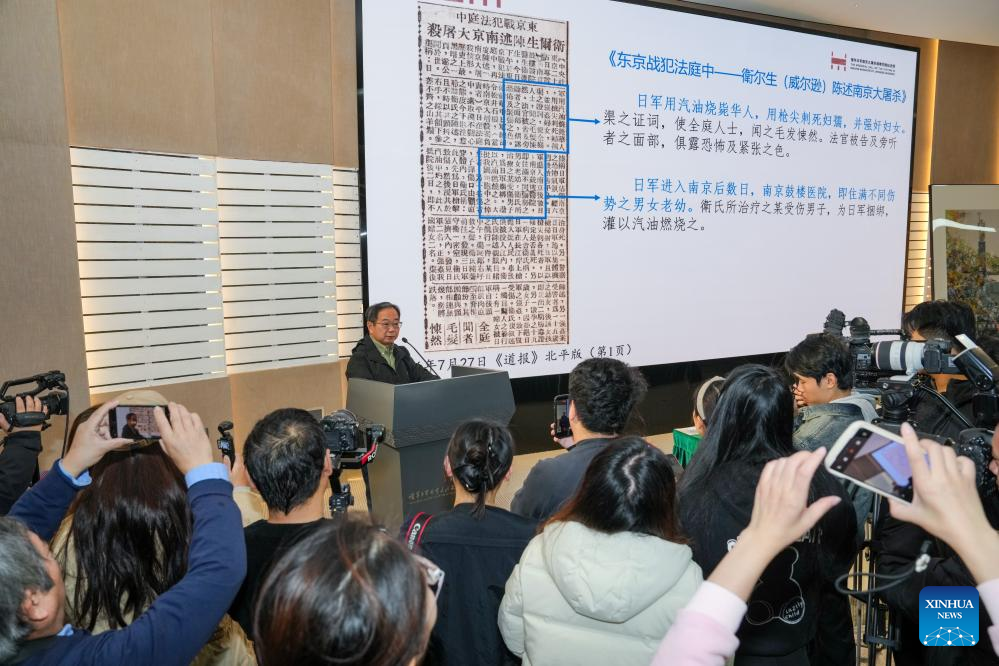
Nanjing-born Chinese-American Lu Zhaoning introduces artifacts and historical materials at a press briefing held by the Memorial Hall of the Victims in Nanjing Massacre by Japanese Invaders in Nanjing, east China's Jiangsu Province, Dec. 5, 2025. (Xinhua/Li Bo)


