
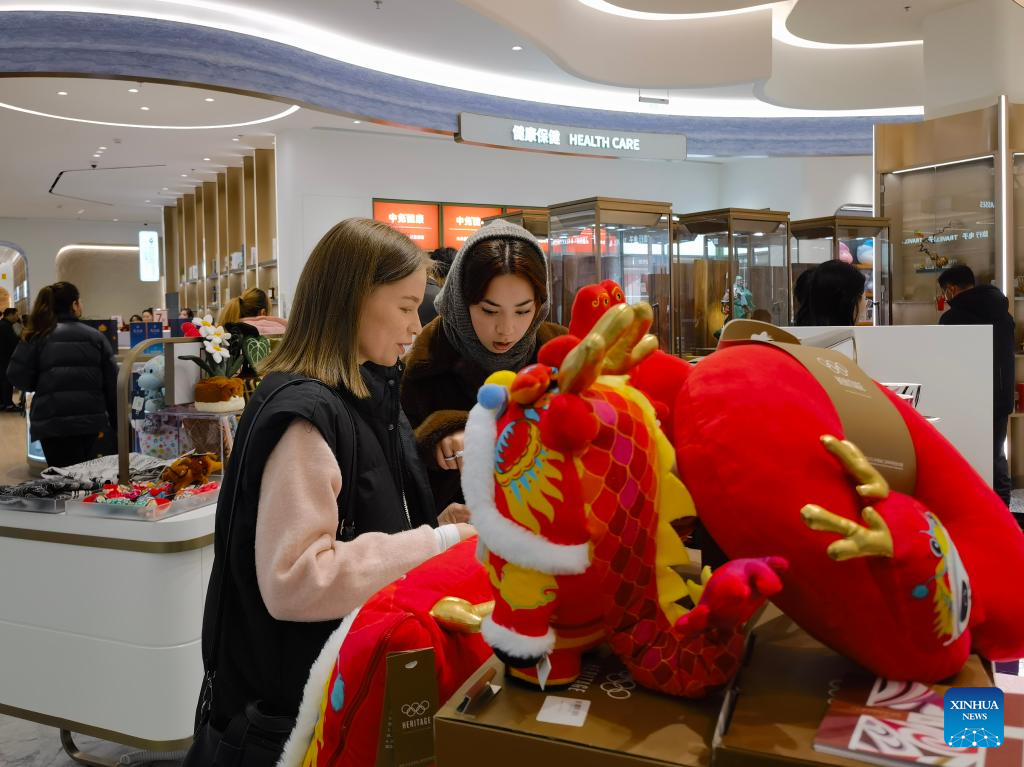
Two Russian consumers view products related with "Guochao", or "China chic", in Tianjin, north China, Nov. 28, 2025. (Xinhua/Song Rui)
TIANJIN, Dec. 5 (Xinhua) -- Stepping into a newly opened downtown duty-free shop in north China's Tianjin Municipality, customers were immediately greeted by a wave of "Guochao," or China-chic trends.
From timepieces of Seagull, China's classic watch brand, to panda plushies, fine tea sets, and indigo-dyed totes, the shelves present a curated selection where contemporary design meets traditional culture.
"My family loves Chinese tea, and these tea sets carry so much history and culture," said Marta Rybakova, a Russian shopper who lingered at the tea display. Planning to return home next month, Rybakova added, "I want to bring home gifts that combine beauty with stories, letting my family feel China more deeply."
Rybakova is just one of many international consumers falling in love with Chinese products. Whether it is intangible cultural heritage, trendy toys like Pop Mart's Labubu dolls, or high-tech innovations such as new energy vehicles (NEVs) and drones, a new generation of Chinese consumer IPs is emerging with global appeal.
Beyond traditional crafts, designed-in-China trendy toys are gaining international popularity. When the "Labubu" blind box series became a global hit, Khvan Yekaterina, a student from Kazakhstan at Tianjin Foreign Studies University, was quick to snap up one, which turned out to be a green, sharp-toothed monster doll.
"It's cool! The blind box experience is full of surprises and anticipation," she said. "This 'fun in uncertainty' meets the psychological needs of young people exploring the unknown."
Since being introduced to the market by Pop Mart in 2019, Labubu dolls have swept the globe. In 2024, revenue from THE MONSTERS series, to which Labubu belongs, reached 3.04 billion yuan (about 429.8 million U.S. dollars), driving a 475 percent increase in the company's overseas revenue.
The perception of Chinese products has also shifted from "cheap and low-quality" to "innovative and high-quality," thanks to the country's industrial upgrades.
Raydis Franco from Venezuela is currently pursuing his Chinese driver's license in Tianjin, motivated by his fascination with Chinese NEVs. He said he has been "won over" by their low-carbon performance, smart features and sleek designs.
"Chinese NEVs are cool. After I get my license, I plan to rent and then buy one for my daily commute and travel," he added.
In 2024, sales of Chinese NEVs accounted for 40.9 percent of total new car sales in the country, ranking first globally for 10 consecutive years.
Meanwhile, from Huawei foldable phones to Insta360 panoramic cameras and Unitree humanoid robots, Chinese tech products continue to attract global attention.
"China's creative products are constantly innovating with a high cost-performance ratio," said Baktygulova Adel, a student from Kyrgyzstan at Tsinghua University, noting that China's comprehensive ecosystem and efficient supply chain support the rapid expansion of these industries, enabling them to bring products to the world stage.
Data from the General Administration of Customs showed that in the first 10 months of this year, China's goods trade continued to grow steadily, with exports rising 6.2 percent year on year to 22.12 trillion yuan.
According to Tuo Yanzheng, an associate professor at Nankai University's College of Tourism and Service Management, the success of Chinese trendy IPs and tech products lies in their ability to meet the global demand for personalization and emotional expression.
"Behind this 'creation of demand' is the strong support of China's increasingly perfect creative ecosystem and agile supply chain, allowing brands to quickly transform ideas into best-selling products," Tuo said. ■
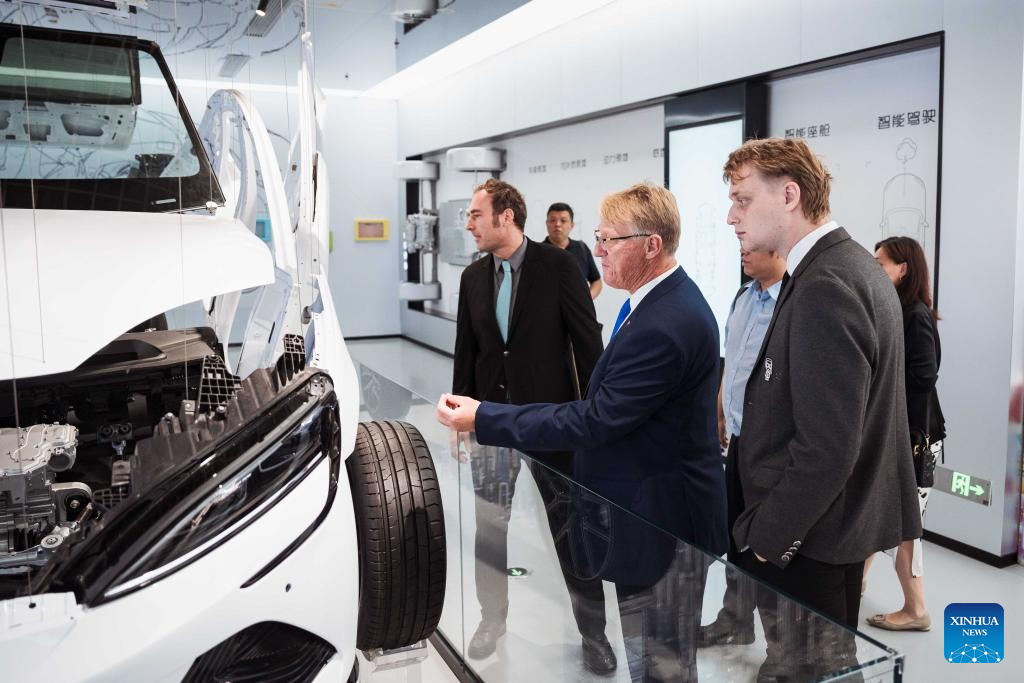
Members of Central and Eastern Europe-China Science and Technology Exchange Association attend a special experience activity for new energy vehicles in Tianjin, north China, Sept. 14, 2025. (Xinhua)

Marta Rybakova shops at a newly opened downtown duty-free shop in Tianjin, north China, Nov. 28, 2025. (Xinhua/Song Rui)


