
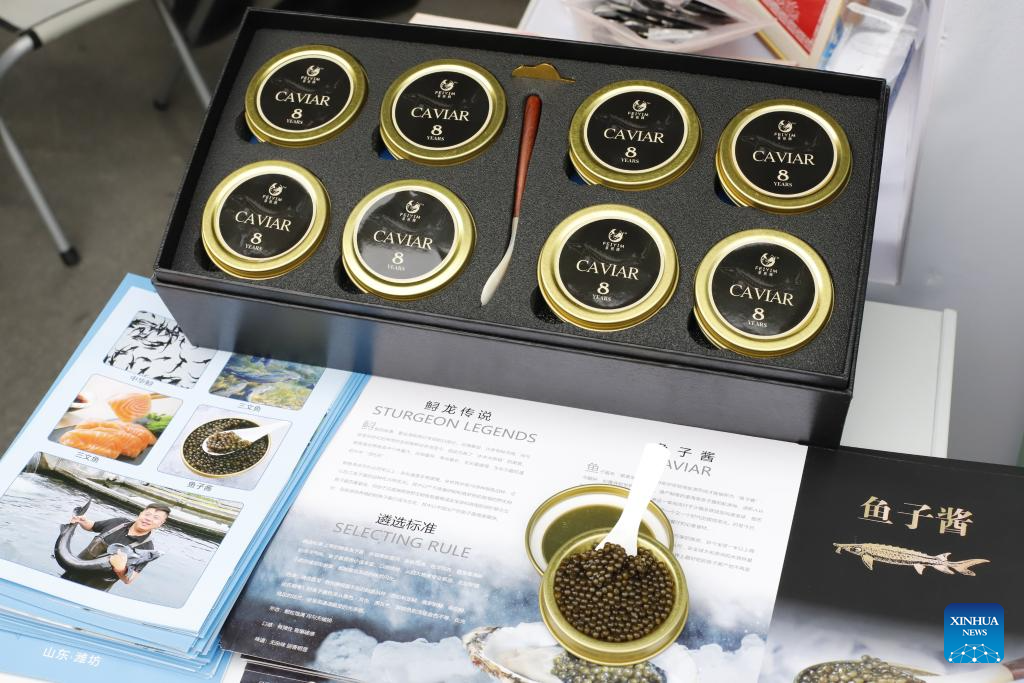
Caviar products are pictured in Linqu County, east China's Shandong Province, Oct. 28, 2025. (Xinhua)
JINAN, Nov. 28 (Xinhua) -- When Perrine Attard from the French foie gras organization CIFOG stepped into a processing plant of Shandong Chunguan Food Co., Ltd. in Linqu County, east China's Shandong Province, she could not hide her surprise.
"Who would have thought the Landes goose, native to southwestern France, would help build an industrial cluster worth 8 billion yuan (about 1.13 billion U.S. dollars) in the East?" Attard said, pointing to a map that shows the company's global market footprint.
Attard made the remarks during a technical exchange visit to Linqu earlier this month. Over the past four decades, Linqu has established a complete industrial chain integrating breeding, raising, processing and marketing since the first batch of Landes geese arrived in the county in the 1980s.
It was among the first places in China to introduce the French specialty breed. The county now produces 5 million Landes geese annually, generating more than 5,000 tonnes of foie gras, accounting for 70 percent of China's domestic market and one-fifth of the world's foie gras supply.
Local companies have built modern breeding bases equipped with standardized feeding workshops and centralized epidemic-prevention systems. With foie gras production now standardized and its quality stable and controllable, enterprises have gained greater confidence in expanding into high-end markets.
Yet Linqu's story does not end with foie gras. The county is quietly carving a name for itself in another arena: caviar.
At the processing workshop of Linqu Haorun Freshwater Fish Breeding Co., Ltd. in Weifang, Shandong, each box of caviar passes through 16 precise steps within a 15-minute "golden window" before cold storage. Behind the clock lies a far longer journey: a female sturgeon typically takes eight years to mature, reach over 25 kilograms, and produce roe, said Xu Jian, head of the company.
For Xu, anticipation for each plump, gleaming box of caviar has been building for far longer than the few minutes it takes to process it.
His farm, fed by waters of Laolongwan, one of China's 72 famous springs with water temperature maintaining around 18 degrees Celsius year-round, nurtures over 5,000 egg-bearing sturgeons.
Demand for caviar has been steadily rising in China and abroad, said Wei Shujuan, director of the agricultural and rural affairs bureau of Linqu County. Farmers such as Xu, she added, have been improving their skills in fry rearing and deep processing. "Our current breeding volume can stably supply 600 tonnes of sturgeon with eggs each year and produce 80 tonnes of caviar."
In recent years, local officials have been promoting a tripartite collaboration among businesses, cooperatives and farmers to build a more integrated and advanced cold-water fish industry.
"Back in 2008, we had to buy sturgeon fry for 6 yuan each," said Dong Yude, head of a local freshwater fish breeding cooperative. Now, through collaboration with research institutes to improve breeding technology, "our self-bred fry sell for just 2 yuan each." Farmers like Feng Yuanquan, once wary of high-risk fish farming, now expand operations with confidence thanks to cooperatives providing feed, disease prevention, funding, and sales channels.
Linqu's sturgeon farming output reaches about 6,000 tonnes annually -- 4 percent of national production and 61 percent of Shandong's total.
Xu said that his company is building a new processing workshop that will meet European Union standards. After going into production at the end of the year, it can process 20 tonnes of caviar and other products annually, and its total processing capacity can reach 200 tonnes when fish meat, tendons and other deep-processed products are calculated, Xu said.
The county also plans to build four additional standardized workshops, thereby raising annual caviar output capacity to 100 tonnes.
"Expanded output doesn't mean compromised quality," said a purchaser from France. "These world delicacies remain elegant, but also down-to-earth and accessible."
Meanwhile, Linqu's foie gras producers continue refining their craft with attention to animal welfare. "Instead of using whole corn kernels, we press them into flakes and blend into a paste, which reduces discomfort and avoids scratching the esophagus," explained Ma Lijun, general manager of Shandong Chunguan Food Co., Ltd. "We even play soothing music for the geese."
Today, China supplies 60 percent of the world's caviar, 45 percent of French-style foie gras and over 80 percent of black truffles, turning these tantalizing luxury ingredients, once exclusively tied to European provenance, into what industry insiders now call "new Chinese specialties."
Behind these figures lies a story of agricultural modernization.
The country has strengthened scientific and technological support for agricultural processing, backing 1,709 towns with strong agriculture-related industries, 350 national modern agricultural industrial parks, and more than 90,000 leading agricultural enterprises at or above the county level. ■
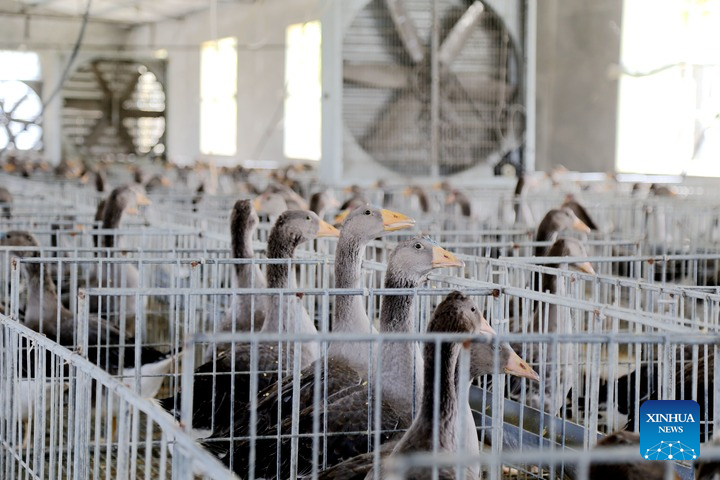
Landes geese are seen at a breeding workshop in Linqu County, east China's Shandong Province, Oct. 28, 2025. (Xinhua)


