Featuring 16 amateur players, Hong Kong men's handball team had a historic fourth-place finish at China's 15th National Games, turning their passion and commitment into a cherished journey.
by sportswriters Cao Yibo and Zhou Wanpeng
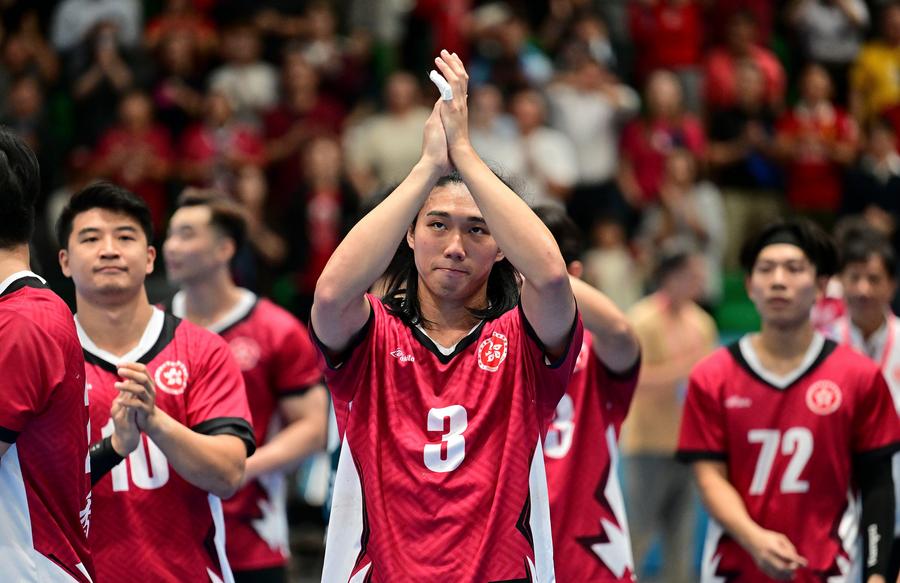
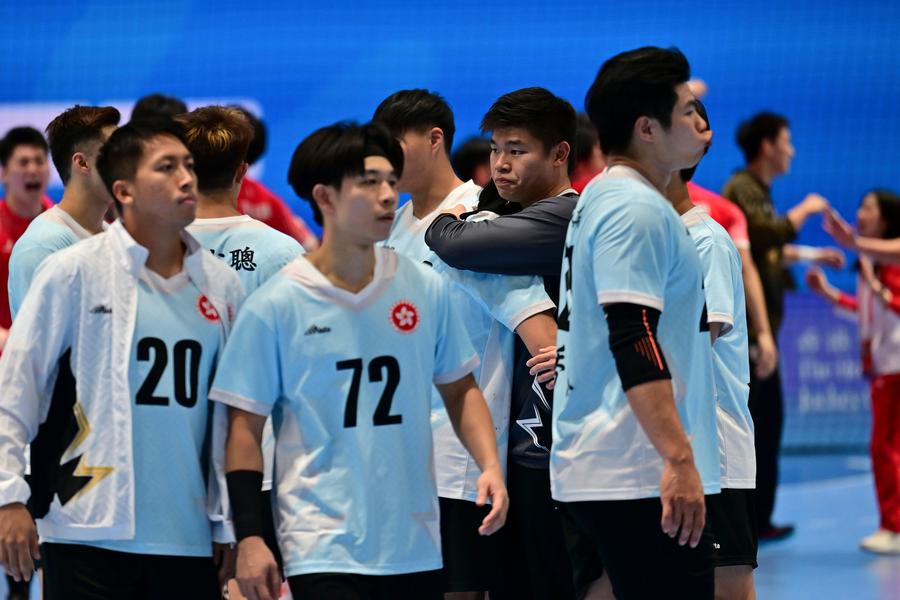
HONG KONG, Nov. 13 (Xinhua) -- The cheers at Hong Kong's Kai Tak Sports Park lingered long after the final buzzer. More than 5,000 fans rose to their feet, clapping and shouting as the Hong Kong men's handball players gathered at center court - arms wrapped around one another, tears mixing with sweat.
They didn't win. The team fell 33-25 to Beijing in the bronze-medal match at China's 15th National Games on Monday evening.
While the scoreboard didn't tell the whole story, the fourth-place finish marked Hong Kong's best-ever result since first competing in the National Games nearly three decades ago.
The Hong Kong men's handball team fielded a squad of 16 amateur players, a group rarely favored in pre-tournament predictions. What remained largely unknown, however, was the sacrifice behind their story: almost every player either resigned from their job or took unpaid leave to compete.
"Out of the 16 players, 15 currently do not have full-time jobs," said Ho Chung-ho, chairman of the Handball Association of Hong Kong, China. "There's no stable salary. What keeps them going is just the passion for the sport."

Unlike the professional teams from the Chinese mainland, Hong Kong's players come from ordinary walks of life - firefighters, flight attendants, and personal trainers among them.
Team captain Tse Wing-fai, a handball coach who also runs a workout studio, recalled that their training sessions took place late at night, squeezed in after long shifts. "Sometimes we couldn't even gather everyone because someone had overtime or an emergency duty," Tse said.
"But the moment we stepped onto the court, the exhaustion disappeared," he added.
Handball - a fast, physical seven-a-side sport that combines the pace of basketball with the contact of rugby - has never been a mainstream discipline in Hong Kong.
The local handball movement began in the 1970s. Although the Hong Kong Amateur Handball Association (now the Handball Association of Hong Kong, China) was founded in 1970, the sport long remained on the fringe due to limited facilities and funding.
When Hong Kong first competed at the National Games in 1997, the hastily assembled team finished ninth. In 2005, they broke into the top eight, and in 2017, they finished sixth - then a record. But a stubborn cycle persisted: modest results meant limited support, which in turn restricted progress.
Without access to the government's elite sports funding tier, the team often trained outdoors on hard concrete courts, managing just one indoor session per week. Weather disruptions were common, and the unforgiving surface heightened the risk of injury.
"Compared to the systematic support enjoyed by professional mainland teams, the gap in training conditions is enormous," said head coach Hui Man-pong.
The 2025 National Games, co-hosted by Guangdong, Hong Kong and Macao, offered Hong Kong a rare opportunity: to play on home soil. For a group that had spent years training in the shadows, it felt like a calling.
"After discussing with the players, we all agreed - if we want to beat professional teams, we must first become as professional as possible ourselves," Hui said.
So the team made an unprecedented decision in Hong Kong handball history: to fully commit to the Games. Nearly the entire squad stepped away from their jobs to train full-time.
They studied match videos frame by frame, managed their diets like professionals, and followed a rigorous training schedule matching that of national-level teams - all despite their limited resources.
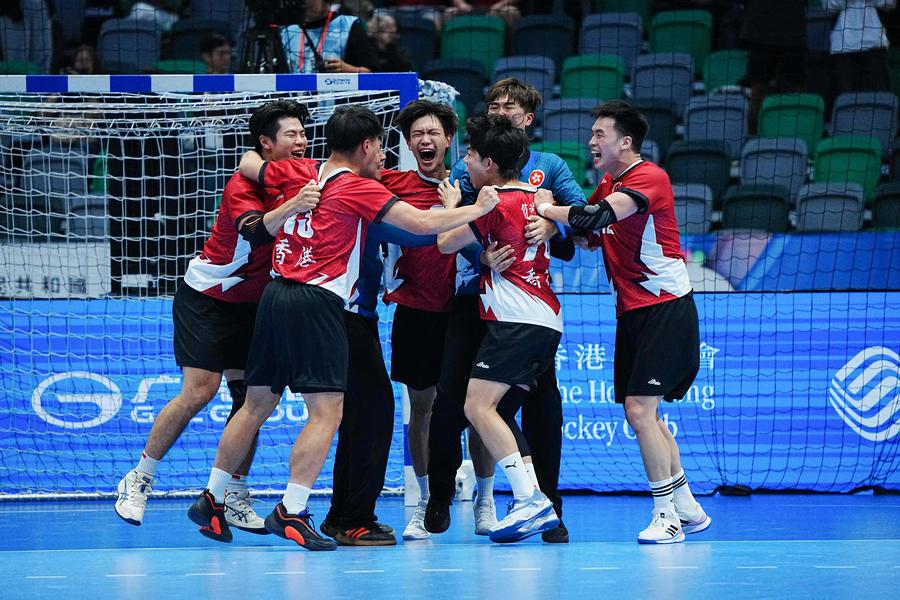
Hong Kong's path at the 2025 Games became a storybook run: defeating Macao and Shanghai in the group stage, stunning Guangdong in the quarterfinals, and pushing Anhui to the final minutes in a narrow three-goal semifinal loss.
The fourth-place finish was more than a statistic - it was proof that passion and discipline could bridge an almost impossible gap.
Hui struggled to describe the moment. "I imagined this scene many times," he said softly. "But when it actually happened, I still couldn't believe it was real."
For Ho, the team's breakthrough carries meaning far beyond a single tournament.
"The National Games allowed more people to see Hong Kong handball," he said. "It brings hope and possibilities for the sport's future development in Hong Kong." ■