
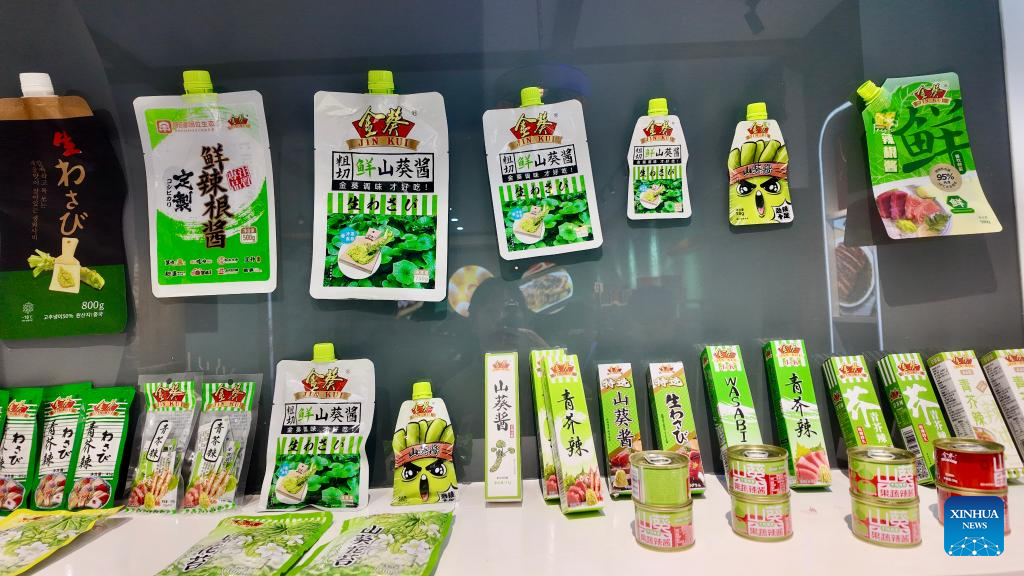
Wasabi products are seen at a wasabi factory in Weixin County, southwest China's Yunnan Province, Oct. 23, 2025. (Xinhua/Wang Xiansi)
KUNMING, Nov. 3 (Xinhua) -- As diners relish the delicate flavors of fresh sashimi in Japanese restaurants, the wasabi accompanying each bite may well have originated in the remote Wumeng Mountains of southwest China's Yunnan Province.
Reaching the wasabi base in Weixin requires a long and winding trip. Starting with a high-speed train from Kunming, the provincial capital, followed by a car ride through misty, rugged terrain. Here, under black shade nets, lush green wasabi plants thrive. Every part of the plant, from leaf to root, is sold under pre-arranged export agreements with buyers from Japan and the Republic of Korea (ROK).
Wasabi, a perennial herb prized for its pungent root used in the famous condiment, is notoriously difficult to cultivate. It thrives only in cool, humid climates, shuns heat and direct sunlight, and requires precise altitude and water conditions. The root takes two to three years to mature before it can be harvested.
In Japan, top-grade wasabi roots can fetch 1,200 yuan (about 169 U.S. dollars) per kg, and supply still cannot meet demand.
Weixin County, located on the northern edge of the Yunnan-Guizhou Plateau, offers a near-ideal environment. With abundant rainfall, lush vegetation, an average annual temperature of 13.6 degrees Celsius, and high humidity, its conditions resemble those of Shizuoka, Japan's famous wasabi production area. Test results show that Weixin-grown wasabi contains high levels of isothiocyanates, giving it a strong aroma and premium quality.
Weixin first successfully cultivated wasabi in 1997. In 2022, the local government introduced Jinkui Agriculture (Yunnan) Co., Ltd. to build a wasabi industrial park. The facility now operates six production lines for processing, powdering, freezing and extracting, producing over 100 tonnes of wasabi and related products each year.
"We've developed wasabi paste, dried horseradish flakes, soy-pickled flower stalks, and more," said Zhu Junya, the company's director, noting that their products are sold in cities like Shanghai and exported to 68 countries and regions, including Japan, ROK and Thailand.
Just last week, an ROK buyer, surnamed Choi, flew to Weixin to visit the planting base. Having previously purchased soy-pickled wasabi leaves from the company, he praised the local wasabi's quality and placed a new order of 100 tonnes of wasabi flower stalks and 60 tonnes of fresh leaves for the coming year.
Wasabi is also bringing new opportunities to farmers in the remote mountains. In the past, many in Weixin relied on growing corn and tobacco, with unstable harvests and low income. Now, with the wasabi industry taking root, more are turning to this high-value crop.
Through persistent effort, Weixin has developed over 3,500 mu (about 233 hectares) of wasabi planting bases. The industry has created 1,200 local jobs, increasing the average household's annual income by 6,200 yuan.
During harvest season, a single 40-mu base can employ over 100 people, allowing villagers to earn without leaving their hometowns. "At my age, it's hard to find work outside. Now I can work right in the wasabi base near my home, earning 120 yuan a day," said Shu Rongxian, a 70-year-old from Zhaling Village.
Scientific support is boosting the booming industry, too. Yang Yongwen, deputy director of Weixin's agricultural specialty industry development center, explained that the county is collaborating with universities and research institutes to select high-quality seeds, develop new wasabi products, and establish a full supply-chain traceability system.
Yang noted that they have also established a wasabi association, bringing over 30 local enterprises and cooperatives from across the supply chain to build an integrated production and marketing system.
Weixin is not the only one tapping into the wasabi boom. Neighboring areas such as Baoshan, Dali and Zhenxiong are also cultivating wasabi.
Customs data show that in the first three quarters of this year, the Tengchong Customs Office supervised the export of 744.7 tonnes of wasabi and related products, with a market value exceeding 19.8 million yuan, mainly to Japan and the ROK. Under the Regional Comprehensive Economic Partnership framework, Chinese wasabi and frozen products enjoy preferential tariffs in these markets.
While exports continue to rise, wasabi is also gaining popularity within China.
Beyond its traditional role alongside sashimi and sushi, innovative chefs and food bloggers are incorporating it into local dishes such as wasabi tofu rice noodles, wasabi-grilled fish, and even coconut-wasabi ice cream. In city shopping malls, Korean-style wasabi barbecue restaurants are also on the rise, bringing this once-remote mountain treasure into the spotlight. ■
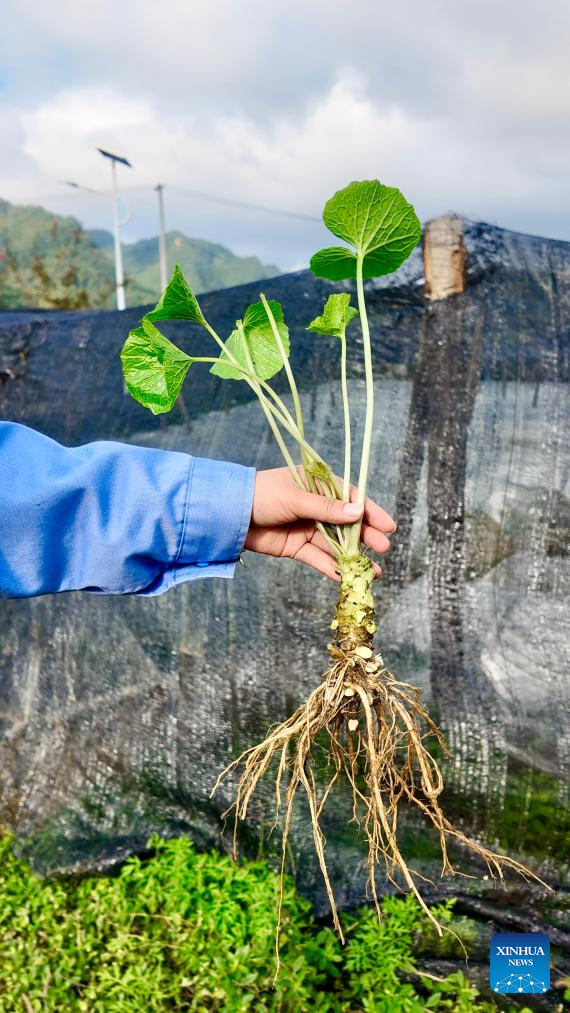
A worker shows a wasabi plant at a wasabi base in Weixin County, southwest China's Yunnan Province, Oct. 23, 2025. (Xinhua/Wang Xiansi)
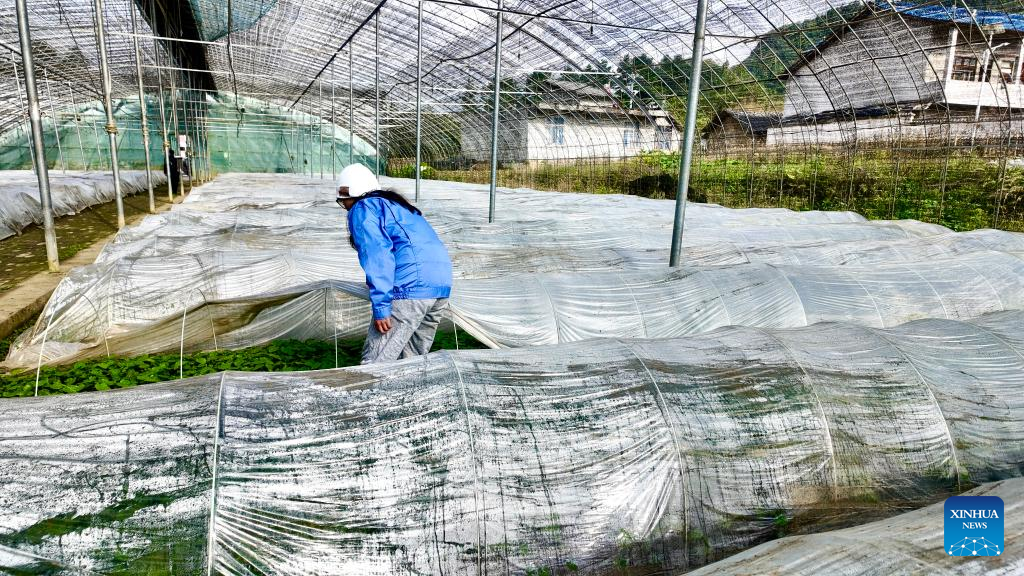
A worker works at a wasabi base in Weixin County, southwest China's Yunnan Province, Oct. 23, 2025. (Xinhua/Wang Xiansi)


