
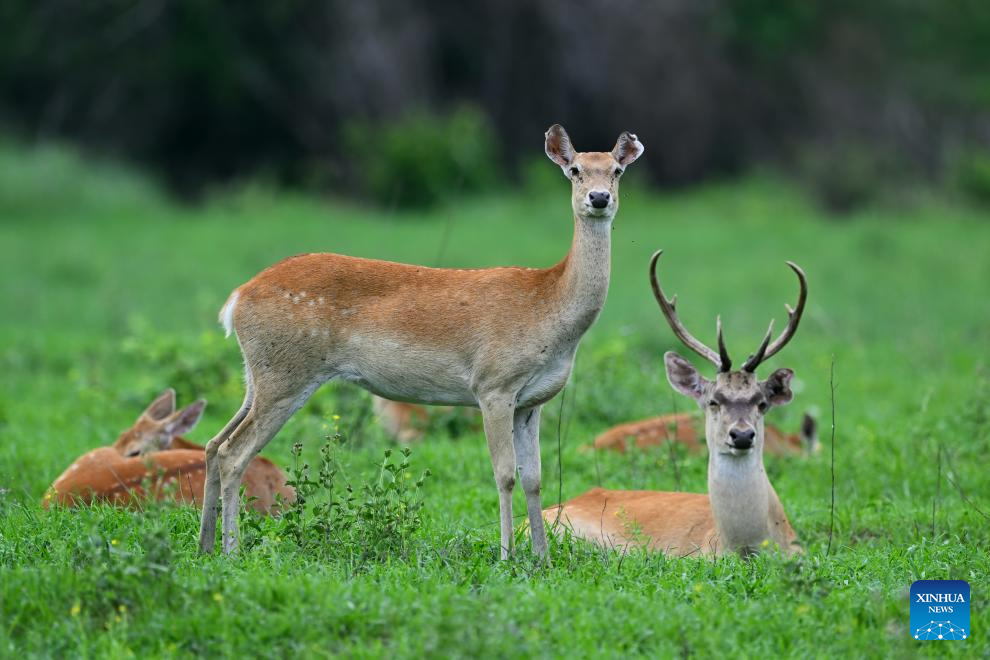
This photo taken on May 27, 2024 shows Hainan Eld's deer at the Bangxi provincial nature reserve in Baisha Li Autonomous County, south China's Hainan Province. (The administration of Hainan Tropical Rainforest National Park/Handout via Xinhua)
HAIKOU, Oct. 15 (Xinhua) -- As dawn breaks over Bawangling Mountain's valleys, the crisp calls of Hainan gibbons pierce the morning mist, forming a daily dawn chorus in Hainan Tropical Rainforest National Park -- China's southernmost tropical rainforest sanctuary.
This October marks the park's fourth anniversary. Over the past four years, this vast ecosystem has delivered a vibrant "ecological report card," showcasing China's remarkable progress in biodiversity conservation and habitat restoration.
Spanning approximately 4,269 square kilometers, the park constitutes China's largest contiguous tropical rainforest on a continental island. It serves as a critical gene bank for global tropical biodiversity, harboring 4,367 higher plant species and 651 wild vertebrate species.
The park's ecological health is epitomized by the Hainan gibbon -- the world's most endangered primate. Once teetering on the brink of extinction due to habitat loss, this flagship species now enters a "golden period of growth."
Today, seven family groups totaling 42 gibbons traverse the forest canopy. The increasingly frequent cries of infants -- along with monitoring teams' footage of a mother cradling her offspring while feeding on wild fruit -- paint a hopeful picture.
This remarkable recovery transcends species revival, embodying China's conservation commitment through national park protection under the world's strictest ecological standards.
Hainan has established a provincial-level coordination mechanism for the park's development, integrating 27 government departments and 10 municipal/county administrations under a unified conservation framework. Forestry patrol teams -- equipped with advanced navigation systems -- conduct regular expeditions through rugged terrain to enforce park boundaries.
"Every additional kilometer I patrol translates into stronger rainforest protection," said Wei Baoquan, a dedicated ranger who meticulously documents daily observations along his assigned trails.
In recent years, Hainan has pioneered the accounting of the park's gross ecosystem product, creating a comprehensive "ecological asset ledger" that quantifies the value of every ecological component -- from individual leaves to entire watersheds. A dedicated ecological restoration plan has been implemented to address rainforest degradation and habitat fragmentation, with strict zoning designating core protection areas and no-development zones.
To restore the rainforest's natural integrity, rigorous measures have been taken: all 63 small hydropower stations have been dismantled, reviving dried-up streams and enabling migratory fish to return to their historical spawning grounds. Native tree species are being replanted in degraded areas, while young rainforest saplings now thrive in former eucalyptus plantations -- allowing the ecosystem to undergo natural regeneration.
The park operates under an "smart protection" system featuring a space-air-ground integrated monitoring network -- utilizing satellite remote sensing, drones and infrared cameras -- to meticulously track vegetation changes and wildlife activity patterns.
To minimize human impact, the park conducted its largest-ever community relocation. "We moved from the mountains to urban outskirts, allowing ecosystems to regenerate," said Wang Xiuhe, a relocated villager who now operates a homestay where tourists purchase rainforest products like wild mushrooms and honey. Former loggers and hunters have transitioned into the rainforest's most passionate protectors.
As morning mist once again enshrouds the valley, the Hainan gibbon's calls harmonize with rangers' footsteps and children's laughter. Four years into this journey, this "treasure house of tropical biodiversity" has become a crystal-clear window into China's ongoing environmental improvement. ■
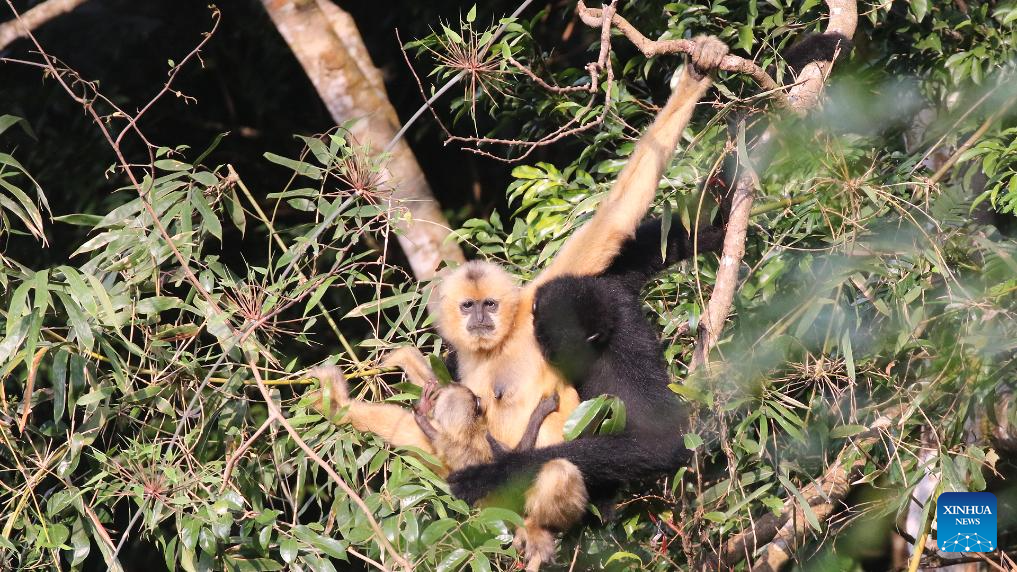
This photo taken on Feb. 29, 2024 shows Hainan gibbons in the Bawangling area of Hainan Tropical Rainforest National Park, south China's Hainan Province. (The administration of Hainan Tropical Rainforest National Park/Handout via Xinhua)


