
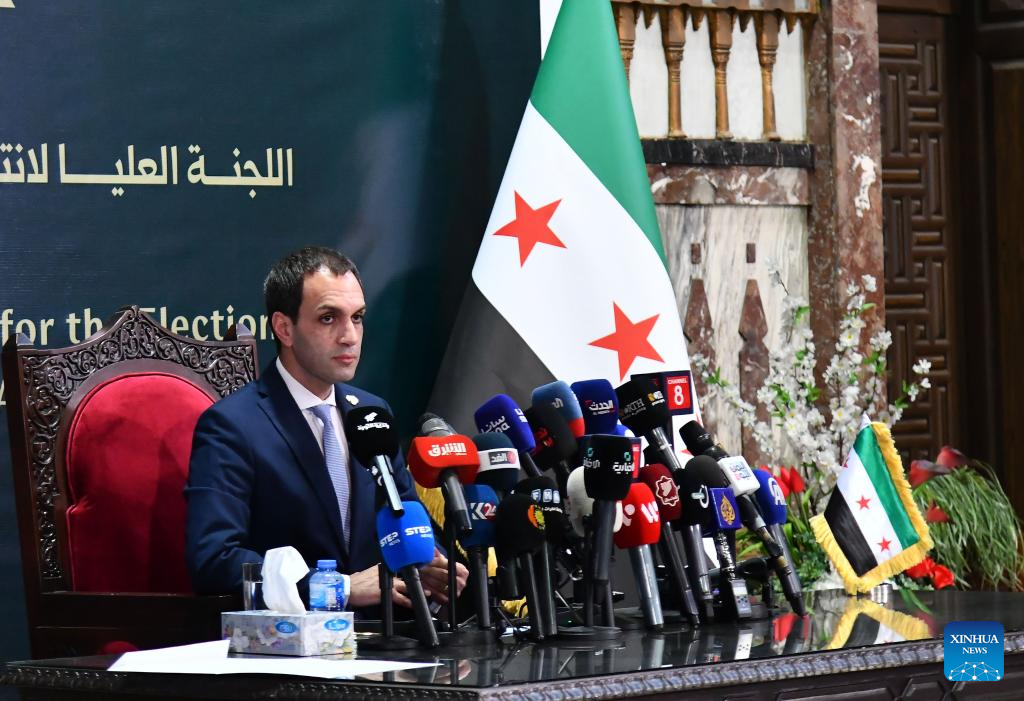
Nawar Najmeh, spokesperson for Syria's Higher Committee for People's Assembly Elections, speaks during a press conference about the parliamentary elections in Damascus, Syria, Oct. 6, 2025. Syria's transitional authorities announced here Monday the final results of the country's first parliamentary elections since the fall of former President Bashar al-Assad in December last year, describing the process as transparent and inclusive despite challenges. (Photo by Ammar Safarjalani/Xinhua)
DAMASCUS, Oct. 6 (Xinhua) -- Syria's transitional authorities announced here Monday the final results of the country's first parliamentary elections since the fall of former President Bashar al-Assad in December last year, describing the process as transparent and inclusive despite challenges.
Mohammad Taha al-Ahmad, chairman of the Higher Committee for People's Assembly Elections, said 119 candidates had been elected to parliament through the voting process. However, al-Ahmad did not mention how many votes each candidate received.
Al-Ahmad also stressed the need for "capable people who can work and rebuild" rather than "quotas."
Under a new temporary system, two-thirds of the 210 parliamentary seats are elected and one-third will be appointed by Syrian leader Ahmed al-Sharaa to ensure fair representation for all regions and social groups during Syria's transition.
Meanwhile, Nawar Najmeh, spokesperson for the committee, told a press conference that the elections, conducted across 49 constituencies, were distinguished by "a high level of integrity" and "transparency," and that the results are final and not subject to appeal.
Due to displacement, missing documents and logistical challenges, the electoral process did not adopt direct public voting, but instead employed community-based electoral bodies, which Najmeh said "have no relation to" the one-third of parliamentary seats to be appointed by al-Sharaa.
Najmeh said the elections could not be held in Raqqa, Hasakah, and Sweida provinces due to security conditions, while voicing concerns over low women's representation in the elections.
The new parliament's role would be to "serve as the official platform for national dialogue" and support the government and monitor its performance during the transitional period, Najmeh added. ■
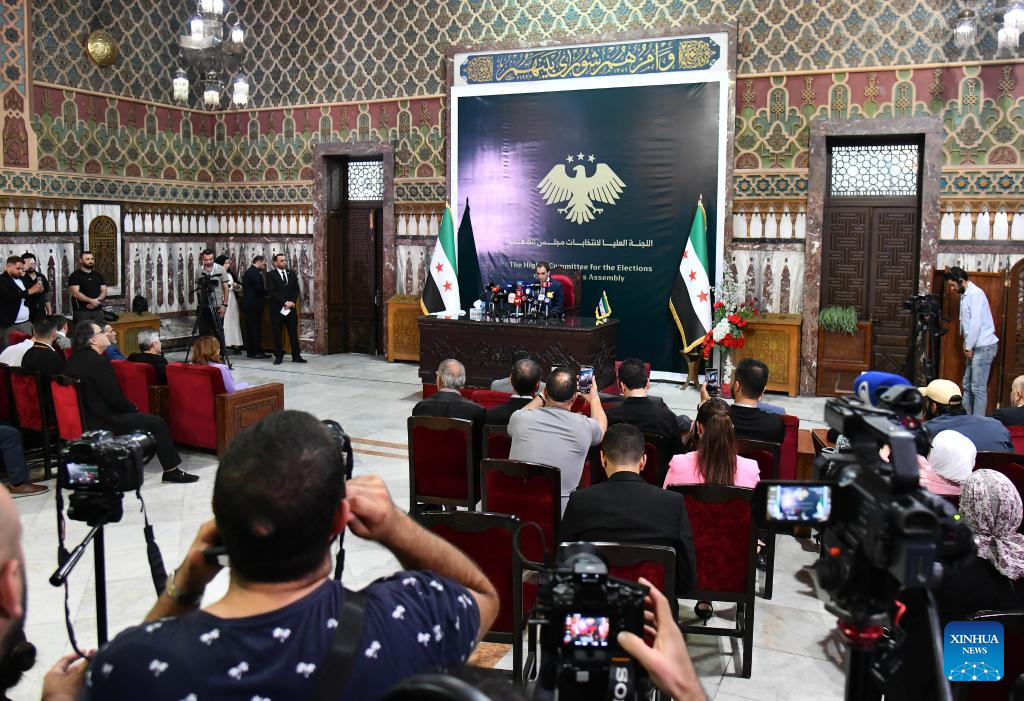
Nawar Najmeh, spokesperson for Syria's Higher Committee for People's Assembly Elections, speaks during a press conference about the parliamentary elections in Damascus, Syria, Oct. 6, 2025. Syria's transitional authorities announced here Monday the final results of the country's first parliamentary elections since the fall of former President Bashar al-Assad in December last year, describing the process as transparent and inclusive despite challenges. (Photo by Ammar Safarjalani/Xinhua)

Nawar Najmeh (L), spokesperson for Syria's Higher Committee for People's Assembly Elections, speaks during a press conference about the parliamentary elections in Damascus, Syria, Oct. 6, 2025. Syria's transitional authorities announced here Monday the final results of the country's first parliamentary elections since the fall of former President Bashar al-Assad in December last year, describing the process as transparent and inclusive despite challenges. (Photo by Ammar Safarjalani/Xinhua)
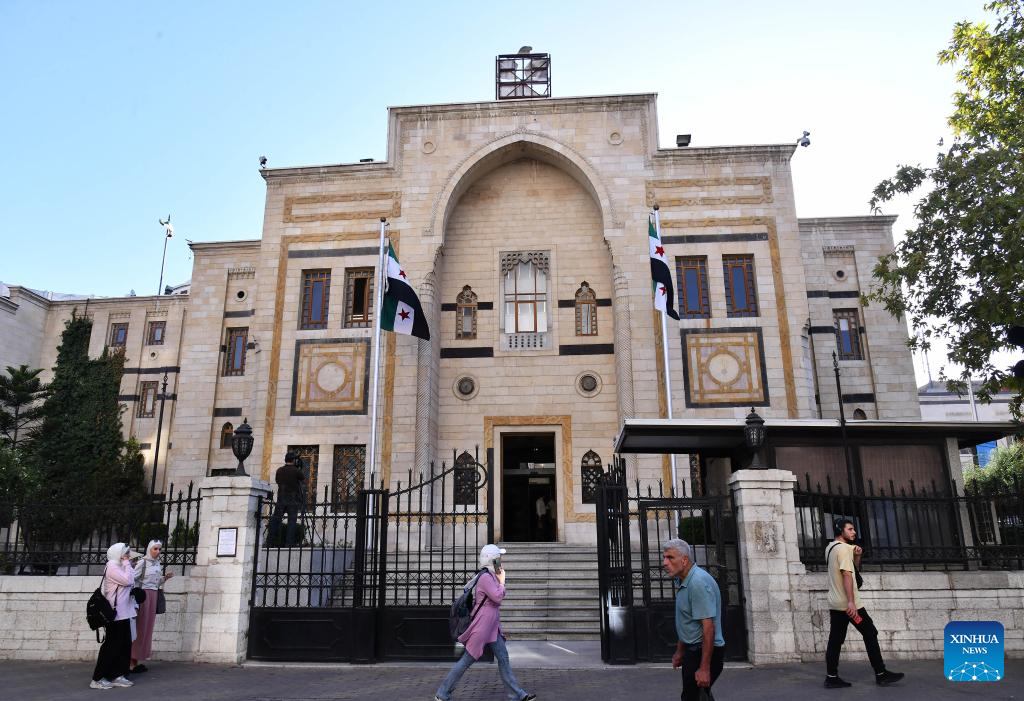
People pass in front of the Syrian parliament building in Damascus, Syria, Oct. 6, 2025. Syria's transitional authorities announced here Monday the final results of the country's first parliamentary elections since the fall of former President Bashar al-Assad in December last year, describing the process as transparent and inclusive despite challenges. (Photo by Ammar Safarjalani/Xinhua)


