
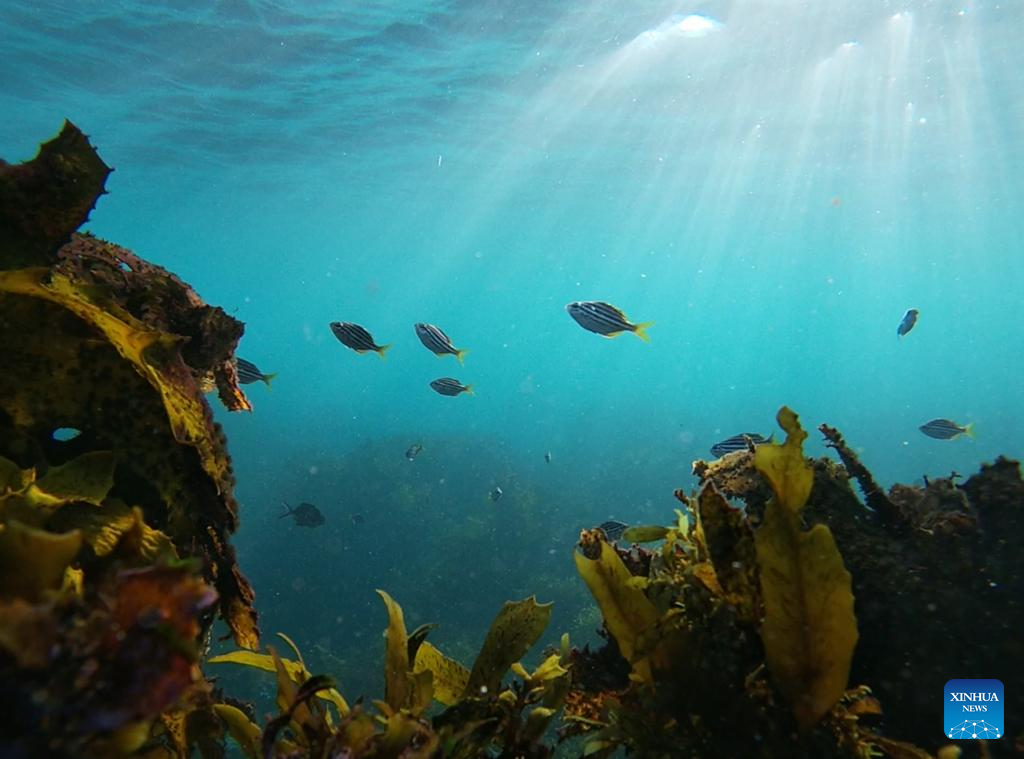
This photo taken on Sept. 25, 2025 shows a school of Australian Mado in a temperate kelp forest in Narooma, Australia. (Photo by Chloe Hayes /Handout via Xinhua)
CANBERRA, Sept. 25 (Xinhua) -- Researchers in Australia have developed a new method combining environmental DNA (eDNA) with visual surveys to track tropical fish species migrating into cooler waters as oceans warm due to climate change.
They surveyed fish communities along 2,000 km of Australia's east coast, from the tropical reefs of the Great Barrier Reef to the temperate kelp forests of the state of New South Wales to test how well eDNA can reveal species on the move, according to a statement released Thursday by Australia's University of Adelaide (UoA).
Researchers have traditionally relied upon visual surveys to monitor these migrations, but that alone does not capture the full picture, leading to an underestimation of migration rates, it said.
"Climate change has already caused more than 12,000 species to shift their homes across land, freshwater and the sea," said UoA researcher Chloe Hayes, lead author of a study on the new approach.
In the ocean, some tropical fish had moved into temperate reefs to seek cooler waters, particularly along the east coast of Australia, one of the fastest warming marine regions on Earth, Hayes said.
"New coral and fish species arrive in Sydney's oceans every year, and this is expected to increase with future climate change," said study co-author Professor David Booth from Australia's University of Technology Sydney.
Hayes drew on forensic science by using eDNA, which captures traces like mucus, scales, and waste that fish leave behind in seawater.
"Every organism leaves behind traces of itself in its environment -- fish shed mucus, scales and waste, all of which contain DNA. By collecting and filtering samples of seawater, we can extract this DNA and identify the species that have lived in a particular area," said Hayes, whose study was published in Diversity and Distributions.
"Just as detectives solve crimes by analyzing fingerprints or hair left at a scene, ecologists can build a picture of marine life from the genetic fingerprints floating invisibly in the ocean," said Project leader Professor Ivan Nagelkerken from the University of Adelaide.
The study detected tropical species in temperate ecosystems that had never been recorded there before, including surgeonfish, parrotfish and cryptic species such as porcupinefish and squirrelfish that "divers are most likely to miss," Hayes said. ■


