
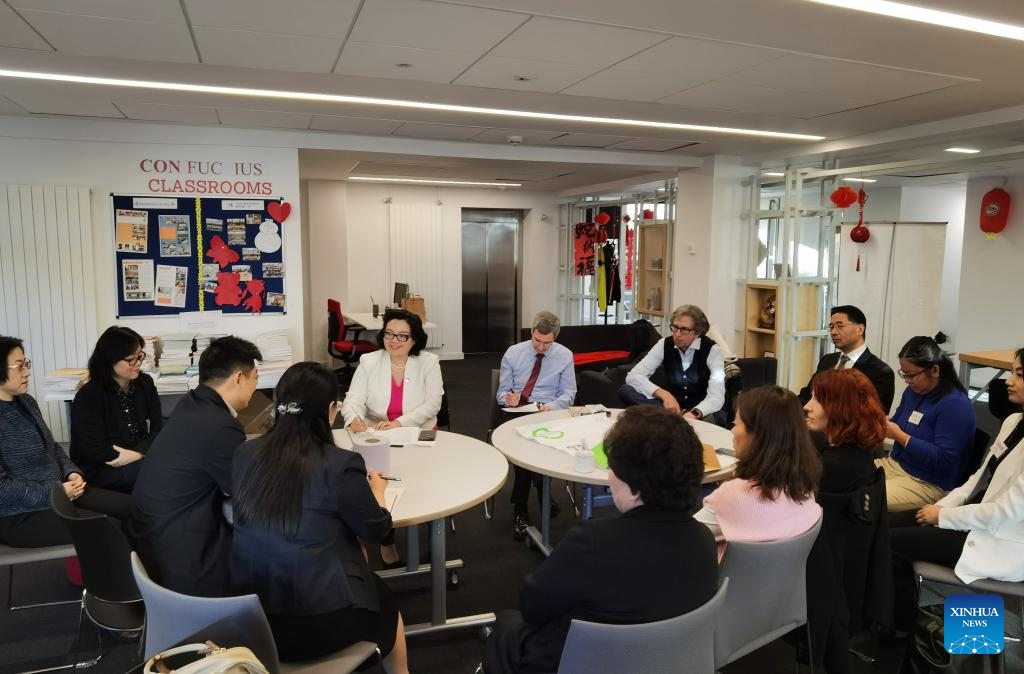
Participants attend a Potential Joint-Funding Application Workshop at the Fifth Belt and Road Initiative (BRI) Interdisciplinary Conference in Lancaster, Britain, on Sept. 23, 2025. Artificial intelligence (AI) took center stage for the first time at the Fifth Belt and Road Initiative (BRI) Interdisciplinary Conference, hosted Tuesday and Wednesday by the Lancaster University Confucius Institute in northwest England. (Xinhua)
by Xinhua writer Gao Wencheng
LONDON, Sept. 24 (Xinhua) -- Artificial intelligence (AI) took center stage for the first time at the Fifth Belt and Road Initiative (BRI) Interdisciplinary Conference, hosted Tuesday and Wednesday by the Lancaster University Confucius Institute in northwest England.
"I find the topic of this year's conference really fascinating as it explores the Silk Road through the lens of AI," said Edward Simpson, dean of the Faculty of Humanities, Arts and Social Sciences at Lancaster University, noting that the BRI framework is increasingly opening new ground.
According to organizer Amily Guenier, the two-day event attracted about 60 scholars from countries including Britain, China, Canada, the United States, Ireland and Bulgaria.
She said the BRI has grown into a hallmark of China's international cooperation, and as China advances, the conference themes have expanded into cutting-edge fields such as AI.
Throughout the sessions, participants discussed both opportunities and challenges posed by AI for academic research.
In a keynote speech, Wang Binhua, professor of interpreting and translation studies at the University of Leeds, illustrated how AI tools can assist translation. But he emphasized that translation in cross-cultural communication is more than literal rendering, and it requires creativity and judgment.
"The real purpose of translation is to convey meaning to the target audience," he said. "That is precisely where AI currently falls short. True international communication ultimately relies on translators with agency, creativity and accountability."
A similar message was echoed by Xu Qihe, director of the King's Centre for Integrative Chinese Medicine at King's College London.
Xu noted that AI and digital technologies are rapidly reshaping traditional, complementary and integrative medicine (TCIM) and broader healthcare, presenting "significant opportunities but also challenges."
He stressed that responsible AI use must combine general best practice with TCIM-specific guidance to ensure robust outcomes.
The organizers also hosted practical sessions, including a Potential Joint-Funding Application Workshop to identify areas for collaboration and develop concrete research projects, as well as an AI-based Interdisciplinary Matchmaking Forum to connect scholars across disciplines and institutions.
Chinese scholar Gai Shuhua from Beijing Foreign Studies University presented her project on the effects of nursery rhymes on English learning among young learners. She said the sessions helped broaden her research vision and offered valuable opportunities for international collaboration. "I also want to explore AI methods more in the future," she added.
Healthcare was another highlight of the event. "As China develops, its international cooperation is no longer just about making money, and it's also about making a better life and making the world a better place," Guenier said.
Delivering a keynote, Ma Yuling, a professor from Harvard University, outlined the enduring value of traditional Chinese medicine (TCM). "The pharmacological study of TCM opens a new era of human medicine," she said.
The multifactorial nature of diseases and the rise of systems biology, she explained, highlight the need for multi-targeting drugs, such as multicomponent medicine or polypills.
"TCM, with thousands of years of development and comprehensive theory, emphasizes holistic regulation to keep the yin and yang of the body in balance. Herbal formulas can be effective without adverse reactions, since detoxifying elements are included," she noted.
Other scholars from China, Britain and beyond discussed themes such as shared decision-making between families and clinicians, healthcare communication, and the ethics of AI in healthcare.
He Qingnan, professor of pediatrics and Party secretary of Xiangya Third Hospital of Central South University in central China, one of the conference's institutional partners, told Xinhua that attending such events helps Chinese scholars learn about international research methods and trends while seeking collaboration opportunities.
"As China's capabilities grow, dialogue is becoming more fluent and mutually beneficial," he said. "This gives us hope for even greater results in the future." ■
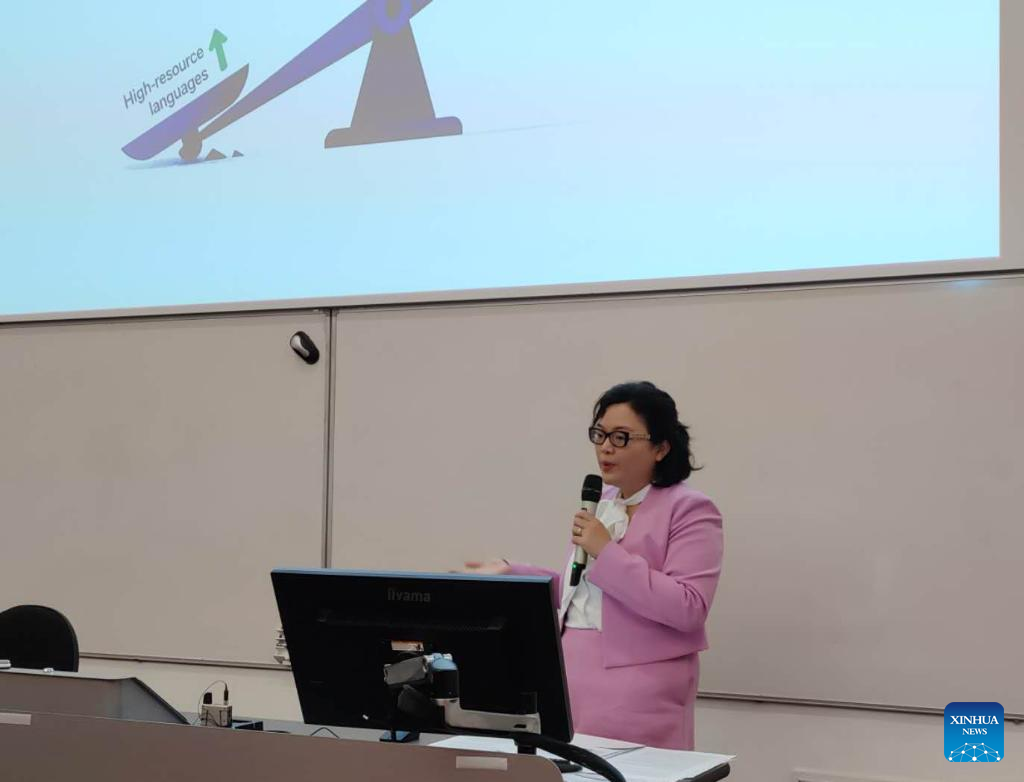
A participant speaks at the Fifth Belt and Road Initiative (BRI) Interdisciplinary Conference in Lancaster, Britain, on Sept. 24, 2025. Artificial intelligence (AI) took center stage for the first time at the Fifth Belt and Road Initiative (BRI) Interdisciplinary Conference, hosted Tuesday and Wednesday by the Lancaster University Confucius Institute in northwest England. (Xinhua)


