
While androids may one day rival human athletic prowess, the Olympic spirit is measured not in seconds and meters, but in the irreplaceable human stories of perseverance, respect, and shared emotion.
by sportswriters Dong Yixing, Shu Wen and Wang Haoming
BEIJING, Sept. 23 (Xinhua) -- The human Olympics have evolved from the ancient Games in Greece to today's global spectacle, with rules refined over thousands of years. Could a robotic Olympics reach the same level of sophistication in a single leap?
With artificial intelligence and robotics advancing rapidly, this is no longer just a theoretical question. What happens if humanoid machines eventually step onto sport's biggest stage?
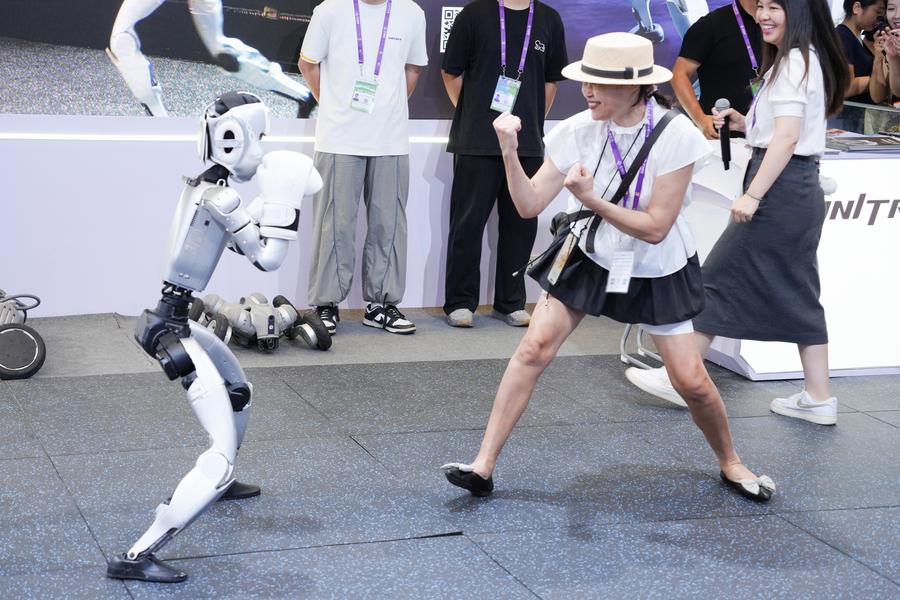
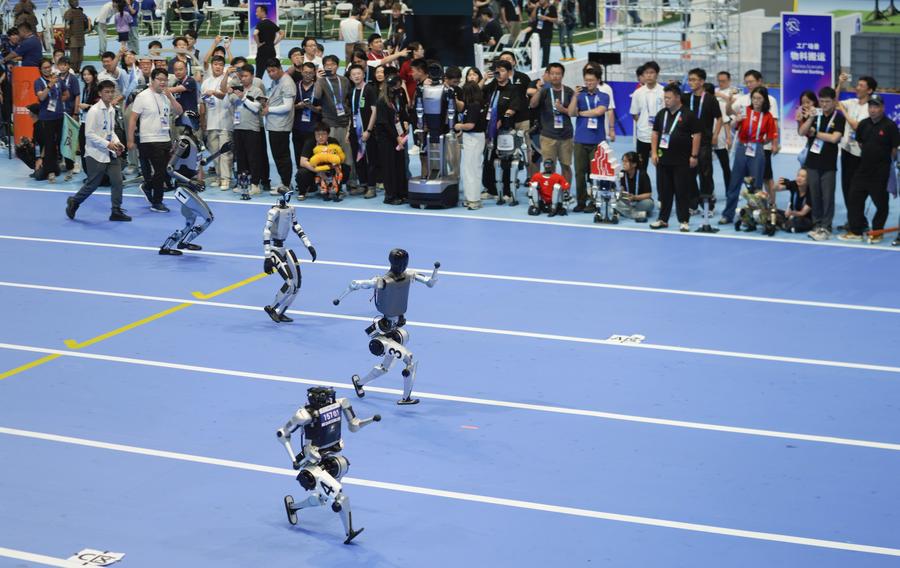
The World Humanoid Robot Games, held in Beijing in August, offered a glimpse of that future. Robots with metallic limbs, camera eyes and AI brains competed in track and field, ball games and gymnastics, testing their autonomous operation and physical abilities in both individual and team events.
In one race, a robot completed 1,500 meters in six minutes and 34.40 seconds. Still far behind the human world record of 3:26.00, but experts believe the gap will narrow.
The title of Philip K. Dick's 1968 novel, Do Androids Dream of Electric Sheep?, poses a profound question. The Chinese translation deliberately uses the word "androids" instead of "robots" to emphasize their human-like form and to provoke reflection on what it truly means to be human.
As androids begin to mimic human athletic behaviors, could the essence of sport itself be altered?

The Olympic motto "Faster, Higher, Stronger - Together" is not only about physical achievement, but also about excellence, respect, friendship and solidarity. Machines may one day surpass humans in speed or strength, and they can be programmed to mimic gestures of sportsmanship.
But do they feel the pride of carrying a national flag, as Liu Changchun did at the 1932 Los Angeles Games? Do they show the perseverance of John Stephen Akhwari, who finished the 1968 Mexico City marathon injured and alone? Can they feel the emotion of Matthias Steiner, who lifted gold in Beijing in 2008 for his late wife?
Such moments show that the soul of sport lies beyond records and medals. It is found in choices, respect, friendships and shared emotions that transcend generations.

Technology has long shaped sports, from high-tech swimsuits to carbon-fiber prosthetics. But enhancement and replacement are not the same. Gene editing, neural implants and bionic limbs may stretch human limits, but they remain part of the human narrative. Androids do not.
Perhaps one day, androids will create their own Games, designed by AI for AI. Humans may also evolve through biotechnology, and the two could even compete together.
For now, the Olympics remain a celebration of humanity - of struggle, spirit and aspiration.
So if asked whether androids will dream of their own Olympics, the answer may be: let them dream. But let us remember why ours remain human. ■