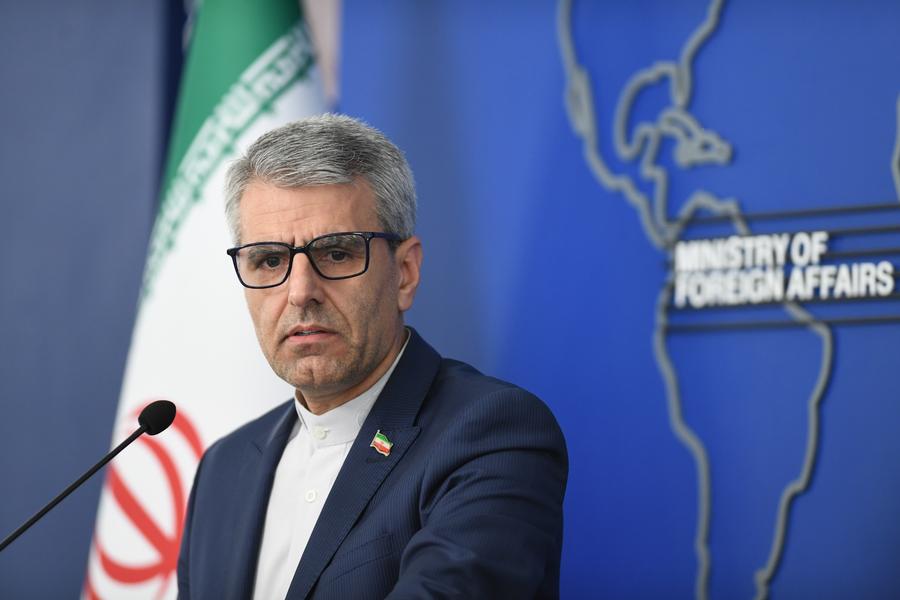
TEHRAN, May 19 (Xinhua) -- Iran's Foreign Ministry spokesman Esmaeil Baghaei said on Monday the country's uranium enrichment is non-negotiable.
He made the remarks at a weekly press conference in Tehran while reacting to remarks on Sunday by U.S. Special Envoy to the Middle East Steve Witkoff, who told the U.S.-based ABC News, "We have one very, very clear red line, and that is enrichment, and we cannot allow (Iran to have) even 1 percent of an enrichment capability."
"We do not seek permission from anyone for uranium enrichment on Iran's soil and the United States is not in a position to be able to give or not to give permission to a country regarding this right that has been stated in the Non-Proliferation Treaty (NPT)," Baghaei said.
He added that claiming that any country seeking to enrich uranium is pursuing unpeaceful objectives is a "conscious fallacy" and aimed at distorting public opinion, noting that "there are states that are enriching uranium but do not have nuclear weapons."
He pointed to the changes in the U.S. positions after each round of the indirect negotiations between the two countries.
After each round, Baghaei said, "we feel that progress has been achieved and, at least, we understand each other's viewpoints, but unfortunately, upon arriving in Washington, the American sides express other positions."
Commenting on the U.S. imposition of sanctions on Iran despite the ongoing negotiations, Baghaei said part of the difficulty of negotiating with the United States lied in the fact that "you are faced with a party that is not committed to any diplomatic process."
He added, "These sanctions are instances of crimes against humanity and in flagrant violation of human rights and prove that U.S. politicians have a hostile attitude towards Iran and its people."
He rejected claims by U.S. media and Witkoff that the U.S. delegation had delivered a written proposal to Iran during the two sides' fourth round of negotiations, saying, "We have not received any written proposal from the United States, and whatever received has been verbal."
In a phone call Sunday evening with his Turkish counterpart, Hakan Fidan, Iranian Foreign Minister Seyed Abbas Araghchi also reiterated that Iran's right to using peaceful nuclear energy could not be disregarded, saying, "If the other side demonstrates real determination and respects Iran's legitimate rights under the Non-Proliferation Treaty, we are ready to form a win-win interaction in return for the lifting of (U.S.) sanctions."
Fidan, for his part, hailed Iran's "constructive" approach of pursuing a diplomatic path to the resolution of the issues, expressing Türkiye's readiness for any contribution and assistance in that regard.
Facilitated by Oman, the Iranian and U.S. delegations have so far held four rounds of indirect talks on Tehran's nuclear program and the lifting of U.S. sanctions. The first, third, and fourth rounds were held in Muscat on April 12, April 26, and May 11, while the second round took place in Rome on April 19.
A fifth round is expected to be held in the coming days, with its date and venue to be announced later. ■