
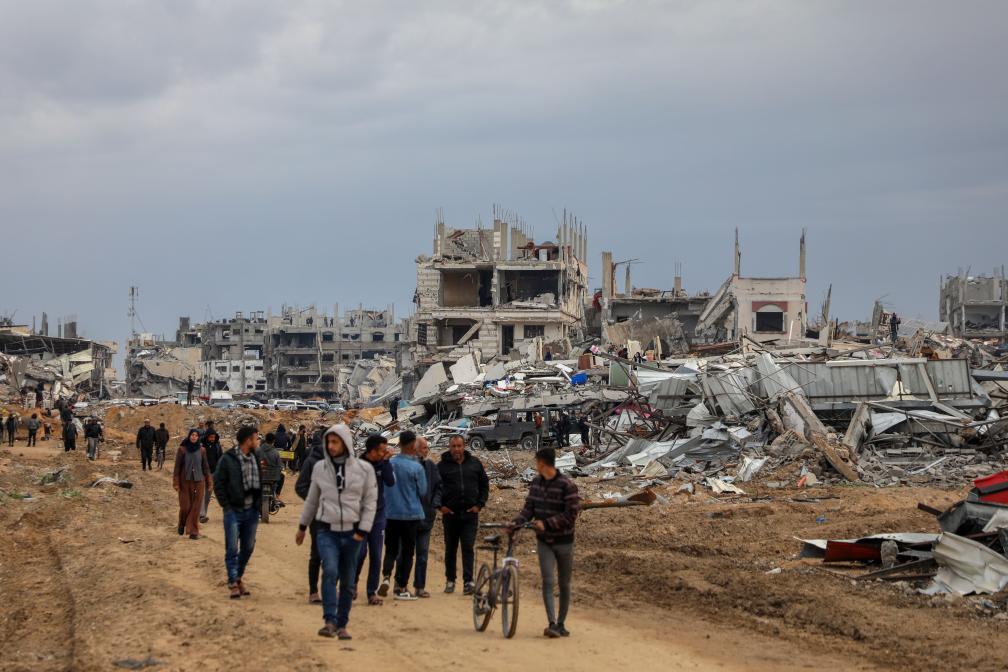
GAZA, Feb. 9 (Xinhua) -- With heavy steps, Emad al-Ramli, a Palestinian man from the central Gazan city of al-Mughraqa, walked through the desolate landscape left behind by the Israeli army on both sides of the Netzarim Corridor -- a strip of land that bisected Gaza from north to south.
The devastation was overwhelming in Wadi Gaza, the only wetland area in the Gaza Strip: once-thriving buildings were reduced to rubble, streets erased, and all signs of life extinguished.
The 45-year-old father of seven stood in stunned silence, struggling to grasp the scale of the destruction. Homes that once echoed with children's laughter had crumbled into scattered debris.
"What are we seeing? Is this a nightmare or reality?" he murmured, his voice choked with emotion. "Israel didn't just fight Hamas, but it fought all of us. It wanted to crush our hope to make us despair," he said with teary eyes.
But the horror of the destruction was not the only shock. As he joined a group of neighbors, his foot struck something partially buried in the sand. Bending down, he uncovered human remains.
His body trembled as he cried out, "There is a martyr here! There are human remains here! "
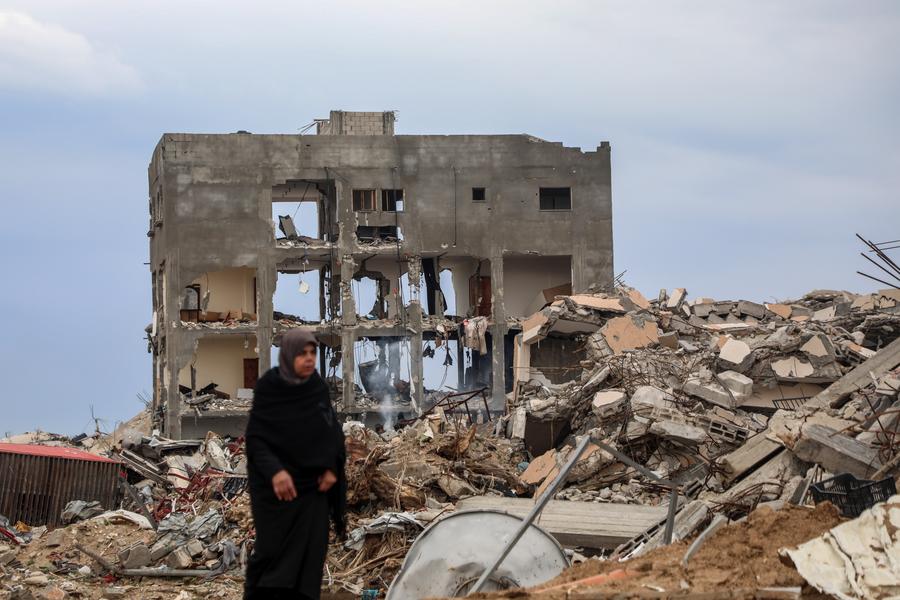
Al-Ramli was not alone in his horror. Those returning to Wadi Gaza found themselves facing an unbearable scene of destruction, with scattered bodies -- some exposed, others trapped beneath the ruins.
Abdul Salam Hamoud, 33, had come with his three brothers to search for their missing sibling, Ahmed, who disappeared a year ago. Instead of finding his body, they discovered only fragments of his clothing.
"These clothes tell us one thing: he is gone," he said, his voice breaking. "Here, life has stopped. All that remains is the echo of sadness and death."
On Sunday, the Israeli army withdrew from the area known as the Netzarim Corridor. This move was part of the Israel-Hamas ceasefire agreement that took effect last month, allowing Palestinians to move freely between northern and southern Gaza.

As survivors returned to their homes in Wadi Gaza, they wandered through the wreckage, feeling like strangers on their own land.
Joudeh al-Maghribi, an 80-year-old man, had once owned a five-story home that sheltered his extended family of 40. Now, it was all gone.
"Where do we go now? How do we even begin to rebuild what the war has destroyed?" he asked, standing motionless.
Al-Maghribi's home is among the 2,500 destroyed by the Israeli army, according to Jaber Abu Hajir, mayor of Wadi Gaza.
"The Israeli army erased all signs of life in Wadi Gaza," Abu Hajir said. "They leveled 2,000 dunams of agricultural land, turning the area into a ghost town unfit for living."
"Bodies lay decomposing in the open; the destruction was immense, and there were no resources to help the survivors. People have been left with nothing but despair and regret," he said, describing the situation as "catastrophic in every sense."
Abu Hajir called on the international community to intervene immediately to rebuild Gaza. "We cannot endure this suffering alone," he said.■