
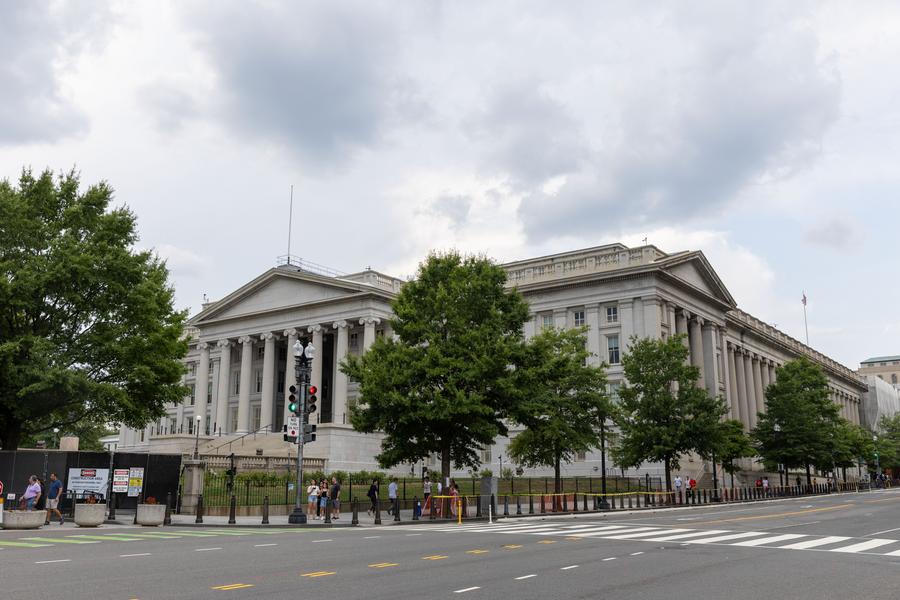
According to projections by the Congressional Budget Office released in June, interest costs would also become the largest "program" over the next few decades -- even surpassing Social Security.
by Xiong Maoling, Yu Rong
WASHINGTON, July 31 (Xinhua) -- The U.S. federal government's debt has surpassed yet another psychological threshold amid widespread concerns.
According to data released by the U.S. Treasury Department on Monday, the federal government's total public debt has surpassed 35 trillion U.S. dollars for the first time, as recorded at the end of last week, equivalent to the combined economic output of China, Germany, Japan, India, and Britain.
Why is the U.S. national debt growing at an accelerated pace? Why can't calls from all sectors awaken a political conscience to address the issue? Has the scale of the debt reached a critical crisis point?
Upon reviewing the historical trajectory of U.S. debt, it has become clear that the country has developed an addiction to borrowing, depending on the dollar's dominant position in the global economy. The debt scale has surged on an unsustainable path, driven by a failing political system and ineffective governance, causing ongoing harm both domestically and globally.
Data shows that 40 years ago, the U.S. federal government debt was less than 1 trillion dollars. However, it has grown rapidly in recent years, surpassing 20 trillion dollars in September 2017 and exceeding 30 trillion dollars in February 2022.
The U.S. debt-to-GDP ratio surpassed 100 percent in 2013 and currently stands at 123.3 percent, according to the International Monetary Fund (IMF).
"We've officially added another trillion dollars to the gross national debt. If this sounds familiar, we only just reached 34 trillion dollars at the very end of 2023. We passed 33 trillion three months before that and 32 trillion three months before that. The borrowing just keeps marching along, reckless and unyielding," Maya MacGuineas, president of the Committee for a Responsible Federal Budget, said in a statement.
The rapid increase in U.S. national debt has directly led to a corresponding rise in future interest payments. Data shows that interest payments on national debt are expected to become the fastest-growing component of the federal budget over the next 30 years.
"We're not investing enough in our future. But we are spending more than 2 billion dollars per day on interest payments on the debt," said the Peter G. Peterson Foundation, a nonpartisan organization focused on addressing U.S. long-term fiscal challenges.
According to projections by the Congressional Budget Office released in June, interest costs are projected to increase from 9 percent of federal revenue in 2021 to 18 percent in 2024 and 23 percent in 2034. Interest costs would also become the largest "program" over the next few decades -- even surpassing Social Security.
"Action is needed by the United States to reduce its high fiscal deficit and to put debt on a downward trajectory. I should say that we have been highlighting these concerns for quite some time," IMF spokesperson Julie Kozack said at a recent press briefing.
"Looking even further ahead, our estimate is that net interest payments are expected to remain elevated even in the medium term. And that is on the basis of high primary fiscal deficits and the resulting public debt," Kozack said in response to a question from Xinhua. "We are calling for an action to be taken to reduce the U.S. deficit and debt at this time."■