
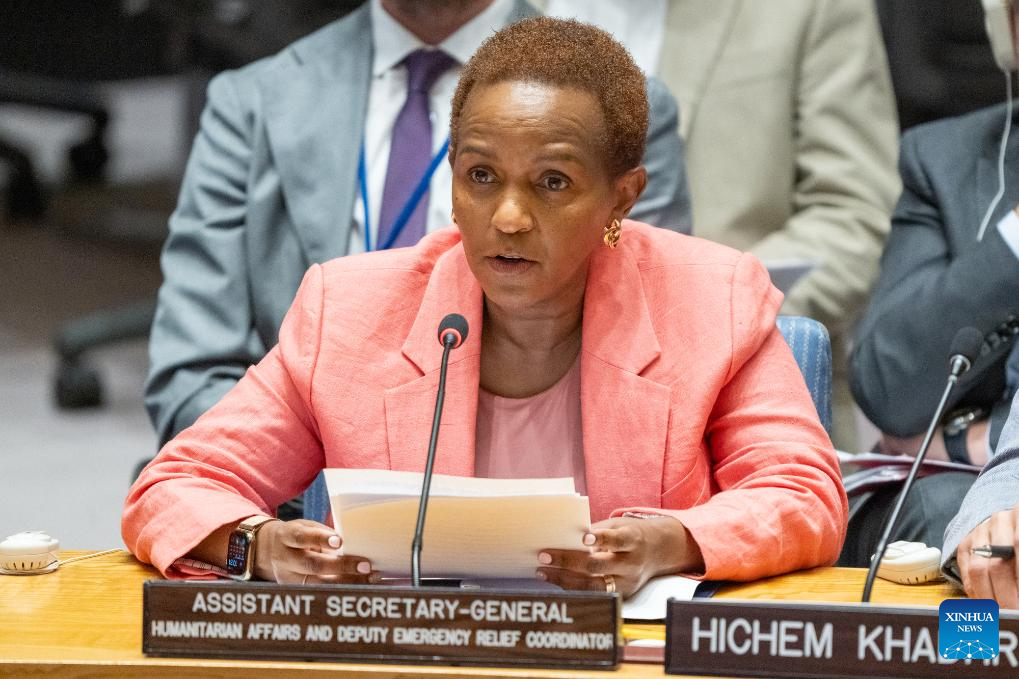
Joyce Msuya, UN assistant secretary-general for humanitarian affairs, speaks at a Security Council meeting at the UN headquarters in New York, on May 21, 2024. The UN official on Tuesday called for a more holistic approach to complement existing measures for the protection of civilians in armed conflict. (Eskinder Debebe/UN Photo/Handout via Xinhua)
UNITED NATIONS, May 21 (Xinhua) -- A UN official on Tuesday called for a more holistic approach to complement existing measures for the protection of civilians in armed conflict.
Joyce Msuya, UN assistant secretary-general for humanitarian affairs, stressed the importance of complying with international humanitarian law (IHL) and international human rights law in the protection of civilians in armed conflict, and the need to go beyond compliance.
The harm and suffering caused to civilians in 2023 signals an alarming lack of compliance with international humanitarian law and international human rights law. It also indicates that the Security Council's protection of civilians resolutions of the last 25 years remain largely unheeded, she said.
"We must redouble efforts to strengthen compliance by parties to conflict with these obligations. This includes third states taking responsibility for ensuring respect for the rules of war. This entails political dialogue, training and dissemination of policies, and withholding arms transfers where there is a clear risk that arms will be used to commit serious violations of IHL," she told an annual open debate of the Security Council on the protection of civilians in armed conflict.
But she stressed the need for a more holistic approach.
The reality is that much of the civilian harm in today's conflicts is occurring even when parties claim to be acting in compliance with international humanitarian law and international human rights law, said Msuya.
"It is time to complement existing measures by adopting a more holistic approach, one that considers the perspective of civilians and takes into account the complex, cumulative and long-term nature of the full range of civilian harm in conflict," she said.
The Political Declaration on Explosive Weapons in Populated Areas and the 2015 Safe Schools Declaration are both good examples of ways that states can commit to the greater protection of civilians in armed conflict, complementing their compliance with international humanitarian law, she said. "We urge all states to endorse these instruments and implement them in full."
She also urged states to follow the steps taken by some national and regional authorities in developing and adopting proactive protection of civilians' policies, processes and tools aimed at better understanding and mitigating a broader range of civilian harm.
States, parties to conflict, UN actors, international and civil society organizations need to reflect on how to further develop and implement the full protection of civilians approach, she added.
"The Security Council and (UN) member states must demand and ensure compliance with international humanitarian law, international human rights law and the council's resolutions," she said. "If it is to have any real meaning for the millions of civilians affected by conflict, it is time to go above and beyond compliance: to strive for the full protection of civilians against the full range of harms they are suffering on our watch." ■


