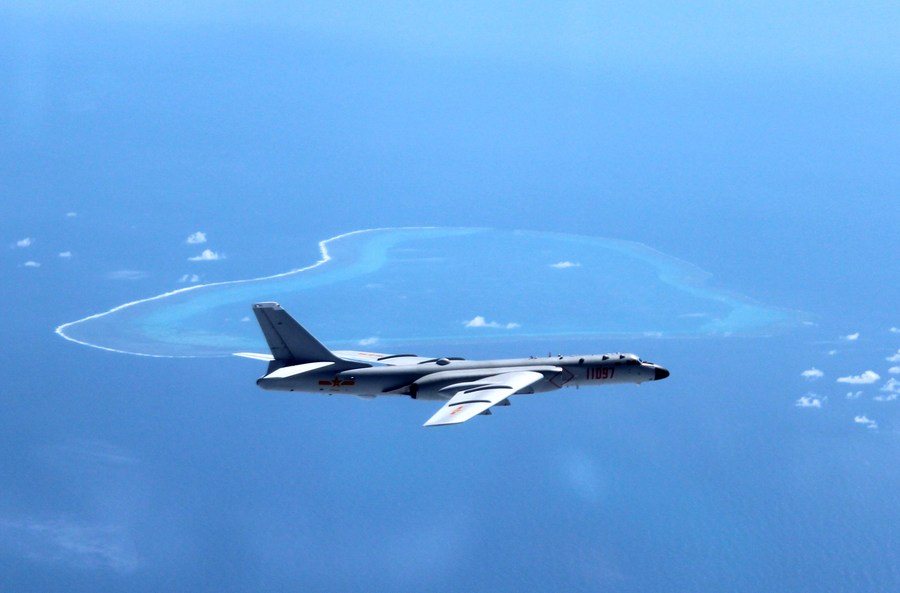
File photo taken in July 2016 shows Chinese H-6K bomber patrolling islands and reefs including Huangyan Island in the South China Sea. (Xinhua/Liu Rui)
Despite professing its security commitments to the Philippines, it is evident that the United States is playing a shrewd game to its own benefit.
BEIJING, Dec. 20 (Xinhua) -- Three Philippine government vessels, without obtaining permission from the Chinese side, on Dec. 9 intruded into the waters adjacent to China's Huangyan Island. Onboard were several invited media outlets, including the New York Times.
In response, Chinese maritime authorities utilized high-pressure water cannons to repel the vessels. The operation was entirely professional, restrained, justified and legitimate.
The New York Times published an article ostensibly endorsing the Philippines after the incident. The objective was to depict China as a "bully," swaying public opinion in the Philippines' favor and exerting pressure on China.
But a closer look at the narrative reveals a disparity between what the article believes and what the Philippine government claims.
The ships departed from a port in the Philippine province of Bataan, located in west Luzon Island, and arrived near China's Huangyan Island after 18 hours "on rough high seas," the article said.
According to the United Nations Convention on the Law of the Sea (UNCLOS), the "high seas" are comprised of the sea not included in the exclusive economic zone, the territorial sea or the internal waters of a State. These seas are open to all states, and no nation can assert sovereignty over them.
Referring to the waters the three ships traversed as the "high seas," the New York Times shows a total disregard for the Philippines' assertion (though legally untenable) that such areas, including China's Huangyan Island, are part of its territory or at least fall within its exclusive economic zone.
The Philippines' claims regarding the South China Sea, which have been hyped up for years and at a great expense, were somehow rendered ineffective by a single piece of writing. The U.S.-based daily newspaper offered no further clarification, leaving the Philippines at sea, if not down in the dumps.
Here it is necessary to notice that the waters the Philippine vessels traversed, namely Huangyan Island and its adjacent water, has always been part of China's territory.
"Huangyan Island has always been part of China's territory and China has indisputable sovereignty over Huangyan Dao and its adjacent waters," Chinese Foreign Ministry spokesperson Mao Ning has said recently, stressing that China Coast Guard took necessary measures in accordance with the law, which were professional, restrained, lawful and legitimate.
Beyond the wording of the New York Times report lies the consistent U.S. stance on maintaining maritime hegemony.
Under the banner of international law, the United States champions so-called "freedom of navigation," but it has yet to ratify UNCLOS, which establishes law and order for the world's oceans. Instead, the United States insists on reserving the "right of final interpretation" based on its own standards.
According to the Washington-based think tank Heritage Foundation, the U.S. refusal to ratify UNCLOS is a calculated strategy -- to defend the rights of maritime power, there is no need to join a seriously flawed multilateral treaty; maintaining a powerful navy is sufficient.
Backed by such logic, as long as the U.S. Navy intends to navigate freely in the vicinity of the Philippines, all they have to do is simply interpret all traversed areas as the "high seas," justifying their standards at their own will.
Despite professing its security commitments to the Philippines, it is evident that the United States is playing a shrewd game to its own benefit. People would wonder if the Philippines could see through this game and stop being used as a pawn of the superpower. ■