
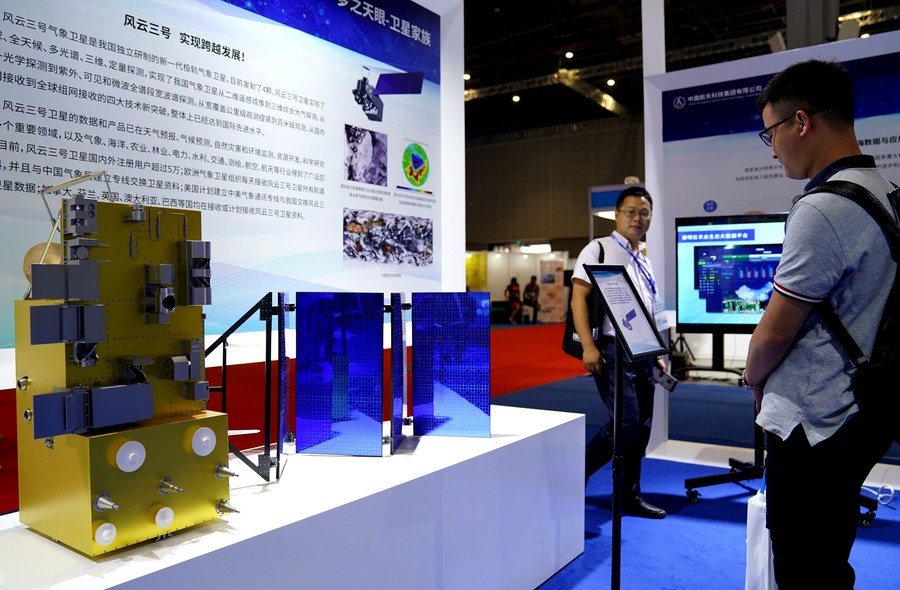
A visitor views a model of Fengyun-3 satellite during the 2019 China International Industry Fair in east China's Shanghai, Sept. 17, 2019. (Xinhua/Zhang Jiansong)
BEIJING, Dec. 12 (Xinhua) -- Chinese researchers have successfully obtained the first column global map of atmospheric ammonia (NH3) observed by the country's Fengyun meteorological satellite, demonstrating its ability to detect global ammonia concentrations quantitatively.
Global NH3 monitoring is critical because it is a chemically active trace gas that plays a significant role in the atmosphere and climate change.
However, traditional ammonia concentration observation methods make it difficult to obtain relevant data from polar regions, deserts, oceans and forests.
Researchers from the Institute of Atmospheric Physics under the Chinese Academy of Sciences established a retrieval algorithm to derive the NH3 column from the Hyperspectral Infrared Atmospheric Sounder (HIRAS) onboard the Fengyun-3D satellite and present the first atmospheric NH3 column global map observed by the HIRAS instrument.
The algorithm can also retrieve interference parameters such as ozone, carbon dioxide, water vapor and land surface temperature synchronously when retrieving NH3.
In the future, they plan to further improve the retrieval algorithm and introduce neural network algorithm to increase the retrieval accuracy and quality of effective observation data in ocean and high-latitude areas. ■