
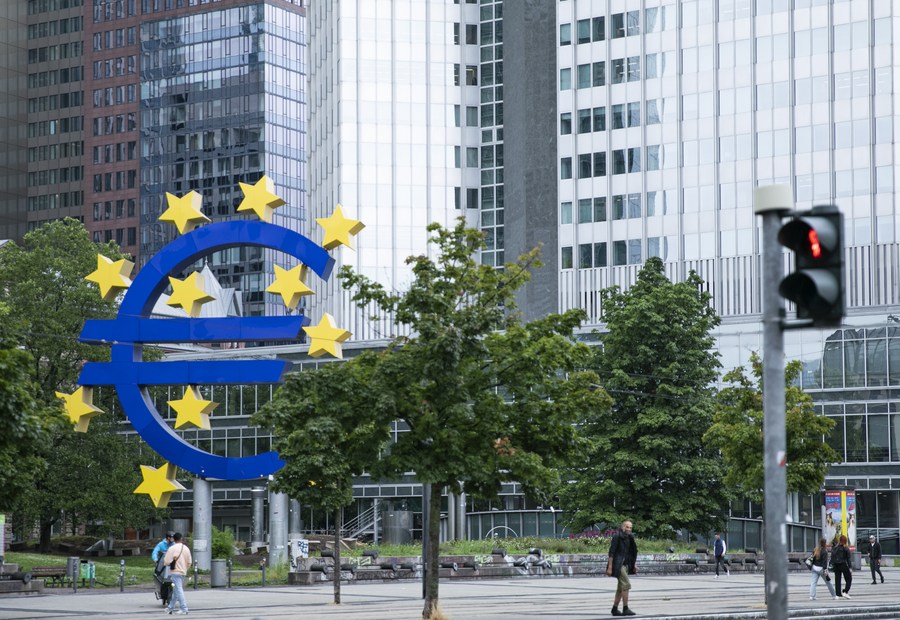
This photo taken on July 27, 2023 shows the Euro sign in Frankfurt, Germany. (Xinhua/Zhang Fan)
Germany's annual inflation rate softened to 6.1 percent in August, as the country seeks to counter high inflation through such measures as interest rate adjustments.
BERLIN, Aug. 30 (Xinhua) -- Germany's annual inflation rate eased further in August to 6.1 percent, according to preliminary figures published by the Federal Statistical Office (Destatis) on Wednesday.
Food prices continued to drive inflation and increased by 9 percent year-on-year in August, while energy prices rebounded to 8.3 percent.
During the 2022 energy crisis, the German government already introduced various temporary relief packages, including discounted local transport tickets and tax reductions on fuels. Since the beginning of this year, a gas and heating price brake have also applied.

Passengers check in at an international airport in Frankfurt, Germany, June 12, 2023. (Xinhua/Shan Weiyi)
To push inflation back below its 2 percent target, the European Central Bank (ECB) raised its key interest rates by 25 basis points (bps) on July 27 to a level seen at the end of the 2008 financial crisis.
After an annual inflation of 6.9 percent last year, the German Economic Institute (IW) said on Tuesday it expected inflation in Europe's largest economy to be only slightly lower at around 6.5 percent in 2023.
Amongst other factors, high inflation is "why Germans are spending less money this year, despite considerable wage increases," the IW said. "It is not only consumers who are reluctant to spend: due to increased production costs and high interest rates, investment has become less attractive for companies." ■